
Physical therapy in mental health: why the body is treated too, and what technology adds
In psychiatric units, day hospitals and psychosocial rehabilitation centres, physical therapy and occupational therapy have been gaining ground for years, and the reason is a serious one: people with severe mental illness live shorter and worse lives because of illnesses of the body, not of the mind, and exercise is one of the few interventions with a demonstrated effect on symptoms, cognition and physical health at the same time. The obstacle is not the evidence but getting the session to happen, to be repeated and to be kept up. This article reviews what the recent literature says, why continuity is the central problem in this population, and what digital tools are adding in the services already using them.
Why physical therapy in mental health starts with a mortality gap
The figure that justifies physical therapy in mental health has been published for years and has just been updated on a European scale. A population study published in 2026 in The Lancet Public Health, covering almost five million people with severe mental illness followed between 2004 and 2023 across several European countries, found all-cause mortality 2.6 times higher than in the general population, with the largest absolute excess in cardiovascular disease, above all in schizophrenia spectrum disorders, and the largest relative excess in respiratory disease. These are deaths caused by the body, in people being treated for the mind.
Behind that figure lies a familiar combination: inactivity, the metabolic effects of medication, smoking, difficulty accessing somatic care, and negative symptoms that drain initiative. Physical rehabilitation does not solve all of that, but it is the part of the treatment that acts directly on the largest modifiable factor, physical activity, and it does so inside the mental health service itself, without referring the person somewhere else they may never reach.
What exercise does for symptoms and cognition
The evidence on exercise in mental disorders has matured a great deal in a few years. An umbrella review published in 2025 in the Journal of Psychiatric Research, bringing together eight meta-analyses with 99 randomised trials and more than 5,600 participants, concluded that moderate or vigorous aerobic exercise improves the specific symptoms of eleven different disorders, from recurrent depression to schizophrenia by way of the anxiety disorders, with a medium-sized effect, and that it also improves cognition in schizophrenia and in attention deficit disorder with a large effect. Its authors call it a transdiagnostic intervention: it works across diagnoses, not only in one. For anyone arguing the case for physical therapy in mental health at a multidisciplinary meeting, that is the single most useful sentence in the literature.
In schizophrenia specifically, a network meta-analysis published in 2024 in Neuroscience & Biobehavioral Reviews, with 47 studies and more than 4,000 participants, compared types of exercise: aerobic was the most beneficial for cognition and depression, the combination of strength and aerobic work for general symptoms, and yoga for total, positive and negative symptoms. The useful reading for a service is that there is room to choose the format according to the person, and that what weighs most is that the exercise exists and is kept up — which is exactly the hard part.
The problem is not the evidence, it is adherence
Any physical therapist who has worked in an acute unit, a medium-stay ward or a day centre knows it: today's session depends on how the person slept, on the morning's medication, on whether they feel like leaving their room at all. Negative symptoms, apathy, sedation and a lack of confidence in one's own body turn into something difficult what in another population is routine, and exercise programmes in mental health carry high dropout rates even in trials, where conditions are as good as they get.
That is why the practical question in these services is less which exercise to prescribe than how to get the person to take part today and come back tomorrow. And it is also where the services that have brought in technology place its main contribution. A physical therapist in a severe mental illness unit at a public hospital in Madrid sums it up in the testimonial published by Rehametrics: the main benefit observed is greater adherence to treatment, and that adherence translates into fewer falls, more involvement in other therapies and an effective tool for addressing chronic pain. It is a clinical observation rather than a trial, but it describes precisely where the bottleneck sits. The same physical therapist explained his experience in detail in the talk below, recorded at the 2026 conference on virtual reality in rehabilitation: how it applies to patients who are not the classic neurological ones, how balance is worked on with technology, and how it is adapted to complex profiles.

Falls, balance and medication in psychiatric units
Falls are one of the most frequent incidents in psychiatric inpatient units, and they are not only a problem of older people. A systematic review published in 2022 on falls among psychiatric inpatients identified factors specific to this population that add to the usual ones: the acute mental state, psychotic symptoms and risk-taking behaviour, and the effects of psychotropic medication, in particular sedation and orthostatic hypotension. Its authors call for fall prevention programmes designed specifically for these settings, because those designed for geriatrics do not take those factors into account.
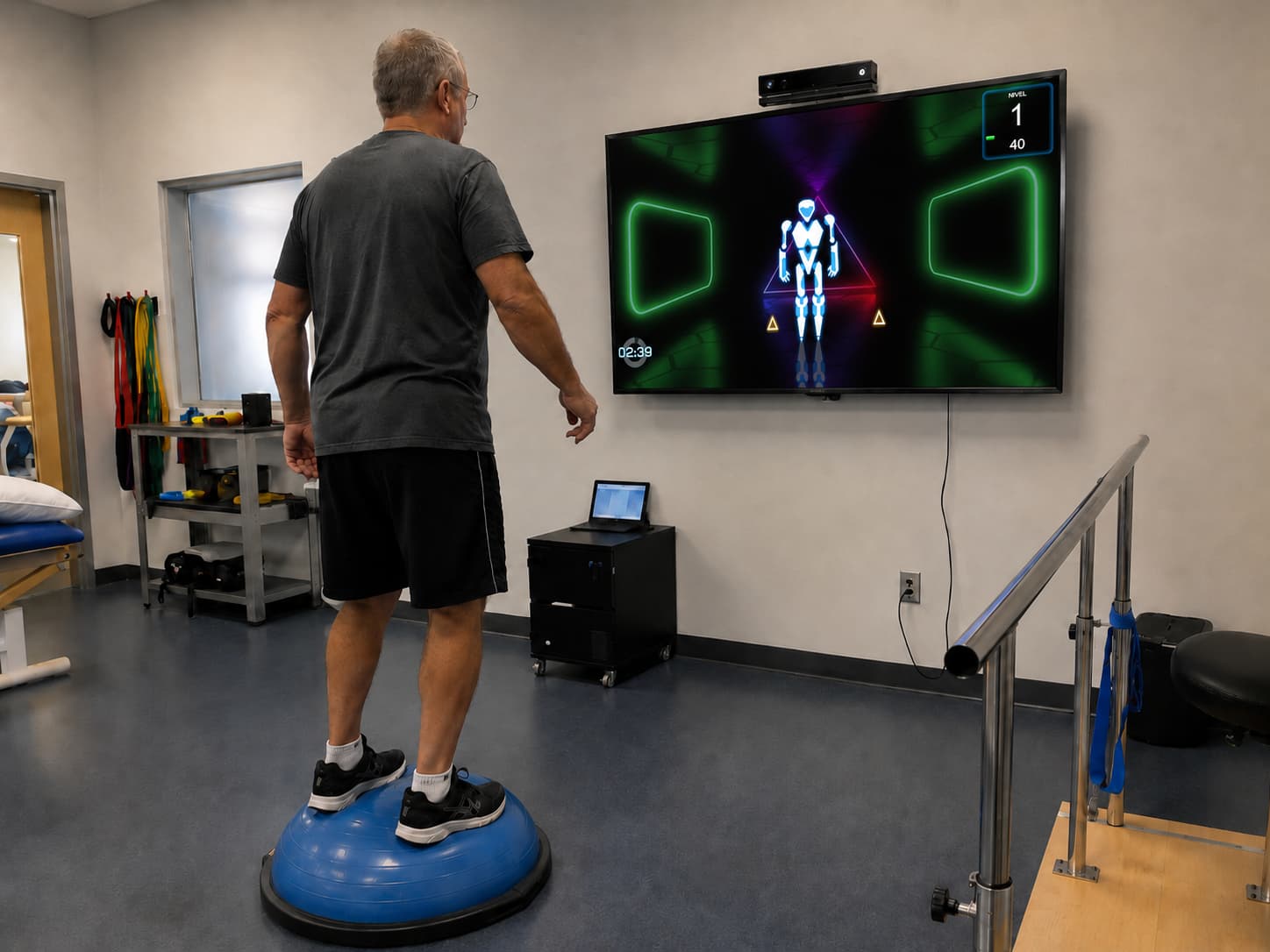
Balance, gait and postural control are frequently impaired in schizophrenia, both by the illness itself and by the medication, and they respond to training. A study published in 2022 in PLoS One with 25 adults with a schizophrenia spectrum disorder found that a dual-task programme improved cognition, upper-limb motor control, functional mobility and postural control, and that the phase carried out with video games tended to produce additional gains. Working on balance with a task the person actually wants to do, and being able to measure how their centre of gravity and base of support change from session to session, is a way of bringing fall prevention into the unit without reducing it to a list of recommendations. It is also one of the clearest jobs physical therapy in mental health can take on, because the outcome is visible to the whole team.
Chronic pain, the unit's other patient
Chronic pain is common in people with severe mental illness, is diagnosed less often and treated worse, and it often reaches physical therapy through the back door: the person who does not want to walk, who does not sleep, who moves less every month. The article on how virtual reality changes the perception of pain reviews the evidence on distraction, immersion and graded exposure to movement. In physical therapy in mental health, what it adds is a way of working on the body with someone who is afraid to move, without the session revolving around the pain — and it is one of the three things the testimonial quoted above names as a result of the person coming back to the session.
What technology adds when the challenge is getting the person to come and repeat
In this population, technology does not compete with conventional exercise: it gives it a way in. A task on a screen or in a headset has a clear, visible goal, responds instantly to what the person does, rewards the attempt and does not judge, and that changes the relationship with exercise for someone who has spent years avoiding it. The professional runs the session, decides the task and the level and stays alongside; what changes is that the person has a concrete reason to lift their arm or shift their weight that is not "because it is good for you".
Three things also fit the way these services work. The first is the group format: activities in which several people take part at once in front of one screen, or each with their own tablet in a cognitive stimulation session, turn exercise into something social, which is what day hospitals and psychosocial rehabilitation centres are looking for. The second is working seated and in calm environments, which makes it possible to start with someone who cannot manage more than that today. The third is the record: every session is saved per person, with repetitions, range, balance or correct answers, and that gives the team something to show in the multidisciplinary meeting and the person something to watch improve, which in mental health has a therapeutic value of its own. This blog has already looked at how virtual reality enriches the therapeutic environment and how it frees up the therapist's time when working with several people.

Precautions specific to this population
The safety of headsets and sensors in physical therapy in mental health is assessed as it is in any other service, with two particular emphases. The first is medication: the sedation and orthostatic hypotension described in the falls review make it advisable to start seated, with slow changes of position and with the professional alongside — which is also how it is recommended to start with any patient. The second is how the person is today: the pre-session assessment is made by the team that knows them, and a relative contraindication today may not be one next week. Intense anxiety, disorientation or agitation are reasons to leave it for another day, just as they would be for any other intervention; diagnosed photosensitive epilepsy and implanted devices are handled as in the rest of the population, with whatever medical consultation applies. On those conditions, the experience of services that have been using them for some time is that acceptance is high, and that the novelty works in their favour.
Rehametrics in mental health
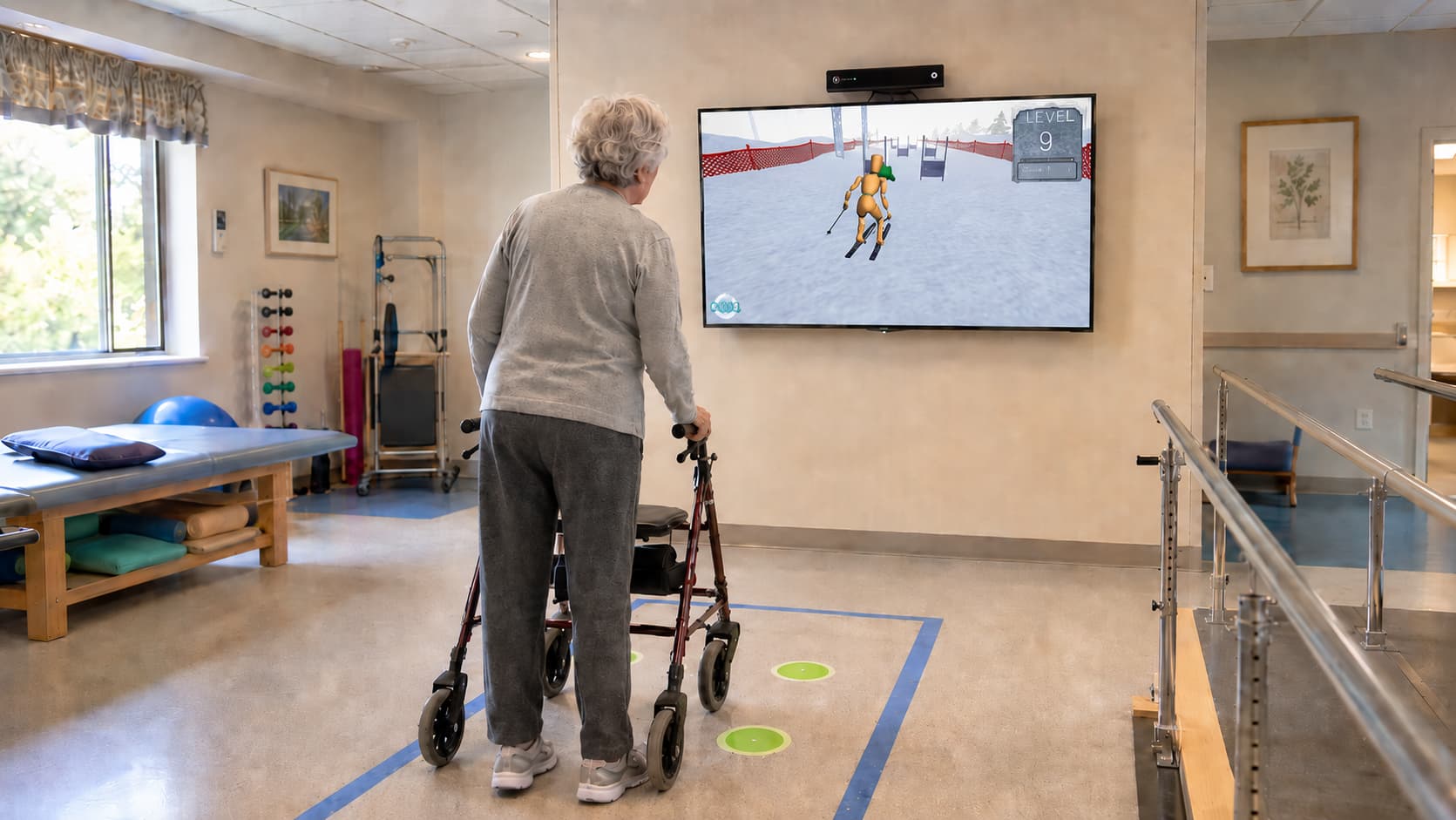
Rehametrics is used in mental health services, among them a severe mental illness unit at a public hospital, and its three modules cover what physical therapy in mental health asks of a platform. Rehametrics Physical works on balance, the upper limb and coordination in front of a screen with a sensor, with nothing attached to the person, records centre of gravity and base of support as well as range of motion and repetitions, and includes group activities for two to four people. Rehametrics VR runs on Meta Quest with hand tracking and mixed reality, with activities that can be done seated and calm environments to start with, and the therapist sees on their computer exactly what the person sees. Rehametrics Cognitive adds more than 190 exercises in attention, memory, processing speed and executive functions on a tablet or whiteboard, for the cognitive impairment associated with the disorder or with the medication, in individual sessions or in groups.
All three record every session per patient and generate progress reports, the platform is a Class I medical device with CE marking and it brings together more than forty clinical studies. The testimonial from Hospital Universitario Dr. Rodríguez Lafora quoted above can be read in full on the Rehametrics VR page, and the twenty-minute talk by its physical therapist on balance in severe mental illness is the best companion to this article for anyone working in a similar unit — bearing in mind that the talk is in Spanish.
Balance and coordination, in groups too
More than 120 exercises with a sensor, recording centre of gravity and base of support, and activities for two to four people.
View module →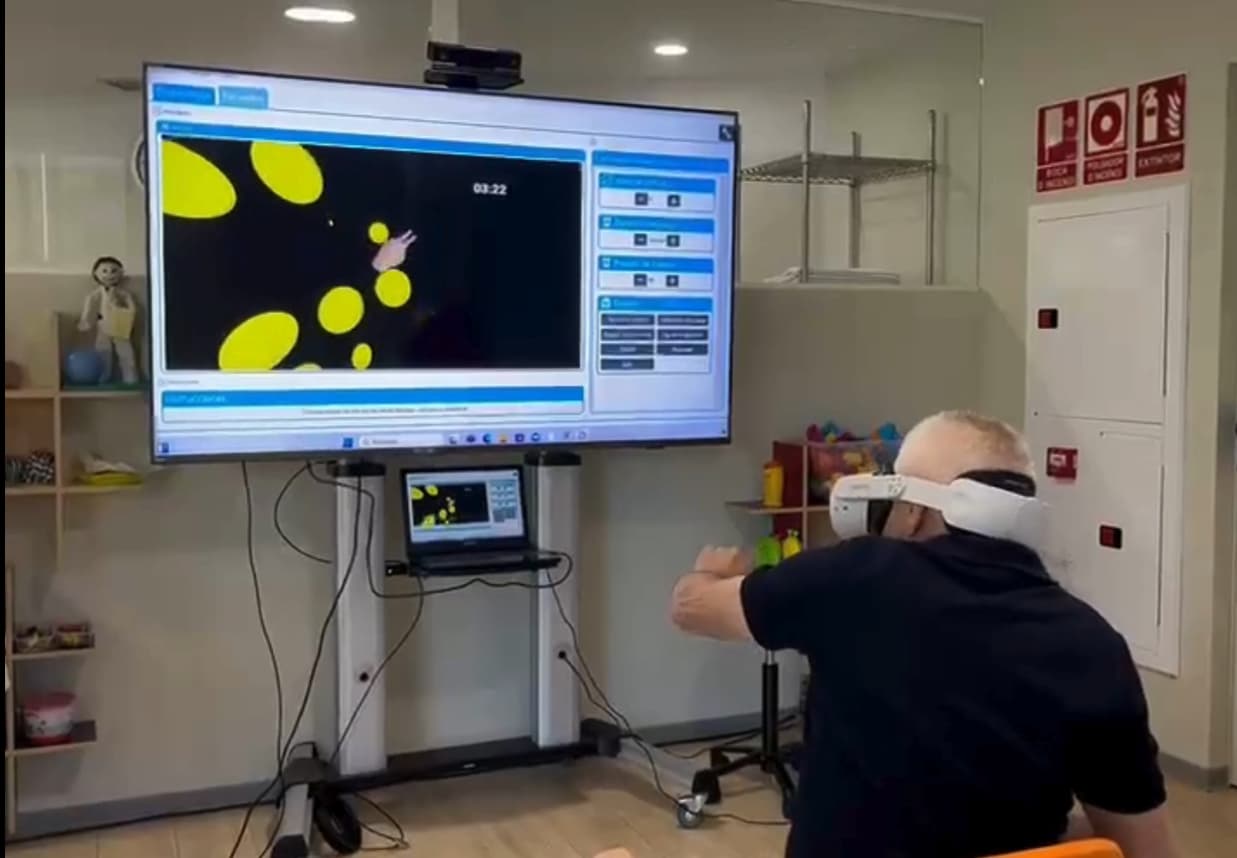
Starting seated, in mixed reality
More than 70 activities on Meta Quest, with hand tracking and control from the therapist's computer.
View module →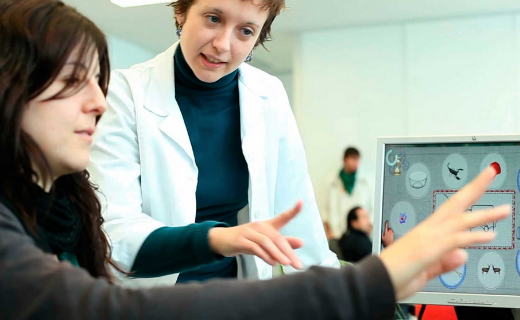
For the associated cognitive impairment
More than 190 exercises on a tablet or whiteboard, in individual or group sessions, with per-patient reports.
View module →Frequently asked questions
What evidence is there that exercise helps in severe mental illness?
The 2025 umbrella review covering 99 trials found that moderate or vigorous aerobic exercise improves the specific symptoms of eleven disorders, schizophrenia among them, with a medium effect, and cognition in schizophrenia with a large effect. The 2024 network meta-analysis in schizophrenia confirms the benefit and shows that different formats serve different goals.
Is virtual reality suitable for people with psychosis?
The decision belongs to the team who know the person, and it is taken day by day. With the person stable, oriented and willing to try, the experience of the services using it is of good acceptance; mixed reality, in which the room and the therapist remain visible, and working seated are the usual starting point. Agitation, disorientation or intense anxiety on a given day are reasons to leave it for another time.
Does it help prevent falls in a psychiatric unit?
Falls in these units have factors of their own, such as sedation and hypotension from medication, and the 2022 review calls for specific programmes. Balance and dual-task training improve postural control in schizophrenia too, and a system that measures centre of gravity and base of support makes it possible to follow progress; the physical therapist in the Madrid unit quoted here names a reduction in falls among the results observed.
Can it be used in groups?
Yes, and in day hospitals and psychosocial rehabilitation centres that is the natural format. Rehametrics Physical includes group activities for two to four people in front of a single sensor, and Rehametrics Cognitive lets several people work at once with tablets, or in a session led from the whiteboard.
Which professional runs the session in physical therapy in mental health?
Usually the unit's physical therapist or occupational therapist, and for the cognitive part the psychologist or neuropsychologist. The professional operates the system themselves from a computer or a tablet, with no technical background needed, and team training is part of the implementation.
Do you work in a mental health unit and want to see it with your patients?
We will show you the balance activities, the group sessions and seated work with a headset, and how other severe mental illness units and day hospitals are using physical therapy in mental health with Rehametrics.