
How virtual reality frees up the therapist's time and makes the session more efficient
In a conventional session, a good share of the physiotherapist's time goes on explaining, counting, correcting and writing things down. Virtual reality takes on several of those tasks, and the interesting question is what the professional does with the minutes they get back. We review where the time goes, what the research says about working with more than one patient at once, and which part of supervision should not be delegated.
What we mean by an efficient session
When efficiency in rehabilitation is discussed, people usually think about the diary, about how many patients fit into a morning. That is a legitimate reading, but an incomplete one, because it leaves out the variable that weighs most on the clinical result, which is how much useful practice the patient receives in each session.
That figure has numbers behind it, and they are low. An observational study by Lang and colleagues (2009), published in Archives of Physical Medicine and Rehabilitation, recorded what happened across 312 real physiotherapy and occupational therapy sessions with patients after a stroke, in seven inpatient and outpatient centres. In the sessions devoted to the upper limb, practice of specific functional movements appeared in 51% of them, with an average of 32 repetitions per session. In gait, the average was 357 steps. The authors concluded that those doses fell far short of the ones associated with cortical reorganisation in animal models, and none of the variables they examined (age, time since stroke, therapist experience) explained the difference.
With that reference point, the efficient session would be the one that achieves more quality repetitions per minute of available therapist, rather than the shortest one or the one that lets you fit more people into the room. And that is where it is worth looking at what that minute is actually spent on.
Where the therapist's time goes in a conventional session
Anyone who works on the floor will recognise the split, even though the proportions vary considerably from one centre to another. Part of the time goes on setting up the exercise and explaining it, another on counting repetitions and checking that the movement is correct, another on deciding on the fly whether to raise or lower the demand, and a final one, at the end, on recording what has been done.
None of those tasks is dispensable. What does vary is how much clinical judgement each one requires. Counting twenty shoulder elevations and checking that the patient reaches the same angle on all of them requires attention, but not judgement. Deciding that today calls for work in a different plane because the patient arrived with more pain, by contrast, requires exactly what the therapist trained for. When both compete for the same person in the same minute, the first usually wins, because it is the urgent one.

Which tasks virtual reality takes on
A virtual reality exercise, both in its semi-immersive on-screen version and in the immersive headset version, comes with several of the functions that in a conventional session fall to the therapist. The instruction is built into the task itself, because the patient sees which object they have to reach and in which direction. The counting is automatic. Correction arrives as immediate feedback, since the target is either achieved or not and the patient sees it instantly. And the session is recorded while it happens, not afterwards.
The effect on the split of time we were discussing is direct. The therapist stops being the person executing the session minute by minute and moves to supervising it, with attention available for what the machine does not see: compensations, signs of pain, fatigue, fear. Not every team values that change of role in the same way, and some professionals prefer to maintain hands-on contact throughout the session with certain profiles. That is a reasonable choice that depends on the patient and the phase.
What the research does show is what happens when that recovered time turns into more practice. The Cochrane review by Laver and colleagues, updated in 2025, brought together 190 trials and 7,188 participants with stroke. Compared with other therapies at equal time, virtual reality obtained a small advantage in upper limb function (SMD 0.20; low certainty). But when it was added to usual therapy, that is, when it served to increase total practice time, the effect rose to 0.42 with moderate certainty, and in balance to 0.68 with low certainty. The authors' own reading is that the greater benefit appears when the tool is used to add dose, not to replace what was already being done.
That finding is what connects efficiency and outcome. If virtual reality allows the patient to practise more within the same slot in the diary, without the therapist having to be on top of every repetition, increasing the dose stops depending on hiring more hands.
One therapist with several patients: what the evidence says
The idea of one professional supervising more than one patient at a time was not born with virtual reality. In stroke rehabilitation there is a model that has been studied for years, circuit class therapy, in which a group of patients rotates through workstations under the supervision of one or two therapists. The Cochrane review by English and colleagues (2017) analysed 17 trials and 1,297 participants and found that, compared with individual therapy or usual care, the circuit improved distance in the six-minute walk test (around 61 metres more) and gait speed (0.15 m/s more), with moderate-certainty evidence. In the Timed Up and Go test the difference was 3.6 seconds. The only point to watch was a trend, without reaching significance, towards more falls during therapy in the circuit groups.
A more recent figure, and one closer to how the room is organised, comes from a clinical audit published by McDonell and colleagues (2024) in Physiotherapy Theory and Practice. They compared 55 patients treated individually with another 55 treated in a circuit after changing the model on a stroke unit. With a ratio of three patients per therapist instead of one to one, each patient received on average 8.5 more minutes of physiotherapy per day, and the functional gains were equivalent to those of the individual model. This is a retrospective study in a single centre, with older and mostly severely affected patients, so the specific figures do not transfer to any room; the direction of the result is consistent with the earlier review.
Virtual reality fits into that model as one more station, with a practical advantage over the classic circuit: the station directs itself. In a conventional circuit, the therapist supervising three people has to divide their attention between the three. When two of them are on a task that instructs, counts and adjusts by itself, the third can receive hands-on work without the other two standing idle waiting for instructions.
What the technology does not save
It is worth setting the limit with equal clarity. That the task directs itself does not mean the patient can be left alone with it, and the research on unsupervised virtual reality is fairly eloquent on the point. A systematic review by Karimi and Aminzadeh (2026), published in Disability and Rehabilitation, examined seven trials of home-based virtual reality for the upper limb after stroke, with 414 participants, distinguishing supervised programmes from unsupervised ones. In the two unsupervised trials that could be pooled, virtual reality did not outperform conventional exercise at home (SMD −0.06). By contrast, programmes that included active remote supervision consistently showed favourable results. The authors summarise it by saying that the human factor may be more decisive than the technology itself, with the caveat that the overall certainty of the evidence is very low.
Translated to the treatment room, the message is that the time virtual reality frees up is execution time, not judgement time. Selecting the exercise, deciding on the plane and range of work, reading why a patient is failing today at what they managed yesterday, and knowing when to stop are tasks the tool does not take on, and which in early phases or with frail patients require direct presence throughout the session. In those cases virtual reality is used just the same, with the parameters bounded to that phase; what changes as the patient progresses is how much continuous attention they need and how much work they can do with the professional a couple of metres away.
There is also an entry cost that does not appear in the trials. Learning to configure sessions, deciding which patients benefit and organising the room around stations takes weeks, and during that stretch efficiency drops before it rises. Centres that plan it as a change of organisation, rather than the purchase of a device, tend to get through that phase better.
Three ways of organising the room
There is no single model, and each centre arrives at its own formula depending on the space, the patient profile and how its team works. These three arrangements are the most frequent among the centres we know, and they often coexist within the same week.
1. Virtual reality within the individual session
The patient still has their forty-five or sixty-minute slot with their physiotherapist, and part of that time is devoted to exercises on screen or with a headset. The therapist uses that stretch to observe how the patient moves without having to direct every repetition, or to prepare the next phase of the session. The ratio does not change; what changes is what the professional does with their attention. It is the usual way to start and the one that fits best with patients in the early phase.
2. Stations in parallel
Two or three patients work at the same time in the same room, each at a station, and the therapist rotates between them. While one does hands-on or loading work, the others are on tasks that the system directs and records. It is the arrangement closest to the circuit in the studies and the one that frees up the most capacity, in exchange for demanding more prior patient selection and a room layout that allows everyone to be seen from any point.
3. An independent stretch at the start or the end
Some centres schedule fifteen or twenty minutes of virtual reality work before or after the session with the therapist, within the same visit. The patient arrives, warms up with a range or balance task already configured, and when the therapist finishes with the previous person they pick up a session that has already been recorded. It works well with patients in the intermediate or advanced phase who already know the tool, and less well with anyone who needs help getting into position or understanding the task.
The three arrangements share one requirement: that the system records by itself what the patient has done. If, at the end, the therapist has to reconstruct from memory what happened at the station they were not watching, most of the time gained is lost writing the report.
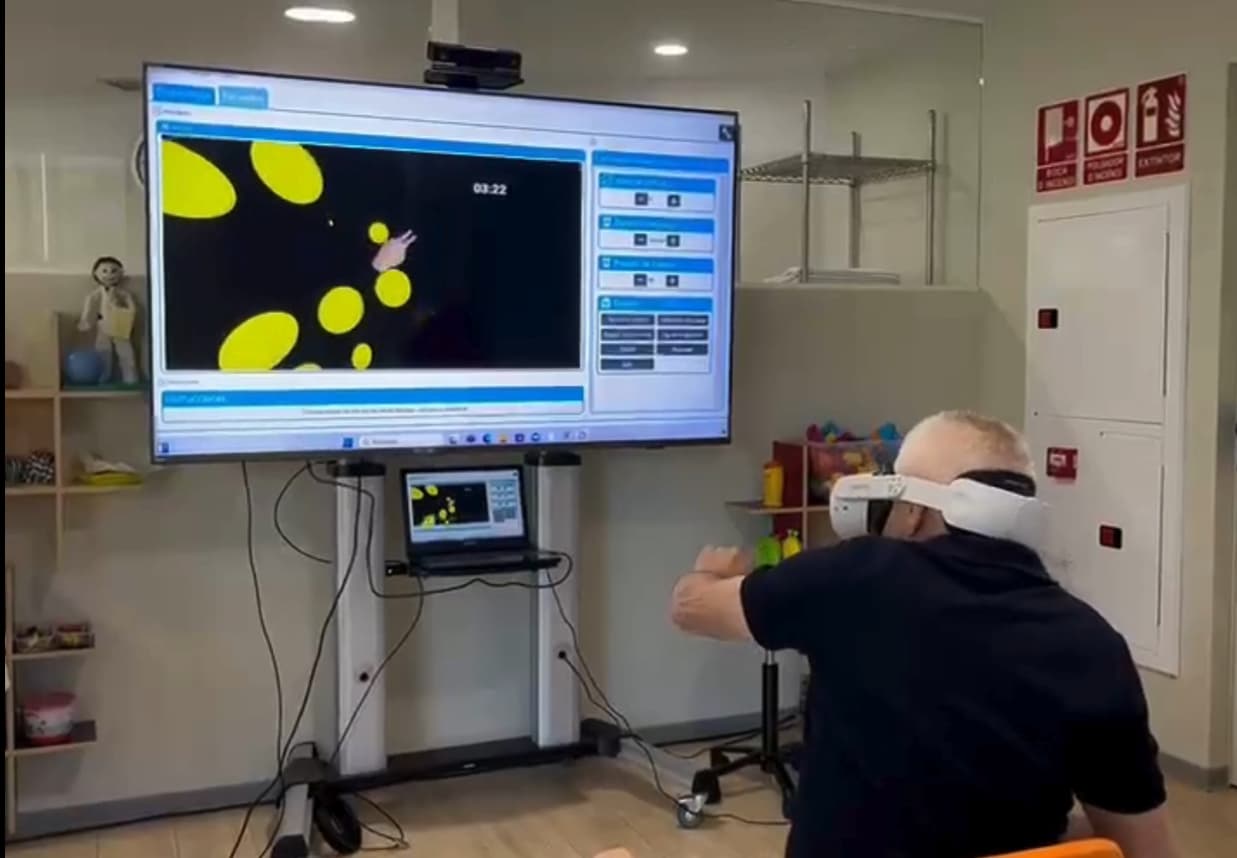
How Rehametrics fits into this set-up
The platform's two movement modules are designed to keep set-up time to a minimum, which is the first place efficiency is lost. Rehametrics Physical works with camera-based motion capture, without body sensors, without controllers and without markers, so getting the patient in front of the screen and launching the prescribed exercise takes as long as sitting down or standing up. Rehametrics VR runs on Meta Quest 2, 3 and 3S headsets with hand tracking, without controllers or gloves, with more than 70 physical and cognitive activities in immersive environments.
During the session, difficulty adjusts automatically across all exercises based on the patient's success rate against the target, which saves the therapist having to keep an eye on raising or lowering the level at each station. That adjustment has a limit worth knowing: the system grades the demand within the parameters the professional has set (side, plane of movement, range, time), and does not decide on its own to change exercise or objective. Choosing the exercise and the objective for each stretch is the therapist's job.
What is recorded by the end is what makes the room arrangements above work. The platform stores repetitions, movement speed and range of motion measured at the shoulder, elbow, hip and knee, as well as centre of gravity and base of support in balance exercises. The physiotherapy report is generated automatically from that data, without the professional having to transcribe anything, and it serves both to decide the progression for the next session and to show the patient what they have improved on. In the cognitive module the approach is the same, with correct answers, errors and response time as the basis of the record.
One clarification on scope: the platform does not measure spinal range of motion, nor does it assess movement quality in the sense of detecting compensations. Detecting a compensation requires looking at the patient, and that is precisely what the time the tool gives back is for.
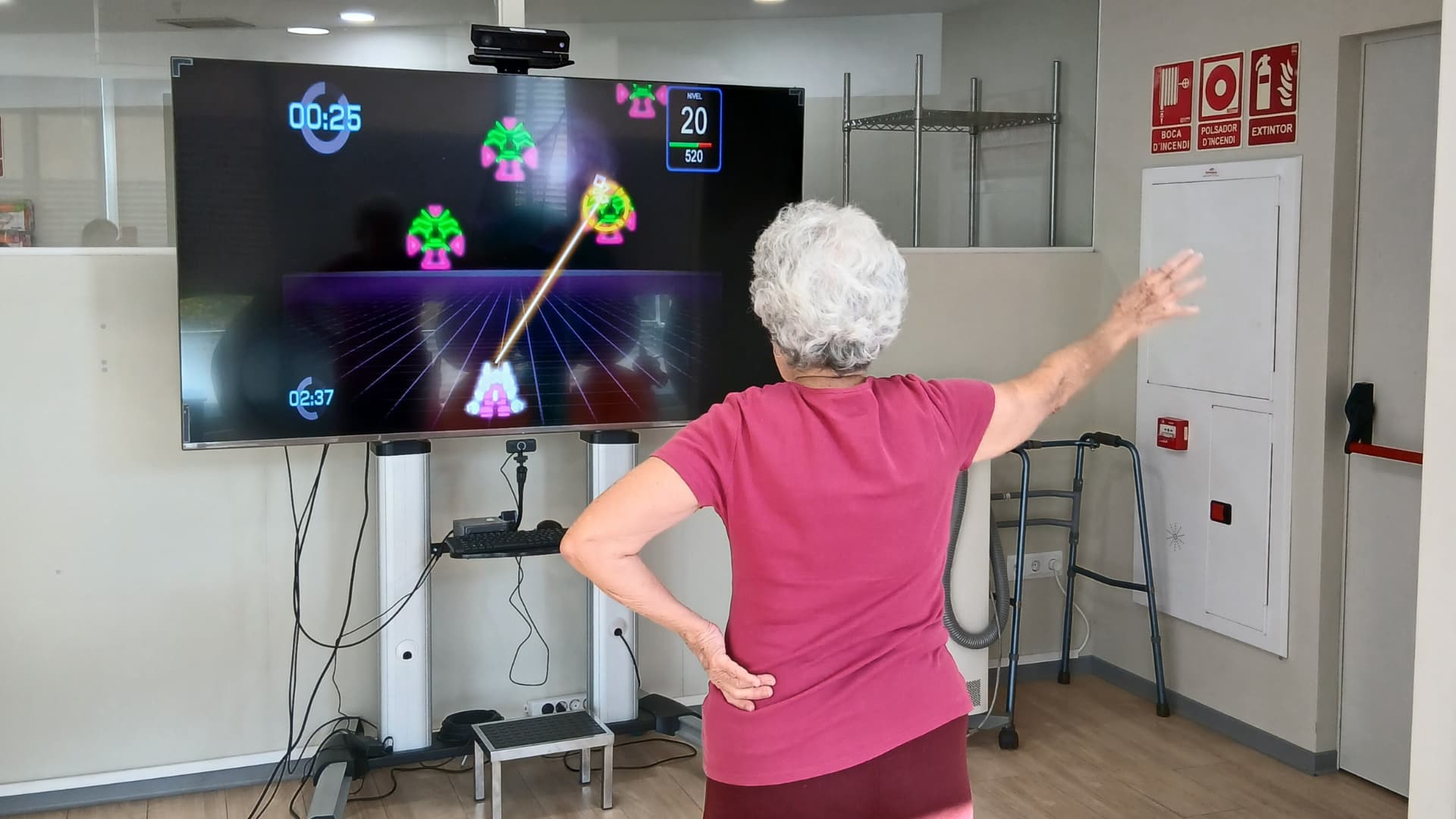
No sensors and no set-up between patients
More than 120 exercises with camera-based capture, difficulty that adjusts itself across all tasks, and measurement of range at the shoulder, elbow, hip and knee, plus balance.
View module →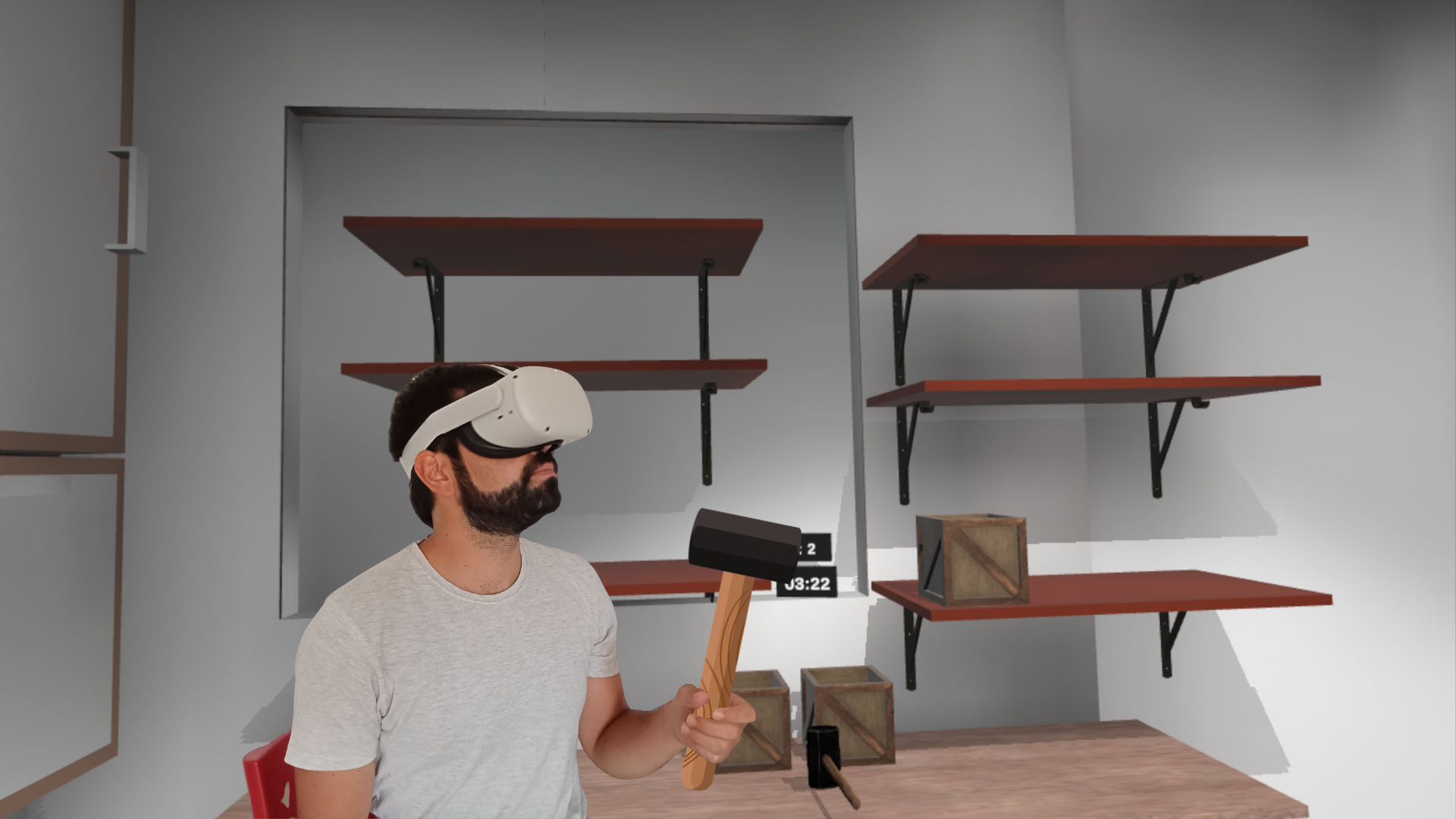
Immersive environments with hand tracking
More than 70 activities on Meta Quest 2, 3 and 3S without controllers or gloves, with automatic session recording and a mirror screen for supervising from another point in the room.
View module →
The session documents itself
Repetitions, speed, range and balance saved while the patient works, with the report ready at the end without transcribing anything.
View reports →What it means for the centre's management
For whoever runs the centre, the above translates into three consequences worth assessing with your own numbers before deciding.
Room capacity without expanding the team
The parallel stations arrangement is the one that generates the most slots in the diary, and also the one that depends most on the patient profile. A centre with mostly recent post-surgical or severely affected neurological patients will get less margin than one with an orthopaedic caseload in the intermediate phase. There is a fuller treatment of this point in the article on management challenges in a physiotherapy clinic treating trauma patients.
Cost per session and perceived value
If the ratio moves from one to one to one to two across part of the diary, the staff cost per session falls, but the session still has to be worth to the patient what they are paying. A progress report with their own data, handed over at the end of each block of sessions, is one of the most direct ways of sustaining that perception once the therapist is no longer beside them for every repetition. There is a more general reflection on how to justify the price to the private patient in how to increase your clinic's profitability.
A change of organisation, not just of equipment
Centres that get value from the tool have usually redistributed the room, adjusted the diaries and decided with the team which patients fit into each arrangement. Without that preparatory work, virtual reality becomes one more exercise within the individual session, which is useful, but does not change the centre's capacity. Whoever makes the purchasing decision would do well to budget for the team's weeks of adaptation too.
Frequently asked questions
How many patients can one therapist supervise with virtual reality?
The figure depends on the patient profile, the room and the team's judgement, and there is no number that works for every centre. Circuit class therapy studies in stroke work with ratios of two or three patients per professional, and the audit by McDonell and colleagues obtained results equivalent to individual therapy at three to one. In the early phase or with high falls risk, the usual approach is to keep one to one even while using the tool.
Can the patient work with virtual reality on their own?
Within the session they can complete stretches without the therapist directing every repetition, which is where the freed-up time comes from. Working with no supervision at all is another matter: the review by Karimi and Aminzadeh on home-based virtual reality found that, without professional follow-up, results did not outperform conventional exercise at home, whereas with remote supervision they did improve.
Does session quality drop when working with several patients at once?
The available evidence in stroke, with the limitations of single-centre studies and moderate certainty, shows functional gains similar to or slightly better in circuit work than in individual therapy, partly because each patient accumulates more minutes of practice. Quality suffers when parallel working is applied to patients who still need continuous attention, which is why prior selection is the decisive step.
How much time is saved on the report?
It varies according to what each centre was documenting before. With Rehametrics, repetitions, speed, measured range of motion and balance data are saved during the session and the report is generated from them without manual transcription. What the system does not capture, such as observations about compensations or pain, is noted by the professional, as before.
Is it useful in early phases too, or only once the patient is independent?
It is used from the early phases, with direct supervision and the activity configured for that moment (limited range, low difficulty, no time pressure, choosing side and plane). What changes as the process advances is the degree of supervision each stretch of the session needs and, with it, how much of the therapist's time is left available for another patient.
Want to see it with your own patients?
We will show you how a room with Rehametrics stations is organised, what is recorded at each one, and how centres with a patient profile similar to yours are approaching it.