
How virtual reality changes the perception of pain
Virtual reality analgesia has an identifiable mechanism, a disputed dosage and limits that research has drawn fairly clearly. It is worth knowing them before deciding what role to give it in a rehabilitation room, because what works during a burns dressing change does not transfer straight across to three-year-old low back pain.
What the virtual reality perception of pain actually means
The pain a patient reports is not a direct read-out of the damage to their tissues. It is an experience constructed by the nervous system from nociceptive information, yes, but also from the attention available, from the expectation about what is going to happen, and from the emotional context in which it happens. Two people with the same injury can score very differently on the scale, and the same person scores differently on a Monday morning and on a Friday after a bad week.
That is why the phrase "changing the perception of pain" does not mean convincing anyone that it does not hurt. It means acting on the modulating variables that are already at work in any session, with or without technology: how much attention is left free to process the signal, what the patient expects to happen when they move their shoulder, and what emotional state they are in as they face the movement they have been avoiding for months.
It is worth saying the other way round too. A patient who scores less pain while wearing a headset has not resolved their problem, and not all professionals interpret that drop in the same way. Some read it as a therapeutic window that allows work that previously could not be done; others read it as a distraction that masks useful clinical information. Both readings have a basis, and the choice between them depends on the case.

Where it acts: attention, immersion and presence
The best-supported hypothesis is attentional. Processing pain consumes cognitive resources, and a task that captures a good share of those resources leaves fewer available for the nociceptive signal. A randomised crossover trial by Hoffman and colleagues (2024), published in Frontiers in Virtual Reality, tested that idea by comparing two systems with different degrees of immersion during a painful stimulus. With the more immersive system, participants reduced pain intensity by 25% more than with the less immersive one, increased their enjoyment during the stimulus by 23%, and made significantly more errors on a divided-attention task, which is exactly what would be expected if the mechanism runs through attentional load.
Immersion, then, behaves as a dosable variable rather than a binary characteristic. The more believable the environment and the more present the person feels within it, the greater the analgesic effect appears to be under experimental conditions.
Now the uncomfortable part. A scoping review by Astek and colleagues (2024), published in DIGITAL HEALTH, which gathered 32 studies and 1,037 participants with chronic primary pain, concluded that the use of immersive virtual reality in this population is at an early stage and that there is no consensus either on the mechanisms or on the associated dosage. Sessions in the reviewed studies ranged from 5 to 75 minutes and the programmes from a single exposure to 56 sessions over eight weeks. With that spread, any dosage recommendation you come across is indicative and provisional.
Where the evidence is strongest: acute pain and procedures
If there is one area where virtual reality has accumulated support, it is procedure-related acute pain. A systematic review with meta-analysis published in BMC Medicine in 2024 brought together 92 randomised trials and 7,133 participants. Across the 83 trials that contributed pain data, the pooled effect was a standardised mean difference of −0.78 (95% CI −1.00 to −0.57).
The breakdown helps place what it is useful for. In paediatric populations the effect was larger (−0.91; 95% CI −1.26 to −0.56) than in adults (−0.66; 95% CI −0.94 to −0.39). By procedure, venepuncture and childbirth sat around −0.99, burns dressing changes at −0.80 and minimally invasive procedures at −0.51. Thirty-one trials also measured anxiety, with a pooled effect of −0.82.
Two caveats before drawing conclusions. Heterogeneity was very high in practically every analysis (I² of 93% in the primary outcome), reflecting the variety of equipment, content and ways of measuring pain across studies. And only 46 trials, 59% of the total, formally reported adverse effects; among those that did, most were mild (nausea, vomiting, headache) and no serious effects were recorded.
For a rehabilitation clinic, the useful reading of these data is not a direct one, because almost none of those trials were carried out in a physiotherapy room. It does indicate the kind of moment where more benefit can be expected: the mobilisation the patient fears, the first sessions after surgery, the removal of hardware, any specific movement whose anticipated pain shapes the entire session.
What happens in chronic musculoskeletal pain
Here the picture is considerably more nuanced, and the numbers lose their meaning if read without their certainty rating alongside. A review with meta-analysis by Sit and colleagues (2024), published in the Journal of Medical Internet Research, analysed 28 randomised trials and 1,114 participants with chronic musculoskeletal pain, distinguishing between active training assisted by immersive and by non-immersive virtual reality.
In short-term low back pain, non-immersive virtual reality showed a large effect on pain intensity (−1.79; 95% CI −2.72 to −0.87; 13 studies, n = 476), but with the certainty of the evidence rated very low and with funnel plot asymmetry consistent with publication bias. In short-term neck pain, immersive virtual reality obtained a moderate effect (−0.55; 95% CI −1.02 to −0.08; 7 studies, n = 316) with low certainty. Functional disability improved in both presentations. In kinesiophobia the results were irregular: significant in low back pain with non-immersive systems, non-significant in neck pain with immersive ones.
That review as a whole rests on 28 studies, of which 26 presented some concerns about bias and none managed to blind the intervention, which is difficult to avoid when the patient knows perfectly well whether they are wearing a headset. The GRADE ratings came out mostly low or very low.
A second meta-analysis, by Zitti and colleagues (2025) in Musculoskeletal Care, with 27 studies and 1,191 participants, organised the results by anatomical region. Only the knee allowed a reasonably stable recommendation (−0.33; 95% CI −0.55 to −0.10, with low heterogeneity, I² = 13%). In the upper limb, neck, lower back and ankle, heterogeneity was too high to conclude.
Does it have to be immersive?
The answer changes depending on whether you look at experimental pain or clinical pain. In the laboratory, raising the level of immersion increases analgesia, as the crossover trial cited above showed. In real patients the direct comparison is scarce and, where it exists, it does not draw such a clear hierarchy: a 2024 meta-analysis on chronic spinal pain with 16 trials and around 800 participants found an equivalent analgesic effect between immersive and non-immersive systems.
A good part of the apparent difference between the two comes from a distribution bias. Low back pain studies were carried out mostly with non-immersive systems and neck pain studies with immersive ones, so what ends up being compared is as much the condition as the technology. With that distribution, attributing the result to the degree of immersion would be premature.
In clinical practice the choice is usually settled on other grounds. A semi-immersive system allows the room to be seen, eye contact with the therapist to be maintained, and work with the patient standing and moving with less risk. An immersive system captures more attention and gives access to environments the room cannot reproduce, at the cost of demanding more tolerance. Mixed reality, which superimposes virtual elements onto the real room, occupies a middle point that some patients find easier to manage. There is more detail on when dizziness appears and how to reduce it in the article on how to avoid motion sickness with virtual reality headsets.
How to make use of the analgesic window in session
The effect concentrates during exposure and holds up poorly once the headset is removed. It is the most consistent finding in this whole literature and the one with the most practical consequences. If the objective is limited to the patient spending twenty minutes in less pain, the therapeutic return will be slight. If those twenty minutes are used to achieve movement that would not otherwise be achieved, that is another matter.
That is why the usual way of fitting it in is as a facilitator rather than a treatment in itself. Some ways of doing that, bearing in mind that each team weighs these things differently:
1. Place the feared task inside the exposure
The patient who avoids raising their arm above 90 degrees usually tolerates the movement better when their attention is on reaching a virtual object rather than on their shoulder. The aim is not to deceive them, but to achieve the first repetition that can then be replicated without the headset. The logic is close to that of the graded exposure already applied in the approach to kinesiophobia.
2. Start short and check tolerance before extending
Short first sessions make it possible to detect dizziness, discomfort from the weight of the headset or visual fatigue before the patient associates the tool with a bad experience. The studies reviewed in chronic primary pain recorded dizziness or nausea in 11 of the 15 papers that reported adverse effects, along with discomfort from the headset and technical incidents that interrupted the session.
3. Close the session outside the virtual environment
Finishing with two or three minutes of the same movement without the headset helps the patient see for themselves that the movement is still possible once the analgesia is withdrawn. That closing usually counts for more than an extra minute inside the environment.
4. Record the execution, not just the pain score
The visual analogue scale at the end of the session says little on its own, because part of the drop is attributable to the exposure and disappears with it. How much range they covered, how many repetitions they sustained, how long they took to respond and whether they stopped early guide the progression considerably better than the final score.
How Rehametrics fits into this work
The Rehametrics virtual reality module runs on Meta Quest 2, 3 and 3S headsets with hand tracking, without controllers, gloves or added accessories, which means a patient with hand or wrist pain does not have to grip anything in order to take part. It includes more than 70 exercises aimed at range of motion and functional strength, gross and fine motor skills, pincer grip and activities of daily living in gamified environments, and the platform automatically collects more than 100 biomechanical and functional variables per session, including response times and execution data.
That record of what the patient does while inside the environment is the part that matters most in work with pain. It makes it possible to separate the drop in the pain scale, which is transient, from the gain in execution, which is what you want to sustain. Rehametrics Physical complements that reading with motion capture without sensors or markers and measurement of range of motion at the shoulder, elbow, hip and knee, as well as balance work.
An honest note on the scope of the measurement: the platform does not quantify spinal range of motion. In patients with low back or neck pain, follow-up is framed around task execution, progression between sessions and tolerance, which is useful information for deciding when to advance, although it does not replace a specific spinal assessment.
With both modules, the report is generated from what is recorded in each session, without anyone having to transcribe anything at the end. That gives the professional a basis for justifying the progression and the patient a visible reference that they are advancing, which in long-standing presentations is not a minor detail.
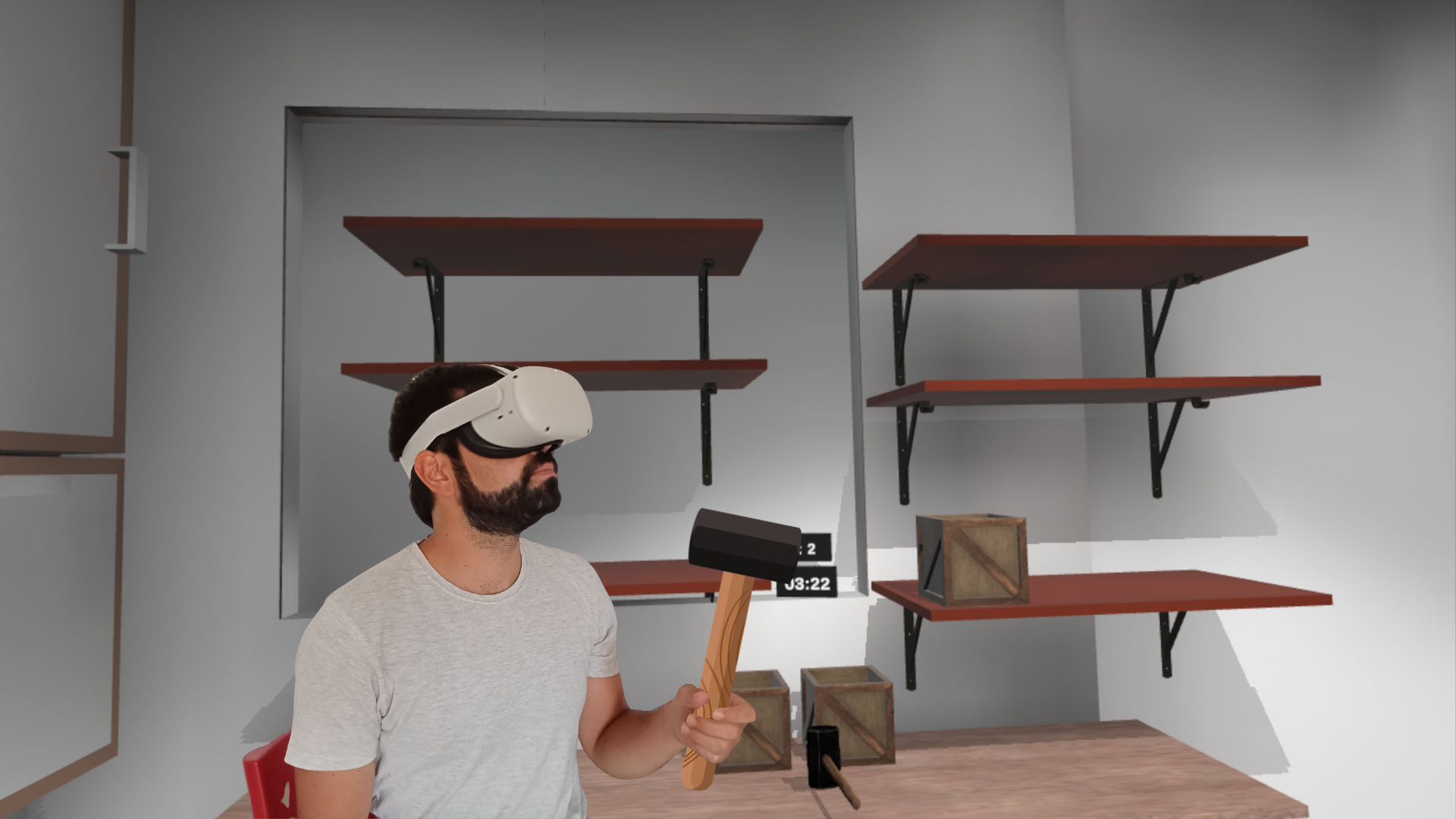
Immersive environments with hand tracking
More than 70 exercises on Meta Quest 2, 3 and 3S without controllers or gloves, with automatic recording of more than 100 variables per session and specific support for work with pain and kinesiophobia.
View module →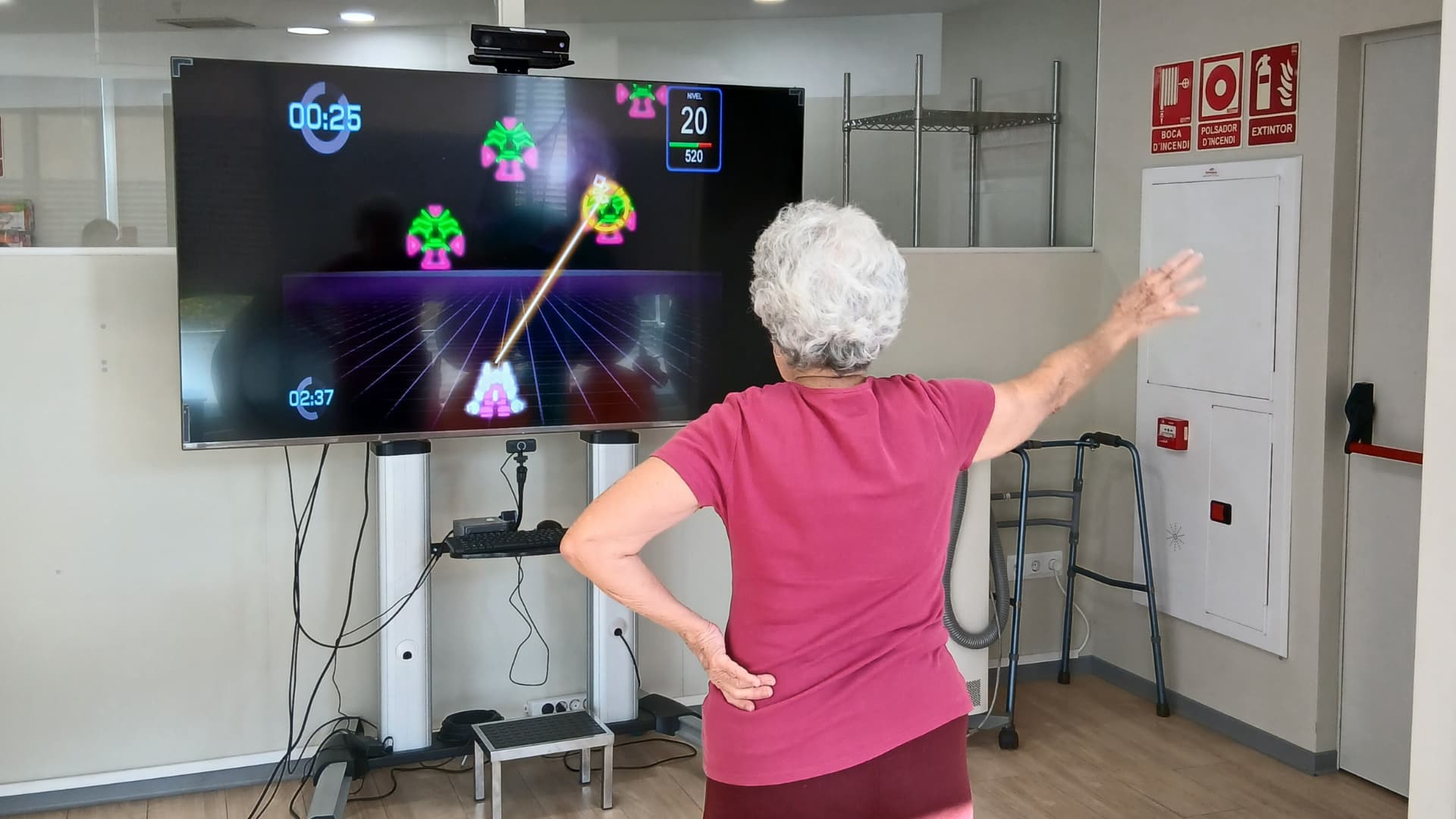
Range of motion and balance measured within the task
Motion capture without sensors or markers, with measurement of range at the shoulder, elbow, hip and knee and graded balance work to provide continuity outside the virtual environment.
View module →
Reports and supporting evidence
Session-by-session recording and automatically generated reports, with the documentation of studies and publications that support the platform's clinical use.
See clinical validation →What it means for the centre's management
Up to this point the article has addressed the treating professional. For whoever runs the centre there are three consequences that follow from the above and that are worth weighing before investing.
Adherence in long treatments
Patients with persistent pain frequently drop out between the fourth and eighth session, when the initial improvement plateaus and the exercise routine loses its appeal. A tool that makes the session more bearable and that shows visible progression helps at that point, although it does not on its own resolve the causes of drop-out, which usually include cost, scheduling and expectations poorly set from the first visit.
Use of the treatment room
Part of the work inside the virtual environment is carried out independently once the session has been prescribed, which allows the professional to supervise while attending to another task. How far that frees up the diary depends on the centre's patient profile and the phase of treatment, and certainly not every condition or every moment allows work without direct supervision.
Making the case to the patient who pays
In a private centre, the patient sustains the treatment for as long as they perceive that they are progressing. Showing them their own curve of range of motion or of repetitions tolerated between the first session and the eighth is a different argument from "you're improving" said out loud, and it usually works better when it rests on data they generated themselves.
None of these three fronts is resolved by equipment alone. The component that most determines the outcome remains the judgement with which you select who is offered it, at what point in the treatment and with what specific objective.
Frequently asked questions
Does virtual reality remove the pain or just distract the patient?
Attentional distraction is the mechanism best supported by the available research, and calling it "just" distraction understates it, because attention is one of the real modulators of the pain experience and not a trick. That said, the effect concentrates during exposure, so its therapeutic value depends on what is done with that window rather than on the reduction in the scale itself.
Does it work the same in acute pain as in chronic pain?
The data are considerably more solid in acute and procedural pain, where the largest meta-analysis covers 92 trials and more than 7,000 participants. In chronic musculoskeletal pain there are favourable effects, but with the certainty of the evidence mostly low or very low, small samples and an absence of blinding in every trial.
Is immersive virtual reality better than semi-immersive for pain?
Under experimental conditions, more immersion is associated with more analgesia. In patients with chronic spinal pain, however, a 2024 meta-analysis found equivalent effects between the two. The practical choice is usually settled by the patient's tolerance, the motor objective of the session and the safety of working in standing, rather than by a general superiority of one or the other.
How many sessions and of what duration?
There is no established dosage. The studies reviewed in chronic primary pain used sessions of between 5 and 75 minutes and programmes of between a single exposure and 56 sessions spread over eight weeks. With that variability, the reasonable approach is to adjust by individual tolerance and by the objective of each phase, reviewing the response over the first sessions.
Can it make any patient worse?
The adverse effects described are mostly mild and transient: dizziness, nausea, headache, discomfort from the weight of the headset or visual fatigue. There is also a less obvious clinical risk, which is exceeding the tolerable load during exposure without the person noticing at the time. Hence the value of reviewing contraindications before starting and of setting the dosage by professional judgement.
Want to see it with your own patients?
We will show you how a virtual reality session is prescribed for patients with pain and what is recorded afterwards, with examples matched to your centre's case profile.