
Virtual reality in herniated disc and spine surgery: what immersive and semi-immersive each contribute
In a herniated disc, and even more so once there is implanted hardware, the clinical problem is rarely a lack of available exercises. It is getting the patient to move with a sufficient dose despite pain and fear, and sustaining that week after week. That is where virtual environments have something to offer, and it is worth knowing which one to choose at each point.
What makes a herniated disc difficult to manage
A good share of lumbar herniations improve with conservative treatment, and not only clinically: on imaging too. A narrative review published in NeuroSci (2026;7(2):30) summarises that between half and two-thirds of herniations show at least a partial reduction on successive MRI scans during conservative treatment, and that the likelihood depends considerably on the type: sequestered fragments regress more often than contained protrusions. These are figures from observational studies, with the heterogeneity that implies, but they point in a direction worth bearing in mind when setting out the plan.
The clinical difficulty, then, is not usually the prognosis. It is the middle stretch: weeks or months in which the patient is in pain, sometimes with radiating symptoms, and in which the objective is for them to keep moving with a useful dose. And three problems accumulate there that anyone treating the spine will recognise.
- Fear of movement. A diagnosis containing the word "herniation" and an MRI with striking images push towards protection. The patient reduces flexion, avoids lifting and stops doing things they could in fact do.
- The dose actually completed. There is a well-known gap between what is prescribed and what the patient carries out at home, and in the spine it widens when every repetition is an effort.
- The absence of visible reference points for progress. If the only yardstick is that day's pain, any bad day is read as a setback.
We cover this general framework of persistent musculoskeletal pain in the article on kinesiophobia, dosage and feedback. In the spine it carries an added nuance: the patient usually arrives with a very specific anatomical label to which they attribute everything that is happening to them.
Immersive and semi-immersive: what each is for
Two formats with different behaviour in the treatment room coexist under the label of virtual reality, and in the spine the choice is not neutral.
Semi-immersive
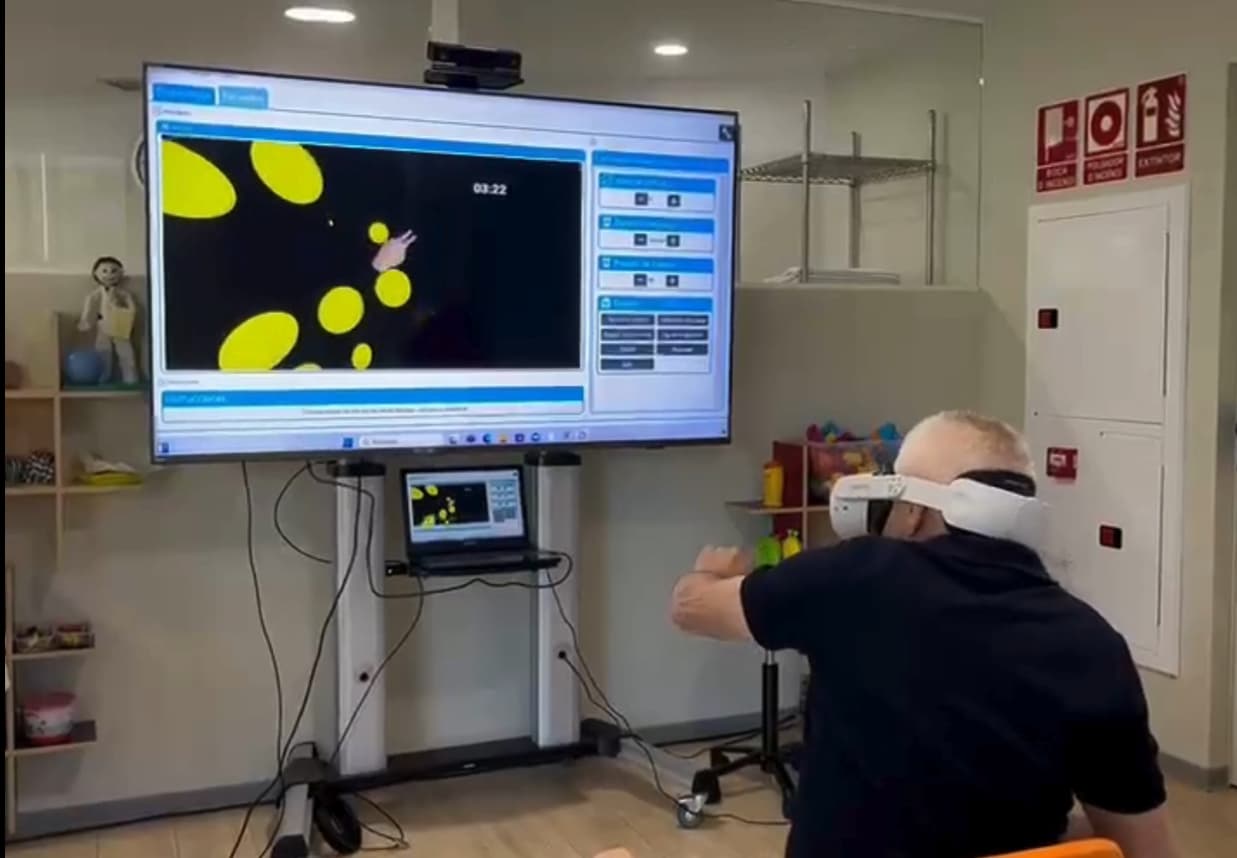
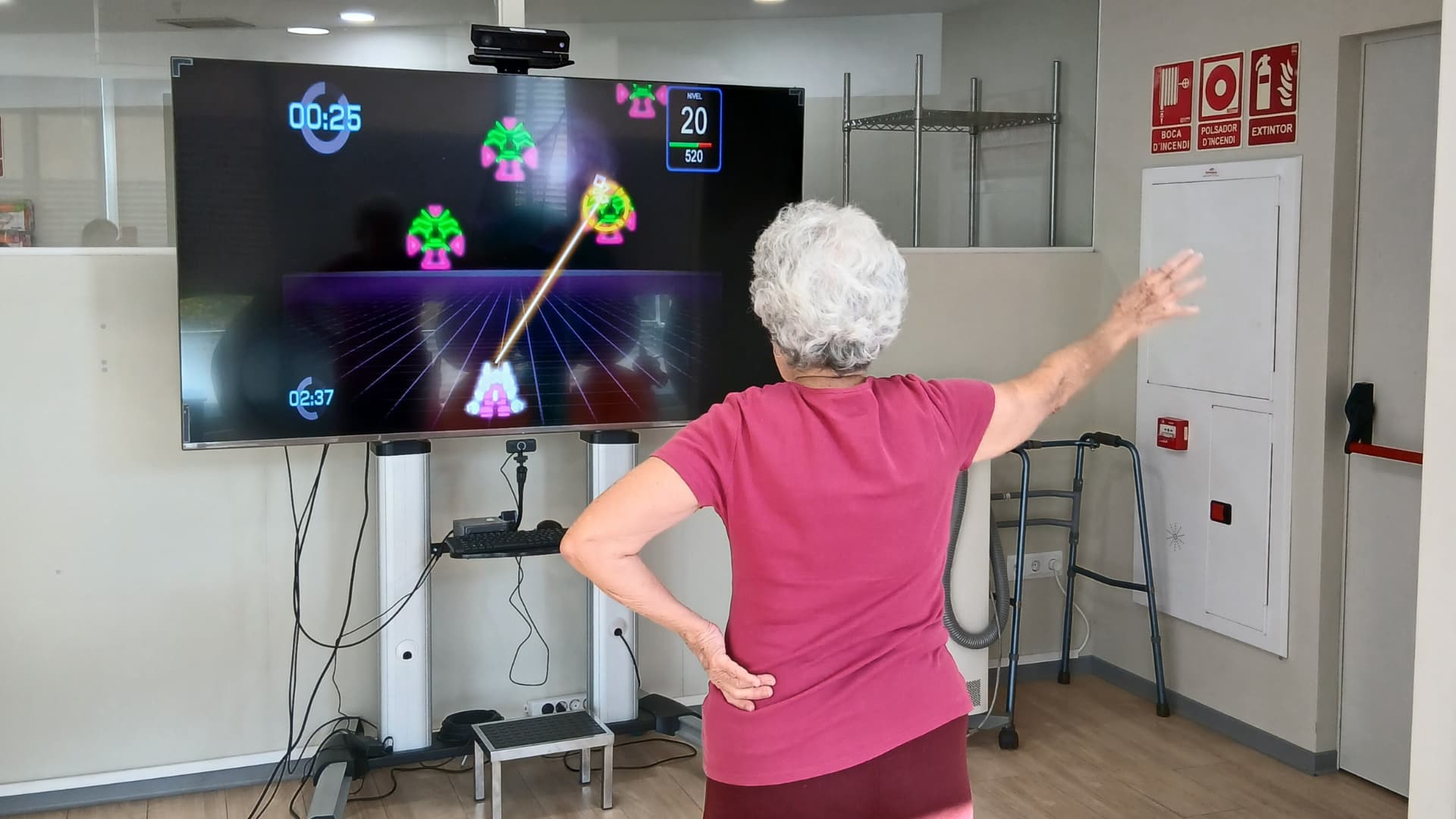
The patient sees the activity on a screen or television and moves in front of a camera that captures their movement, without a headset or sensors on them. They keep their reference to the surroundings, they see the therapist and they see their own body, which in a patient with low back pain and distrust of movement considerably reduces the friction of the first session. It is the natural format for repeated work on trunk control, weight transfers, gait and balance, and for accumulating volume of supervised practice.
Immersive
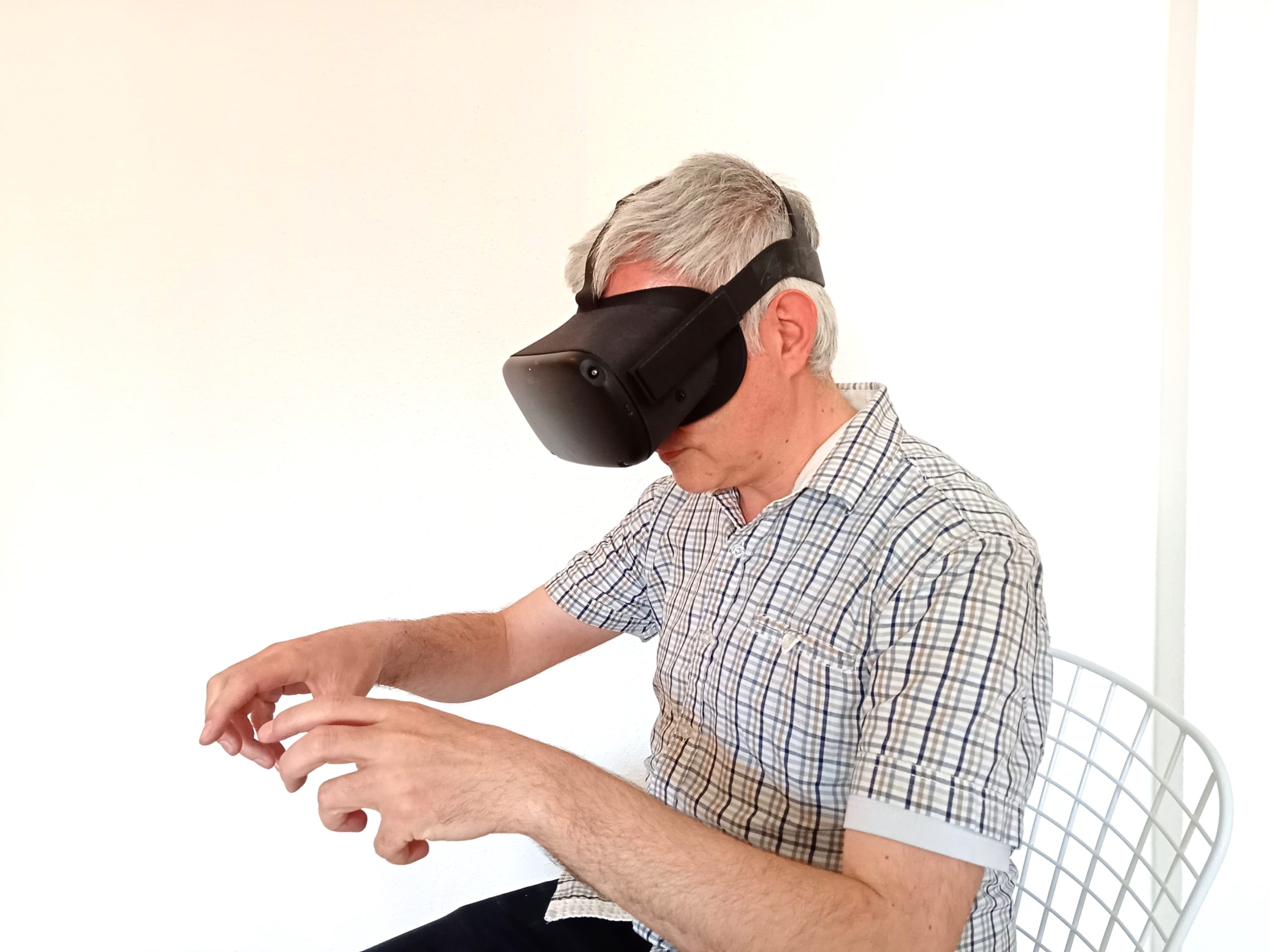
With a headset, the virtual environment fills the visual field. It offers two things the screen does not: a greater capacity for attentional distraction — relevant when pain is the main limiting factor of the session — and the ability to reproduce complete situations that do not fit in the treatment room, such as a work task involving reaching at different heights or a household movement the patient has stopped performing.
The choice between the two depends less on the diagnosis than on the objective of that particular session and on the patient's tolerance. It is worth first assessing the usual criteria for headset use, set out in the article on contraindications of using virtual reality headsets, and bearing in mind the guidance on minimising motion sickness in the first exposures.

What the evidence says in spinal pain
The most direct reference for this question is a systematic review with meta-analysis published in JMIR Serious Games (2024;12:e50089), focused specifically on chronic spinal pain and covering 16 randomised controlled trials and 800 participants. Two results matter here.
The first: virtual reality reduced pain intensity compared with control groups, with a weighted mean difference of −1.63 points (95% CI −2.11 to −1.16), above the 1.5-point threshold usually considered minimally relevant to the patient. The second, and the more useful for deciding in practice: when separated by format, immersive and non-immersive obtained practically identical analgesic effects (−1.50 each). In other words, you do not need the most immersive equipment to obtain the effect on pain; the format can be chosen on other grounds.
The same authors mark the limits clearly. They found no significant differences on kinesiophobia scales and no improvements in spinal range of motion, heterogeneity between studies was very high and the quality of the evidence sits between moderate and low. It is worth adding that other reviews do not entirely agree: an earlier meta-analysis published in JMIR (2024;26:e45406), focused on chronic low back pain, does describe improvements in pain, kinesiophobia and disability during the intervention. When two syntheses with similar methods diverge, the reasonable course is to treat the effect on fear of movement as plausible but not established, and not to sell it as a secure result.
There is a practical reading in the range-of-motion finding that deserves stating explicitly: in the spine, the objective of work with virtual environments is not to gain degrees of spinal mobility. It is to reduce pain during the session, sustain participation and allow the therapeutic exercise to be completed at the prescribed dose. Measured by that yardstick, the available evidence is a considerably better fit.
The operated patient: discectomy, fusion and disc replacement
Some of these patients arrive already operated, and with implanted hardware: discectomy or microdiscectomy, instrumented fusion with screws and interbody cages, or disc arthroplasty. The precautions and the timetable change, not the underlying reasoning.
The Cochrane review by Oosterhuis and colleagues (2014), with 22 trials and 2,503 participants, remains the reference on rehabilitation after lumbar disc surgery, and leaves three usable messages:
- Exercise programmes started between the fourth and sixth week after surgery are associated with a faster decrease in pain and disability than no treatment, with small to medium effect sizes.
- High-intensity programmes appear to achieve that decrease somewhat faster than low-intensity ones.
- None of the trials found an increase in the reoperation rate. It is a figure that tends to reassure both the patient and the team, and one to handle with the caution imposed by low to very low quality evidence.
A fourth finding has organisational consequences: no significant differences were observed between supervised and home-based programmes in pain, disability or global perceived improvement. That opens the door to splitting the work between the centre and the home depending on the case, provided the prescription is well defined and the patient carries it out.
What changes when there is implanted hardware
The presence of instrumentation is not in itself an obstacle to work with virtual environments, because what is carried out are supervised movement tasks, not techniques applied to the implant. What changes is the configuration: the surgeon's instructions and timescales are respected, range and speed are bounded at the start, safe starting positions are chosen — sitting or standing with support rather than free weight-bearing work — and direct supervision is maintained for as long as that period lasts. As consolidation progresses and restrictions are lifted, the axes of progression widen and the patient can take on more active work with less supervision.
Put another way: in the first weeks after surgery the tool is used just the same, with the session configured for that phase; what is graded over time is how much supervision it requires and how much demand the task allows.
How to bring it into the session
With the above on the table, the practical decision can be organised into four questions.
1. What is limiting the session today?
If what prevents the dose being completed is pain during execution, the attentional distraction component of the immersive format offers more. If what is failing is the quality of execution and the patient needs to see themselves and be corrected, the screen leaves the therapist more room. And if the obstacle is initial distrust of the technology, starting without a headset usually saves a whole session of negotiation.
2. Which movement do you want to recover?
For trunk control, weight transfers, gait and balance, the semi-immersive format covers the repeated work well. To reproduce complete tasks — reaching at different heights, work-related movements, household activities the patient has been avoiding — the immersive environment allows the whole situation to be set up and graded, which is hard to improvise in a treatment room.
3. How do you progress?
In the spine, progression does not mainly run through adding load. It usually advances through the amplitude of the task, speed, starting position (from sitting to standing, from supported to unsupported), duration and predictability of the stimulus. These axes are moved one at a time; when three are changed at once and the patient gets worse, there is no way of knowing what to revert. This reasoning connects with that of prescribing therapeutic exercise.
4. What do you observe and what do you record?
As well as the pain response during and after the session, what matters is the number of repetitions completed, tolerance of the position, and whether the patient accepts progressing to the next task in the hierarchy. Having that record session by session is what allows you to say "three weeks ago you were stopping after two minutes" instead of arguing about sensations. We cover the value of immediate feedback for this kind of work in the article on biofeedback in rehabilitation.
What Rehametrics offers in spinal conditions
The platform covers both formats, which avoids having to choose one for the whole course of treatment.
Rehametrics Physical works in semi-immersive virtual reality, with more than 120 exercises in which the patient interacts through the movements of their own body, without controllers or sensors placed on them. Its categories include trunk and lumbar control, gait, balance, transfers, body schema and activities aimed at kinesiophobia and pain, which are precisely the fronts that usually need attention in a herniated disc.
Rehametrics VR, the occupational module with immersive virtual reality, includes more than 70 physical and cognitive activities and two assessment tasks, with categories for lumbar and trunk control, reaching and range of motion, work tasks, activities of daily living and specific work on pain. It is operated by remote control from an external computer, so the therapist changes parameters or interrupts the activity without the patient having to remove the headset: in a recent post-operative case, that ability to intervene on the fly matters more than it might seem.
In both modules the difficulty adjusts automatically according to the patient's success rate against the target, which helps keep the task within a useful band of demand without reconfiguring it manually on every set.
On follow-up it is worth being precise. The platform's objective record rests on repetitions, movement speed and range of motion at the shoulder, hip, elbow and knee, along with centre of gravity and base of support in balance tasks. In the spine, therefore, progress is built from task execution, progression within the hierarchy and session-by-session tolerance, together with whatever scales the team already uses in clinic. It is a form of follow-up consistent with what the evidence shows: the objective of virtual work in the spine is not the degree of mobility, but pain, participation and function.
Clinical judgement is not delegated. The professional selects the patient, chooses format and activity, respects surgical instructions where they apply, supervises tolerance and interprets the data. You can see more about how these tools fit in musculoskeletal injuries and in the platform's clinical validation.
Modules relevant to spinal conditions
Trunk and lumbar control
More than 120 exercises without controllers or sensors, with categories for trunk control, gait, balance, transfers and work aimed at kinesiophobia and pain.
View module →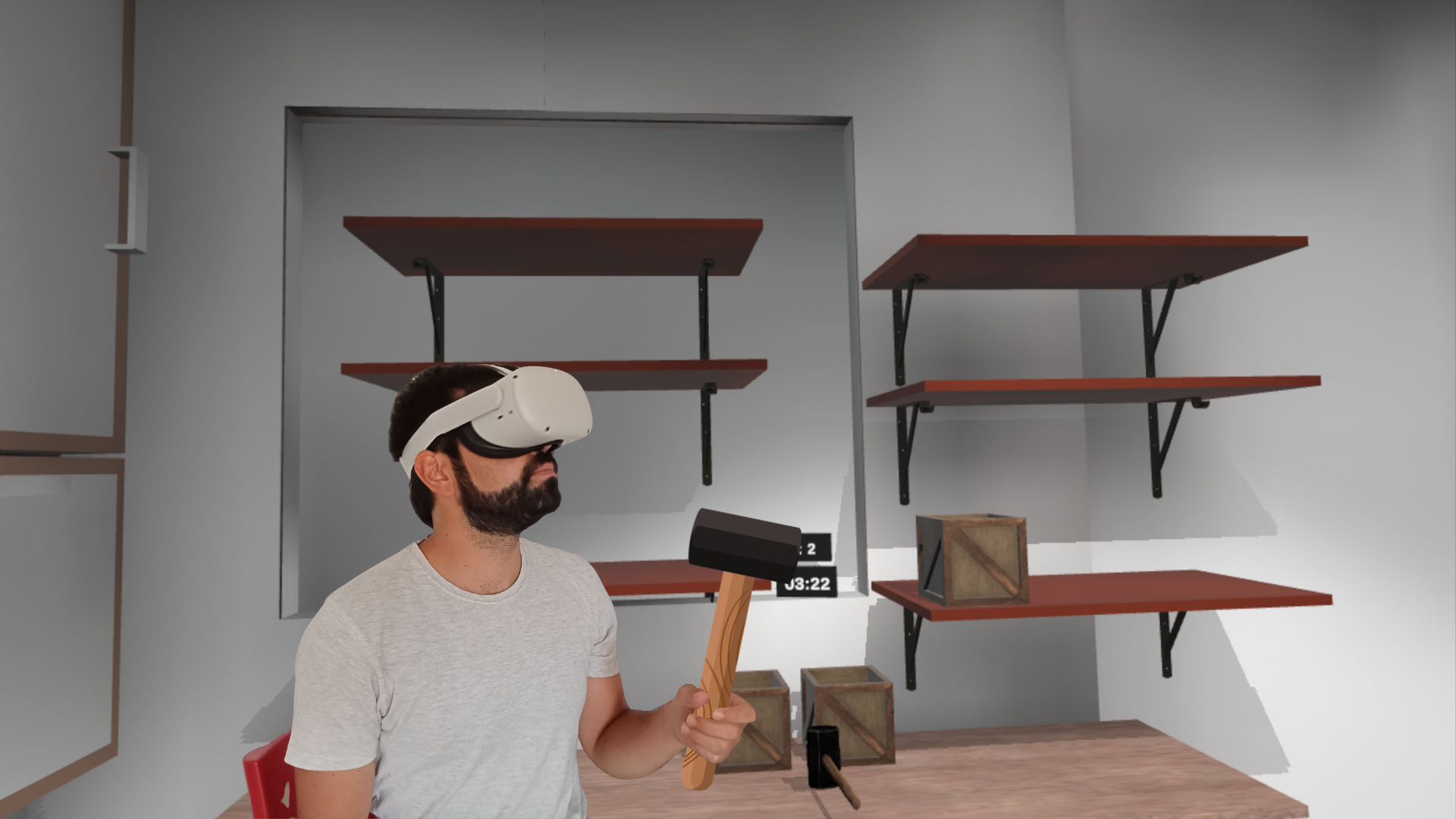
Functional and work-related tasks
More than 70 activities in an immersive environment, with remote control from an external computer to adjust the session without removing the patient's headset.
View module →
Progress reports
Session-by-session recording of repetitions, speed and progression within the plan, useful for deciding when to advance and for explaining progress to the patient.
See clinical validation →Frequently asked questions
Can virtual reality be used in a patient with instrumented fusion or a disc replacement?
Yes, in selected patients and with the session configured for their phase: respecting the surgeon's timescales and instructions, bounding range and speed at the start, choosing safe starting positions and with direct supervision. What is carried out are prescribed movement tasks, so the presence of implanted hardware shapes the parameters, not whether the tool is used.
When can you start after a discectomy?
The Cochrane review on rehabilitation after lumbar disc surgery places the start of exercise programmes between the fourth and sixth week, with no increase in the reoperation rate observed in the included trials. The specific timing is set by the surgeon and the patient's progress; before that point the work usually focuses on other objectives and with closer supervision.
Is immersive or semi-immersive virtual reality better for spinal pain?
The meta-analysis specific to chronic spinal pain found practically equivalent analgesic effects between the two formats. The choice can therefore be made on other criteria: the patient's tolerance, the objective of the session, the type of movement to be reproduced and the centre's resources.
Is it useful if the patient has pain radiating into the leg?
It can be used once red flags have been ruled out and with the task adapted to what the patient tolerates, avoiding positions that intensely reproduce the radicular symptom. In the presence of progressive motor deficit, bladder or bowel disturbance or suspected serious compression, the answer is referral, not exercise progression.
Does it replace therapeutic exercise and manual therapy?
No. It works as part of the plan: it provides volume of practice, immediate feedback and a component of attentional distraction that can make it easier to complete the prescribed dose. Assessment, prescription and progression remain the physiotherapist's, and the available evidence supports these environments as a complement to treatment, not as a replacement.
Want to see it with your own patients?
We will show you how spinal work is prescribed with the semi-immersive and immersive formats of Rehametrics, including examples of supervised post-operative sessions.