Psychogeriatrics and Technology: How Cognitive Stimulation Fits into Nursing Homes
Neuropsychologists determine what to work on with each resident, and they remain the decision-makers in every session—a role that neither management nor technology can replace. What management provides is ensuring the program has a dedicated spot in the team's schedule, doesn't rely solely on a single staff member, and generates objective reports to share with families. That is where operational technology makes a difference.
Why cognitive stimulation is also a management priority
In a nursing home setting, cognitive stimulation programs typically start as a clinical decision by neuropsychologists or occupational therapists, who define exercise targets and session frequencies for each resident. The true operational hurdle lies in sustaining this program long-term: a facility may care for dozens or hundreds of residents with vastly different cognitive profiles, while the clinical staff must also split their time across physical therapy, occupational tasks, and social care. At this point, the challenge shifts from purely clinical to managerial.
Facility directors do not need to master every nuance of a working memory protocol. They need to know whether the program is sustainable with available resources, what tangible progress reports can be presented to families or healthcare inspectors, and how it differentiates their care facility. Here is where the role of technology evolves: beyond making sessions engaging for residents, it reduces the administrative workload required to keep the service running.
This article addresses those core operational aspects: what cognitive stimulation technology actually tracks, how it lightens the burden for clinicians and directors, and what insights can be gathered from public care homes already using it.

Common challenges when implementing a cognitive stimulation program
Regardless of facility size, care teams delivering cognitive stimulation in nursing homes consistently face four primary obstacles:
- Personalizing tasks without duplicating workload. Every resident requires distinct exercise complexity and focus areas. However, manually creating custom pen-and-paper materials for each resident, session after session, is unfeasible at scale.
- Sustaining stimulation beyond formal therapy hours. Direct clinical contact time is often limited; facilities require structured activities that residents can repeat independently without full-time direct supervision.
- Maintaining resident motivation. Apathy and low participation are common in geriatric populations, especially when paper tasks feel repetitive or lack personal meaning.
- Clinical documentation overhead. Manually logging correct answers, error types, and longitudinal progress for every resident eats up hours that clinicians could spend on direct care.
These four challenges exist in every care environment. Software platforms serve as specialized tools to streamline these exact friction points without replacing clinical judgment.
What cognitive technology measures and how it adapts session by session
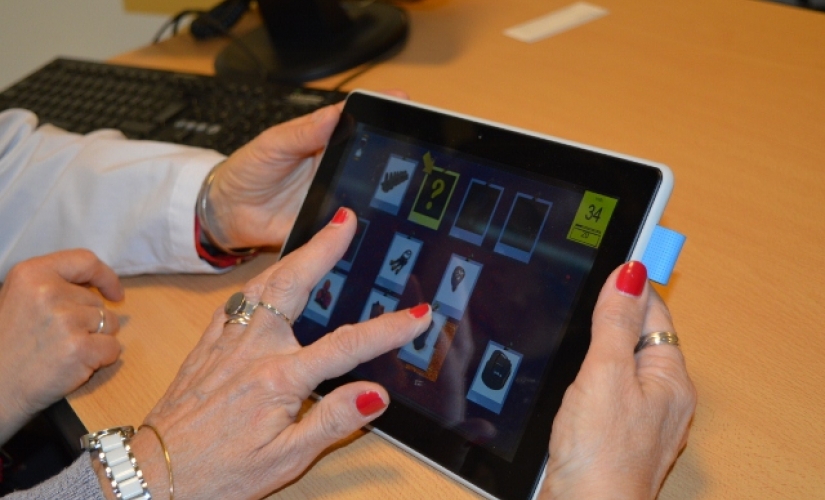
Rehametrics Cognitive addresses six main cognitive domains: attention, memory, working memory, processing speed, language, and executive functions. For every exercise, it registers three quantitative data points per resident: correct responses, errors (categorized by stimulus type or distraction level), and response times. Based on performance, exercises automatically scale in difficulty, eliminating the need for clinicians to recalculate parameters between sessions.
The system includes pre-designed protocols tailored for elderly care and cognitive impairment, providing a solid clinical starting point rather than requiring staff to build protocols from scratch.
Selecting which cognitive domain to prioritize remains the clinician's responsibility. The software provides an automated, objective record of performance that would otherwise be difficult to track consistently on paper.
From session to reporting: value for directors and care teams
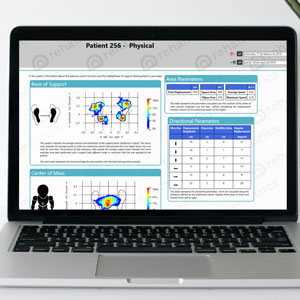
Every completed session compiles data into printable PDF evolution reports. For the clinical team, this eliminates manual record-keeping. For management, it provides standardized documentation ready for family meetings, quality audits, or internal case reviews.
For facility directors, this objective data turns general claims about providing cognitive care into verifiable, documentable evidence of clinical activity.
Case studies: public care homes in Galicia and Madrid
Real-world public implementations support this approach. The Regional Government of Galicia (Xunta de Galicia) integrated Rehametrics Physical and Cognitive modules across its network of public care homes. This initiative aligned with a modern care framework built on four pillars: technological leverage, health and social care coordination, welcoming environments, and humanized care delivery. While technology primarily addresses the first pillar, clinical reports highlight improved resident engagement in both physical and occupational therapy sessions. The full case study is available in our article on rehabilitation programs in Galician nursing homes.
Similarly, the Regional Government of Madrid utilizes Rehametrics across public residential facilities alongside other healthcare and social service providers. Nationwide, over 75 care homes in Spain now use the system as part of a global footprint encompassing more than 400 healthcare organizations in 20 countries.
Fitting into a broader comprehensive care program
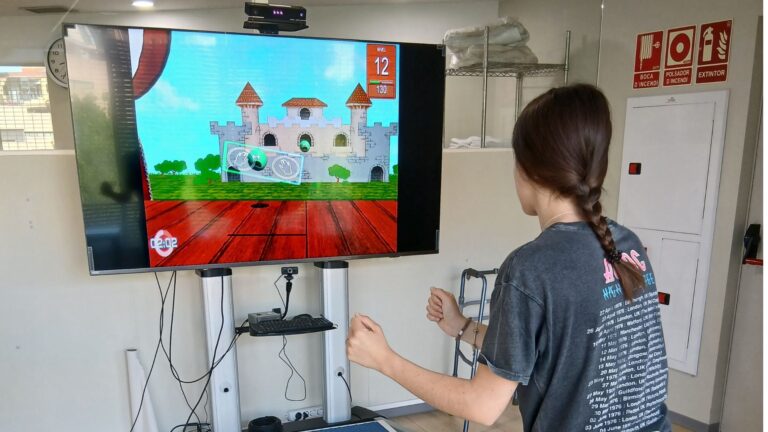
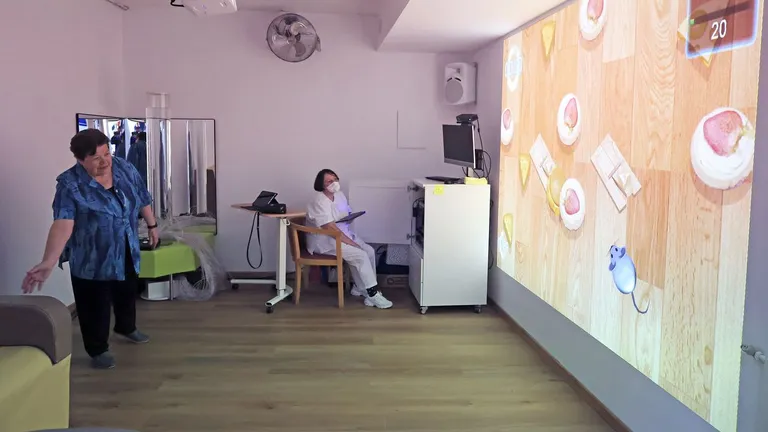
Cognitive stimulation rarely exists in isolation. In public care homes, it is frequently deployed alongside physical rehabilitation software. This combined approach streamlines staff onboarding: care teams use a unified software interface, identical reporting formats, and consistent tracking methodologies across physiotherapy, occupational therapy, and cognitive stimulation.
Rehametrics also offers an immersive VR module using virtual reality headsets. In nursing home settings, immersive VR is applied selectively—it is generally avoided for residents with severe cognitive impairment, significant visual deficits, or device refusal. The appropriate modality (tablet vs. VR headset) is determined on a case-by-case basis by the attending team.
The resident profile suitable for cognitive stimulation is broad: ranging from active aging groups without diagnosed impairment to individuals with vascular dementia, acquired brain injury, or neurodegenerative conditions. Tailoring the specific intervention protocol remains under the direct supervision of the clinical specialist.
The role of Rehametrics in care home cognitive stimulation
Rehametrics Cognitive provides an extensive library of exercises covering attention, memory, working memory, processing speed, language, and executive functioning. Featuring automatic difficulty scaling and pre-configured geriatric protocols, its touchscreen interface accommodates users with no prior tech experience. Meanwhile, automated PDF reports give directors and care teams access to objective data that previously relied on manual notes.
Software provides the underlying tracking framework, task personalization, and administrative time savings, while clinical teams retain complete authority over treatment plans. We explore this collaborative model further in our article on increasing resident engagement in neuropsychology sessions.
Relevant software modules for care homes
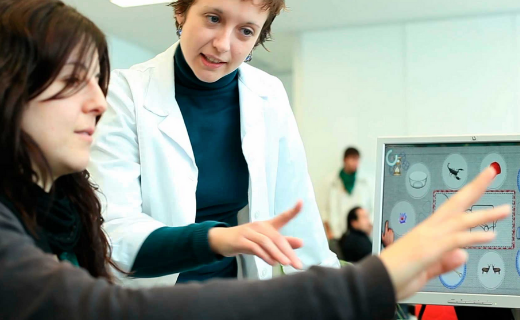
Attention, Memory & Executive Functioning
Cognitive exercises with automated difficulty adjustment, touchscreen navigation, and specialized geriatric protocols.
Explore module →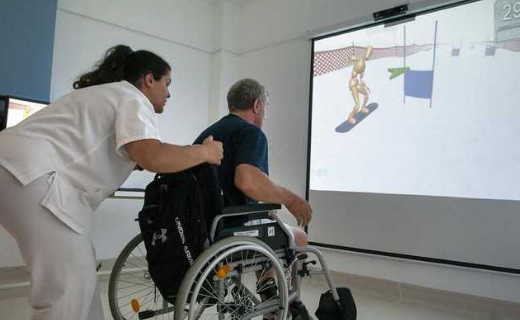
Complementary Physical Rehabilitation
Often deployed alongside the cognitive module to streamline workflows for multidisciplinary care teams.
Explore module →
Automated Progress Reports for Directors
Automated tracking of accuracy, errors, and response times compiled into exportable PDF reports for family meetings and audits.
View clinical evidence →Frequently Asked Questions
Does this technology replace formal clinical evaluations?
Does staff require extensive technical training to run sessions?
Is the software suitable for residents with severe cognitive impairment?
What administrative benefits does the platform offer facility directors?
How can progress reports be shared with residents' families?
Interested in integrating digital cognitive care into your facility?
Contact us to discover how Rehametrics Cognitive fits into daily care home workflows and streamlines reporting for your management team.
Request a Live Demo