
Digital speech therapy for aphasia: what it adds to language rehabilitation
Aphasia is one of the consequences of stroke that isolates a person most, and one of those that needs the most treatment time. Recent years have brought a European guideline, several reviews and trials that make it possible to say with reasonable precision what software-supported language therapy contributes, first as working material within the session itself and then as a way of carrying on practising between sessions, in which domains the evidence for digital speech therapy for aphasia is firmest, and which part of the work still depends entirely on the speech and language therapist. This article summarises it for anyone working with these patients.
Where technology enters language rehabilitation
When people talk about digital language therapy, they often picture an app the person uses at home. That is one part of it, and not the main one for most speech and language therapy services. Technology enters aphasia rehabilitation through two distinct doors, and it is worth separating them from the outset because the evidence and the uses are not the same.
Within the session
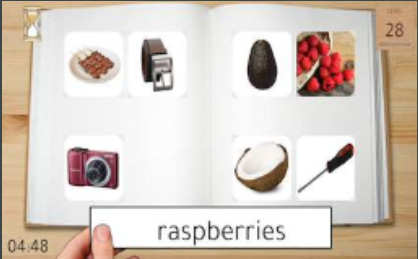
The first door is the session with the therapist itself, individually or in a group, with the software as working material on a tablet or an interactive whiteboard. What changes compared with worksheets and picture cards is the quantity and the control of the stimuli: hundreds of word-picture pairs with differing lexical frequency, phonological or semantic distractors at whatever degree of similarity the professional decides, adjustable response times and a difficulty level that rises or falls with performance without remaking the material. Every response is recorded with whether it was correct, its timing and the difficulty level at which it occurred, and the person receives immediate feedback on each attempt. The therapist does not disappear from the scene; they stop preparing and counting, and instead watch, listen and intervene on what the screen cannot see.
Beyond the session: the hours that never arrive
The second door is the time between sessions. Language recovery responds to practice, and responds better the more specific practice the person receives; the hours of therapy a health system can offer, public or private, almost always fall below what the research associates with the best gains. The most-cited figure comes from the RELEASE collaboration, which pooled individual data from 959 participants across 25 trials in a network meta-analysis published in Stroke in 2022: the largest gains in overall language and comprehension were associated with programmes of more than 20 total hours, with several sessions a week, receptive and expressive content tailored to the person, and prescribed home practice. The authors stress that those conditions exceed what usual services offer in most countries, and that their findings are exploratory. Software allows part of that practice to happen outside the clinic, with the same material used in the session and with the professional reviewing afterwards what has been done.
What the 2025 European guideline recommends
The European Stroke Organisation guideline on aphasia rehabilitation, published in 2025 in the European Stroke Journal, is the most recent reference and the one carrying most weight in Europe. Following GRADE methodology, the working group reviewed the controlled trials of language therapy and made recommendations on ten clinical questions.
On low-quality evidence, the guideline recommends delivering a higher total dose of therapy (20 hours or more) and suggests greater intensity and frequency. Along the same lines, it suggests individualised therapy and, explicitly, digital and group delivery models as valid ways of providing that therapy. For non-invasive brain stimulation (tDCS) combined with speech and language therapy, the evidence was so scarce that expert consensus limits it to the clinical trial context.
What the evidence shows on digital speech therapy for aphasia
The most comprehensive review to date is by Alhejji, Cunningham, Dorney and Palmer (2026), published in the International Journal of Language and Communication Disorders. It analysed 67 studies between 2013 and 2026, of which 14 were randomised controlled trials, and distinguished three types of technology: computer-based language therapy (38 studies, both in session with the therapist and at home), virtual reality (17) and artificial intelligence (13, used mainly for assessment and classification). The firmest and most consistent evidence is for naming, with high certainty supported by several trials that delivered therapy at or above 20 hours. For language production and comprehension, functional communication and reading, results were more variable, with moderate certainty. For writing, certainty is low, because of small samples and gains limited to the trained task.
The authors' conclusion is worth quoting almost verbatim, because it fits everything above: across all domains, the studies with higher doses obtained better results, which suggests that technology works above all as a tool for making intensive practice possible, rather than as a therapeutic ingredient that is effective in itself.
The three sources that follow look mainly at the second use, autonomous work between sessions, which is where most of the research has gone in recent years. A second review, by Ericson and colleagues (2025) in Brain Sciences, focused on self-administered computer- or tablet-based therapies in chronic aphasia. Across 39 studies, anomia was the most frequently targeted objective (24 of them). The therapies proved effective for trained items and the gains were maintained over time; there was some evidence of transfer in sentence-level treatments. One detail that matters to the professional: almost all the studies included prior training sessions, observation or monitoring during the self-administered therapy, and only a minority supplemented it with face-to-face therapy.
To see how this translates into a specific, recent trial, Kim and colleagues (2025) published in JMIR mHealth and uHealth a randomised trial with 37 people with chronic aphasia (a mean of 4.6 years post-onset) who trained naming with an app for five weeks, around 20 hours in total, remotely and independently. The Boston Naming Test score rose by 1.6 points (Cohen's d 0.3), trained items and the WAB-R naming subtests improved, and perceived communicative quality of life increased significantly. The overall aphasia quotient and communicative effectiveness as rated by those around the person did not change. It is a modest effect, obtained in chronic patients with few treatment options, and the authors present it as exactly that.
On telerehabilitation specifically, a 2025 meta-analysis in Advances in Clinical and Experimental Medicine compared six studies with 168 participants and found no differences between remote and face-to-face therapy in naming accuracy, aphasia quotient, auditory comprehension or functional communication; the only significant difference favoured telerehabilitation for generalisation. With six studies, the authors themselves call for caution.
What changes in the speech therapy clinic
Coming down from the reviews to the clinic, these are the differences that therapists working with a platform describe most often. Each professional will give them whatever weight they see fit.
The first is the quantity and control of the stimuli. Preparing a hundred word-picture pairs by hand with differing lexical frequency and differing degrees of phonological similarity takes hours; a platform has them available and allows the type of stimulus, the response time or the similarity between distractors to be adjusted without remaking the material. The second is the record. Every response is saved with whether it was correct or an error, its timing and the difficulty level reached, which makes it possible to see trends that go unnoticed within a session, such as response times coming down before accuracy goes up, or performance dropping beyond a certain level of demand. The third is immediate feedback, which the person receives on every attempt without waiting for the therapist to step in. And the fourth is continuity: the work can carry on between sessions, in the waiting room or at home, with the professional reviewing afterwards what the person has done, which is the arrangement the self-administered therapy studies describe as usual.
The effect on the therapist is similar to what is seen in other areas of digital rehabilitation: less time spent preparing material and counting responses, and more on what the programme cannot do, which is listening to how the person speaks, working on conversation and deciding what comes next.
Where the limits of the technology are
The same studies that support digital speech therapy for aphasia set out its limits fairly sharply, and those deserve to be kept just as firmly in view.
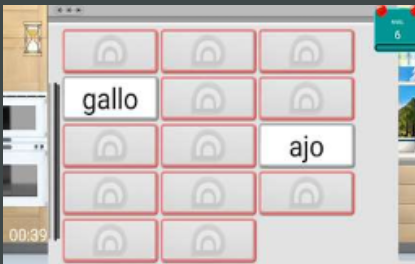
The first is specificity. What improves most is what is trained: the words practised, the particular task. Transfer to untrained words and, above all, to real conversation is smaller and more variable, and functional communication is the domain where results are least consistent. The second is the domain: naming has high-certainty evidence, writing low, and in between lies a wide stretch of ground where each study says something different. The third is that technology does not replace the therapeutic relationship or the assessment: in the reviews, the programmes that work have behind them a therapist who has selected the objectives, trained the person in using the programme and follows their progress. And the fourth is the person with aphasia themselves: access to a tablet, understanding of the instructions, fatigue and mood all shape how much of the intended dose actually gets done.
With those limits in view, the defensible claim today is that software allows the person to practise more, with controlled stimuli and a record of what happens, and that the return on that practice depends on who designs it and who accompanies it.
How Rehametrics fits into language rehabilitation
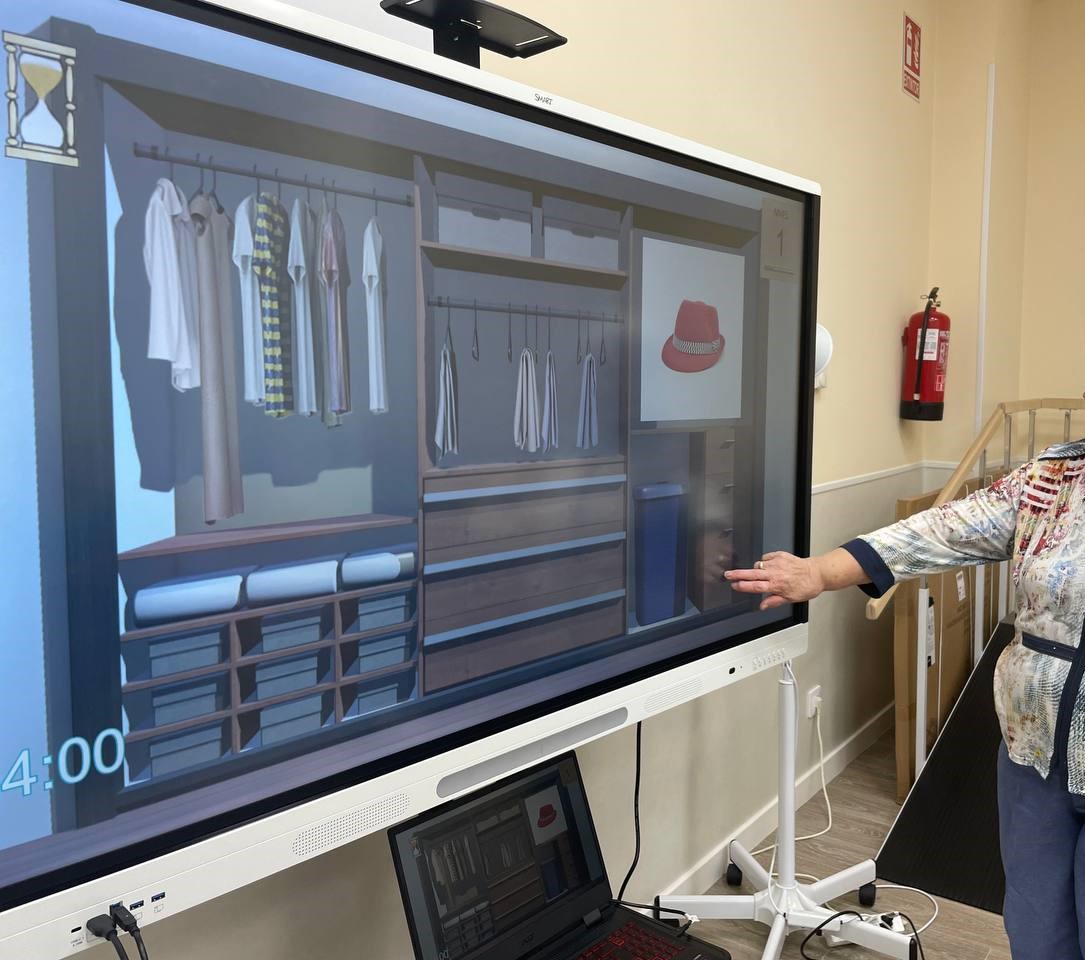
Within Rehametrics Cognitive, the language area brings together more than 40 tasks organised by level, from the letter and the syllable to the word, the sentence and the text. It covers letter and syllable identification, phonological awareness, naming and lexical access, reading comprehension and reading speed, spoken and written expression, verbal memory, discrimination between similar linguistic stimuli, and sentence and text processing. It is designed for aphasia, acquired dyslexia, cognitive impairment and neurodevelopmental disorders affecting language, and some exercises are used with children from the age of four.
The professional configures the type of stimuli, the response time, the typeface, the degree of similarity between stimuli and reading aloud, and difficulty adjusts automatically to performance during the session within those parameters. The platform records correct answers, errors, response time and difficulty level for each task. From that data it generates printable reports showing progress across sessions. It runs on tablets and interactive whiteboards, in the clinic under direct supervision or in remote mode with team follow-up, depending on how it is configured.
It is worth being equally clear about what the platform does not do. The automatic record captures the responses the person gives on screen; assessment of spontaneous spoken output, of conversation and of functional communication belongs to the speech and language therapist, who is also the one deciding which objectives are worked on and with what material. Nor does the platform diagnose or replace language assessment. For concrete examples of tasks there is more in aphasia and exercises for language rehabilitation and in the update that added 35 speech therapy tasks; on how the difficulty of a cognitive task is graded after a stroke, in the article on stroke and acquired brain injury.

More than 40 tasks, from the letter to the text
Naming, phonological awareness, reading comprehension and speed, expression, verbal memory and sentence processing, with configurable stimuli and timings.
View language area →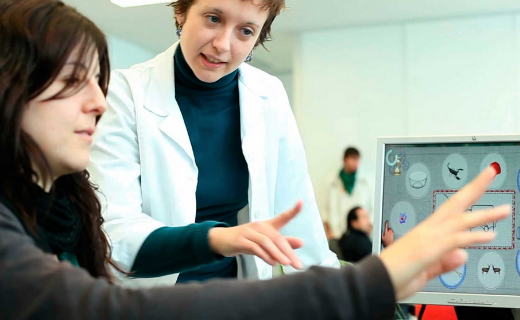
Six domains with a record of every exercise
More than 190 exercises in attention, memory, working memory, processing speed, language and executive function, with difficulty that adjusts itself.
View module →
Progress, session after session
Correct answers, errors, response times and difficulty level saved while the person works, with the report ready at the end.
View reports →Frequently asked questions
Does digital speech therapy for aphasia replace the speech and language therapist?
Recent reviews describe it as a complement to face-to-face therapy, and the 2025 European guideline suggests it as a route to increasing practice hours. In the studies that work, a therapist selects the objectives, trains the person in the programme and follows their progress; assessment of spontaneous speech and of conversation is not done by the software.
In which aspect of language is the evidence firmest?
In naming and lexical access. The review by Alhejji and colleagues (2026) assigns it high certainty when therapy reaches 20 hours; comprehension, production, reading and functional communication have moderate certainty with more variable results, and writing has low certainty.
Does it work in chronic aphasia, years after the stroke?
The self-administered therapy trials have been conducted mainly in chronic aphasia, and they show improvements in trained items that are maintained over time. In the trial by Kim and colleagues (2025), with a mean of more than four years post-onset, naming and communicative quality of life improved modestly but measurably.
Does remote therapy give worse results than face-to-face?
The 2025 meta-analysis comparing them, with six studies, found no differences in naming, aphasia quotient, comprehension or functional communication. The sample is small and its authors call for prudence, but there is no indication that supervised remote delivery is inferior.
What gets recorded in Rehametrics?
Correct answers, errors, response time and difficulty level for each task, with progress across sessions. It is a record of performance on the tasks trained, which complements rather than replaces speech and language assessment.
Want to see it with your own patients?
We will show you the language area of Rehametrics Cognitive, how the stimuli are configured and what gets recorded in each session, and how other speech and language therapy and neuropsychology services are using it.