
Explaining digital rehabilitation to patients and families
A centre can have the room ready, the team trained and the software running, and still find that the technology gets used less than planned. The reason often lies somewhere before the first session: in how the patient and whoever comes with them were told what this thing is, what it is for and what happens to what it records. This article brings together what recent research says about what patients and families hope for and fear from technology-assisted rehabilitation, the questions they ask most often, and which information helps them decide with confidence. It is written for whoever organises the centre's communication, from the website to the first appointment, and for whom explaining digital rehabilitation to patients is part of the job.
Explaining digital rehabilitation to patients starts before the first session
Most people arriving at a rehabilitation service have never heard of motion capture and have never held a virtual reality headset. What they know about those words comes from television, from their grandchildren's video games, or from nothing at all. They form a view in the first few minutes on that basis, and that view shapes how they walk into the room: with curiosity, with suspicion, or with the feeling that they are going to be made to play games instead of being treated.
The same goes for the family. The son who brings his mother to the appointment, the spouse who comes to every session, the daughter who is paying for the treatment, all form their opinion just as quickly and voice it afterwards, in the car or over dinner, with more weight than the therapist usually carries. A centre that has thought about how to explain the technology to these people, and not only to patients, saves itself a good part of the resistance that shows up in the first few weeks.
This blog has already covered why some patients accept a digital activity while others reject it right from the start, from the professional's point of view within the session. Here the angle is the centre's: what gets said beforehand, to whom, and through which channels.
What they hope for and what they fear, according to the research
Recent years have brought a fair amount of qualitative research asking patients and carers directly what they think about technology-assisted rehabilitation. The results are useful to anyone who has to explain it, because they show what genuinely worries people and what gets taken for granted when it should not be.
A meta-synthesis published in 2025 in the Journal of NeuroEngineering and Rehabilitation brought together fourteen qualitative studies with 133 people who had done virtual reality rehabilitation after a stroke. Their experiences group into four themes: the benefits people perceive in themselves, physical and emotional; what makes use easier, above all feeling involved and having a supportive environment; what makes it harder, which combines technical limitations with personal ones; and expectations about how the technology ought to be. The authors conclude that the outcome depends as much on the person as on the system, and that personalisation and support are what make the difference.
On age, which is the objection families raise most often, a 2023 systematic review with meta-analysis in Sensors analysed 54 studies with 1,853 people over 60 who used immersive technologies to exercise. Most described the experience as enjoyable and said they wanted to do it again; the increase in motion sickness symptoms measured with the standard questionnaire was small in healthy people and moderate in those with a neurological condition, which the authors read as a sign of feasibility in this population.
A qualitative study published in 2026 in the Journal of Medical Internet Research interviewed 21 stroke survivors about what they felt was missing from their rehabilitation and what they would expect from virtual reality. Attitudes varied: some saw it as a convenient tool and others felt no need for technology at all. What is interesting for anyone handling communication is the list of what they asked for: that the family could take part, being able to see their own rehabilitation data, continuity of treatment, safety and technical support. Those are, almost point for point, the things worth covering in the first conversation.
And on the family specifically, a focus group study published in 2024 in JMIR mHealth and uHealth, which included neurological patients, their carers and professionals, found a clear preference for a hybrid model, with face-to-face sessions at the start and technological support afterwards, and stressed that carers have a decisive influence on whether the technology is adopted or abandoned, despite which their opinion is rarely sought. The study's setting is different from the Spanish one, but that finding repeats itself in most centres' experience.
The questions patients and families ask
The questions repeat themselves from one centre to the next, and having the answer ready avoids improvising at the first appointment. Each team will answer in its own style; what follows is the substance of each one.
"Is this a game?" It is the first question and the one that matters most, because behind it lies a fear: that the treatment is less serious. The answer is what it is: the exercises take the form of an activity so that they are easier to stick with and so that the person repeats the movement or the task more times, and behind each one there is a therapeutic objective the professional has chosen for them. That the software is a medical device, and not a video game, is an argument families understand and appreciate.
"Does it replace the therapist?" No, and it is worth saying so early and plainly. The professional is still in the room, decides what is worked on and adjusts the session; the technology gives them tools and data. This answer reassures the patient and, above all, the family, who often fear that technology is a way of treating more people with fewer staff.
"Is it any use at my age?" The research cited above says yes in most cases, and the experience of care homes and day centres bears it out. It helps to explain that no computer skills are needed: with motion capture the person touches nothing, and with the headset and the tablet the professional sets everything up.
"Will it make me feel sick?" This one comes up with the headset. The answer is that it can happen to some people, that the first sessions are short and seated, that mixed reality lets them see the real room, and that the therapist is beside them and the session stops the moment the person asks.
"What happens to my data?" Increasingly common, and more so among relatives than patients. What the person needs to know is what is recorded, what for, who sees it and where it is kept. That the data serves to produce their report and follow their progress, and nothing else, is the answer they are looking for.
"Is everything going to be on a screen now?" Many patients, and more so those who have been in treatment for a while, fear that technology will replace what they already know: the physiotherapist's hands, the usual exercises, the bit of conversation with the speech therapist. The most reassuring answer is the true one: the technology is added to the session, it does not replace it. The professional decides when and what for they use it, with whom and with whom not, and combines it with the rest of the treatment; a session with technology still has a plinth, conventional exercise and a therapist.
The progress report as a conversation tool
One of the most visible differences between technology-assisted rehabilitation and conventional rehabilitation is that the first leaves a record of every session: how many repetitions, what range of movement, how many correct answers, how long the response times, what difficulty level. That record becomes a report the centre can show and hand over, and it changes the conversation with the patient and the family.
It changes, first of all, for the patient themselves: each activity has a specific objective and a visible result at the end, so they understand what the session was for without having to ask. And it changes because the question "how is it going?" stops being answered with an impression alone and starts being answered with a chart the person can look at: the shoulder range three weeks ago and today, the errors on an attention task at the start and now. For many patients it is the first time they see their progress rather than hear about it, and in phases where improvement is slow, as in chronic rehabilitation, that small, concrete evidence sustains motivation better than any words of encouragement. For the family, the report answers the question they are really asking, whether the treatment is doing any good, with data they can keep and show to the referring doctor.
The report also helps set expectations. It helps to explain from the outset that the exercises are designed to be demanding but achievable, that difficulty goes up as the person improves, and that this is why the sense of effort does not disappear even when the data is moving in the right direction. When progress stalls, the data shows it sooner and with less emotional weight than a difficult conversation, and lets the professional explain why and what is going to change. And it puts in its place what the technology measures and what it does not: the report captures performance on the tasks; the overall clinical judgement still belongs to the professional, and saying so stops anyone mistaking a chart for a discharge.

The family's role
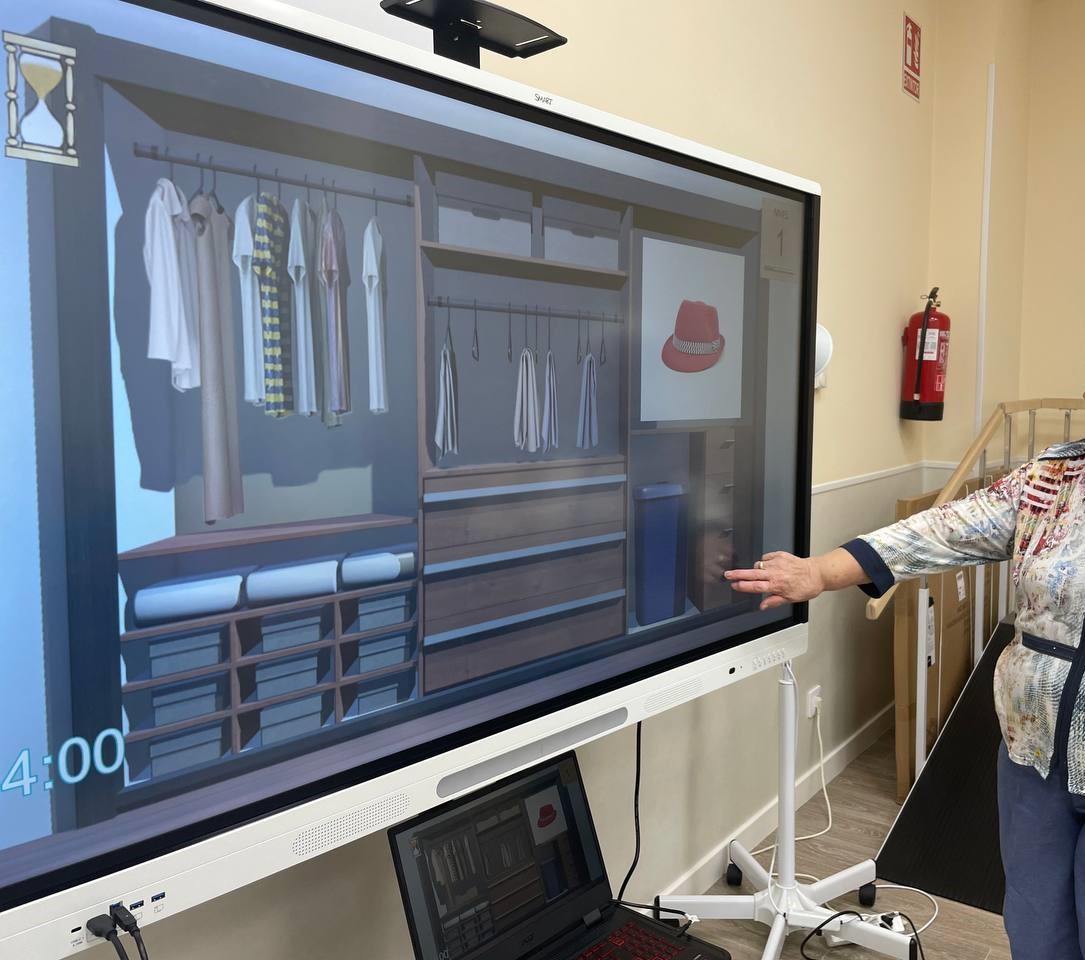
The family appears at three moments, and needs different information at each. At the first appointment, whoever comes along wants to understand what the technology is and why it is going to be used with their relative, and this is the moment for the answers in the previous sections. During treatment, many companions want to watch the session, and here the technology helps: with motion capture the screen is in plain view, and with the headset the mirrored screen lets the relative see the same thing as the patient, which turns a black box into something understandable and, often, into a topic of conversation at home. And between sessions, the relative is the one who hears how it went, who encourages the person to go back and who notices if something made them uncomfortable, so they appreciate an explanation of their own, brief and practical, and a channel for asking questions.
The studies cited agree that the family is decisive in adoption and that their opinion is rarely sought. A centre that includes them from the start, even with five minutes and a single sheet of paper, gains an ally instead of a sceptic.
What is worth putting in writing
Much of the above is said out loud, but three things deserve to be written down, because families reread them at home and because they protect the centre. The first is a plain explanation of what technology is used, what for and who supervises it, which can live on the centre's website, in a waiting-room leaflet or in the welcome pack. One clear paragraph heads off a lot of repeated questions and gives the relative who was not at the appointment the same information as the one who was.
The second is the information about data. Technology-assisted rehabilitation generates health data, and the patient has the right to know what is collected, for what purpose, who has access, where it is hosted and for how long. That information usually goes into the consent form and privacy policy the centre already has, with help from its data protection officer; the software provider should give the centre what it needs to draft it.
The third, where virtual reality headsets are used, is the information about their use: what sensations may come up, that the session stops at the person's request, how the headsets are cleaned between patients. Some centres fold this into the general informed consent form and others hand it over as a separate sheet. The specific content is for each centre to decide with its clinical team and, where it has one, its quality committee.
How Rehametrics helps
Several features of the platform are designed to make explaining digital rehabilitation to patients easier. All three modules are medical devices with CE marking, which answers the first question many families ask. In Rehametrics Physical, the person wears nothing and the screen is in plain view of whoever is with them. In Rehametrics VR, the therapist controls the session from an external computer whose mirrored screen shows what the patient sees, so the relative can follow it, and mixed reality makes it possible to start with the room visible through the headset. In Rehametrics Cognitive, the exercises are done on a tablet or interactive whiteboard, with the professional adjusting the parameters.
All three modules record every session — range of motion, repetitions, speed and balance in the physical module, correct answers, errors, response time and level in the cognitive one — and generate progress reports the centre can hand to the patient and the family. During implementation, the Rehametrics team provides the centre with the product and data processing information it needs for its welcome pack and its consent forms.
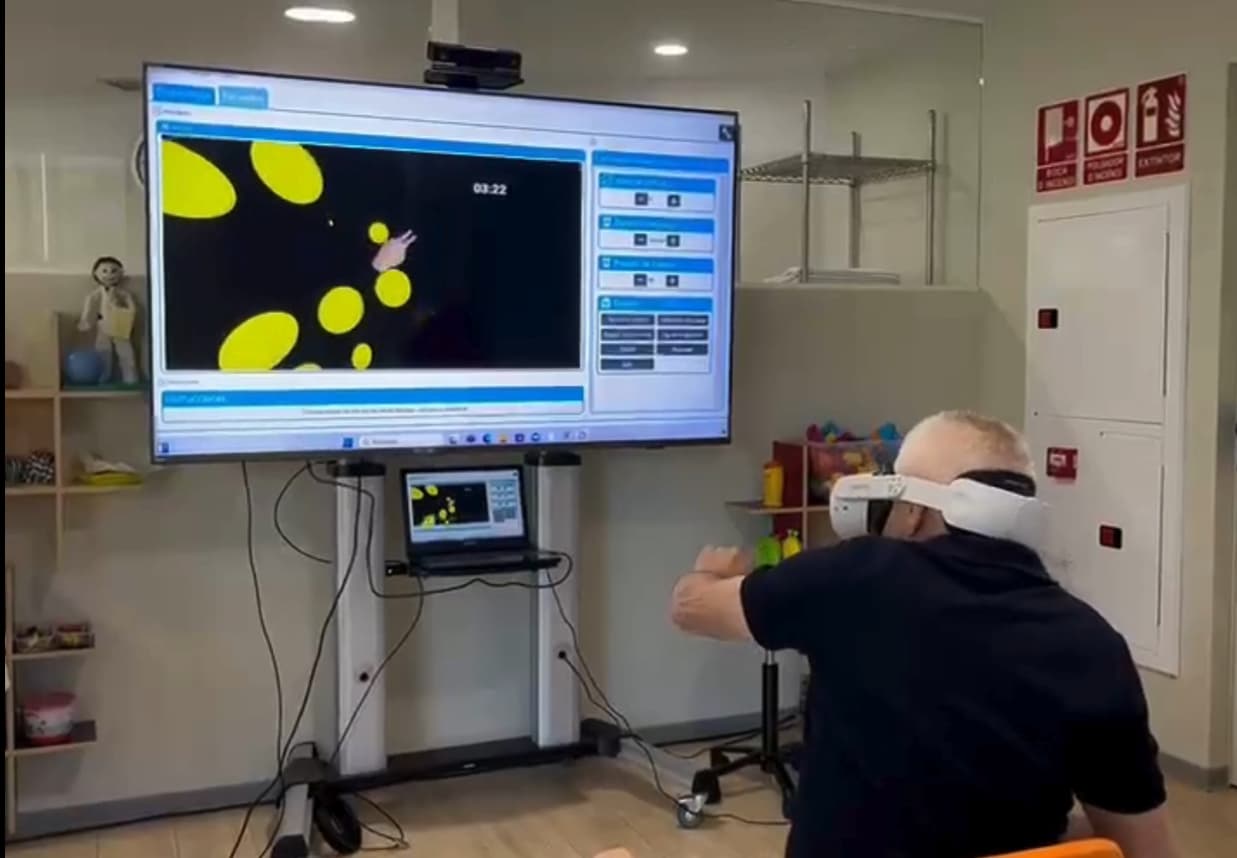
A mirrored screen so the family can watch the session
More than 70 activities on Meta Quest, with mixed reality for the first sessions and control from the therapist's computer.
View module →
Progress, on a sheet you can hand over
Every session is recorded and the report is generated at the end, ready for the patient, the family or the referring doctor.
View reports →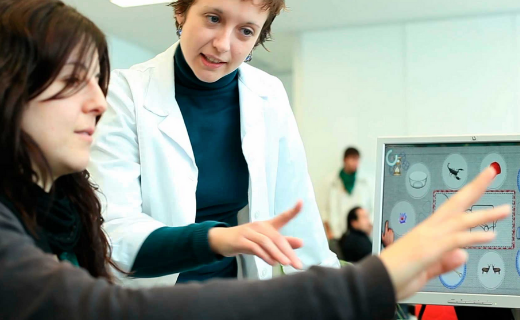
On a tablet or whiteboard, with the professional alongside
More than 190 exercises with difficulty matched to each person and a record of every response.
View module →Frequently asked questions
When explaining digital rehabilitation to patients, what should come first?
That the exercises take the form of an activity so they get repeated more often and better, that behind each one there is an objective the professional has chosen for them, and that the therapist is still in the room deciding and adjusting. That covers the two most frequent doubts: whether it is a game and whether it replaces the therapist.
Do older people take to virtual reality?
The 2023 review with 1,853 adults over 60 found that most described the experience as enjoyable and wanted to do it again, with small motion sickness symptoms in healthy people and moderate ones in those with a neurological condition. Experience in care homes and day centres points the same way; acceptance depends more on how it is presented and supported than on age.
What do families want to know?
Whether the treatment is serious, whether there will still be a therapist, whether it is doing any good, and what happens to the data. The progress report answers the third with evidence, and written information about the product and the data answers the fourth.
Can a relative watch a session with the headset?
Yes, where the system has a mirrored screen: the therapist's computer shows what the patient sees and the companion can follow along. It is one of the simplest ways for the family to understand what is being worked on.
Does the technology replace the usual therapy?
No; it is added to the session. The professional decides when they use it and with whom, and combines it with conventional exercise, hands-on work and the rest of the treatment. Saying so early reassures anyone who fears losing what they already know.
What should be in writing?
A brief explanation of what technology is used and who supervises it, the information about what data is collected and how it is processed, and, where headsets are used, the information about their use. The specific content is set by each centre with its data protection officer and its clinical team.
Want material to explain it in your centre?
We will show you how other centres present the technology to patients and families, what they put on their website and in their welcome pack, and we will give you the product and data information you need for yours.