
Virtual reality for the upper limb after stroke: what the recent evidence shows and what changes in the session
The arm and the hand are the part of recovery after a stroke that resists most, and also the area where virtual reality has been most researched in recent years. We review what the reviews published since 2022 say, what a trial carried out in a Spanish hospital with our platform found, and what changes, in practice, when part of the upper limb work is done with a task that instructs and records by itself.
Why the upper limb is the hardest part
Anyone working in neurorehabilitation knows it well: gait usually recovers sooner and better than the arm, and within the arm, the hand comes last. Upper limb hemiparesis persists in a high proportion of patients months after the stroke, and its impact on daily life (dressing, eating, washing, writing) is among the things that weigh most on a person's sense of independence.
Part of the difficulty is biological and part is practical. Fine hand control depends on corticospinal tracts that are easily damaged, and recovery demands an amount of specific, repeated practice that is hard to accumulate in a conventional session, because every assisted movement takes up the therapist's hands and the patient's attention runs out sooner than it does for the legs. It is on that ground — getting more useful practice within the same amount of time — that virtual reality has been most studied.
What the recent reviews show
The general reference is the Cochrane review by Laver and colleagues, updated in 2025, which brings together 190 trials and 7,188 participants with stroke. For the upper limb it distinguishes two situations. When virtual reality replaces another therapy at equal time, the advantage is small (SMD 0.20; low certainty). When it is added to usual therapy — that is, when it increases total practice time — the effect is larger (SMD 0.42; moderate certainty). The authors describe adverse effects as few and mild.
Focusing specifically on the arm and hand, the meta-analysis by Chen, Or and Chen (2022) in the Journal of Medical Internet Research analysed 43 trials with 1,893 participants. Virtual reality as an adjunct to therapeutic exercise improved upper limb motor function measured with Fugl-Meyer (SMD 0.45), range of motion (SMD 1.01) and strength, with more variable results in manual dexterity and spasticity depending on the scale used. One finding worth bearing in mind: they found no evidence that the benefits were maintained once the intervention ended, which suggests the work has to be sustained over time, as with any other exercise modality.
The most recent review is by Xu and colleagues (2025), also in JMIR, which restricted itself to studies published from 2022 onwards (15 papers, 1,243 participants) and looked for which factors were associated with better results. Programmes totalling more than 15 hours, spread over four to six weeks with four or more sessions a week, obtained greater improvements than shorter or less frequent ones, and younger patients responded somewhat better. By contrast, the design of the virtual reality content (number of features, personalisation, progressive difficulty) made no significant difference between studies. This is a reading across studies, not a prescription, and each team will translate it to their own context as they see fit.
A trial in a Spanish hospital with Rehametrics
The reviews mix very different systems, from commercial video games to clinical platforms, so it is worth seeing what happens with one specific system in a nearby setting. Rodríguez-Hernández and colleagues (2021), from the University of Castilla-La Mancha, published in Brain Sciences a randomised controlled trial with 43 patients in the subacute phase (around 55 days after the stroke) treated at the Hospital General Universitario de Talavera de la Reina.
Both groups received the same amount of therapy: 150 minutes daily across 15 sessions over three weeks. The control group did it entirely conventionally, with physiotherapy and occupational therapy. The experimental group replaced 50 of those minutes with rehabilitation-specific virtual reality, within a protocol combining several devices, in which Rehametrics, with camera-based motion capture, took up 30 minutes per session for shoulder, elbow and trunk work.
The upper limb Fugl-Meyer score went from 12.6 to 30.1 in the experimental group and from 12.7 to 24.7 in the control group, with a between-group difference of 5.4 points at the end and 4.2 at three months. Muscle tone measured with the Ashworth scale fell further in the virtual reality group, and reported pain in the affected limb decreased markedly after the intervention. Patients started from severe impairment, with Fugl-Meyer scores of around 12 out of 66.
The limitations are those of a single-centre trial with a small sample, and the comparison was made at equal time, so it does not measure what happens when virtual reality is used to add practice, which is where Cochrane places the larger effect. With those caveats, it is one of the few occasions on which a specific platform has been tested in a Spanish public hospital, with subacute patients and with the scale most teams use.
What changes in the session
Beyond the figures, what explains the results above is a fairly concrete change in how the stretch of the session devoted to the upper limb unfolds. Each team decides how much weight to give it within their way of working; what follows simply describes what happens when the system directs the task.
The instruction is inside the task. The patient sees which object to reach for, in which direction and at what speed, without having to have every repetition explained to them. Counting and correction are immediate: the target is either reached or not, and the patient sees it instantly, which replaces a good part of the therapist's verbal feedback. And repetition stops being monotonous, because each attempt has a context (a game, a simulated everyday task) that holds attention far longer than a cone on a table.
The effect on the therapist is that they stop directing every movement and start observing it. With the task running, they can focus on what the system does not see, such as compensatory shoulder elevation or trunk lean, or attend to another patient while this one accumulates repetitions. Some professionals prefer to maintain hands-on contact throughout the session with certain profiles, and that is as valid a choice as the other.
What the technology does not change is the need for supervision. A systematic review by Karimi and Aminzadeh (2026) on home-based virtual reality for the upper limb after stroke found that, without professional follow-up, results did not outperform conventional exercise at home, whereas programmes with active remote supervision did show favourable results. The authors sum it up by saying that the human factor appears to weigh more than the technology, with the caveat that overall certainty is very low.
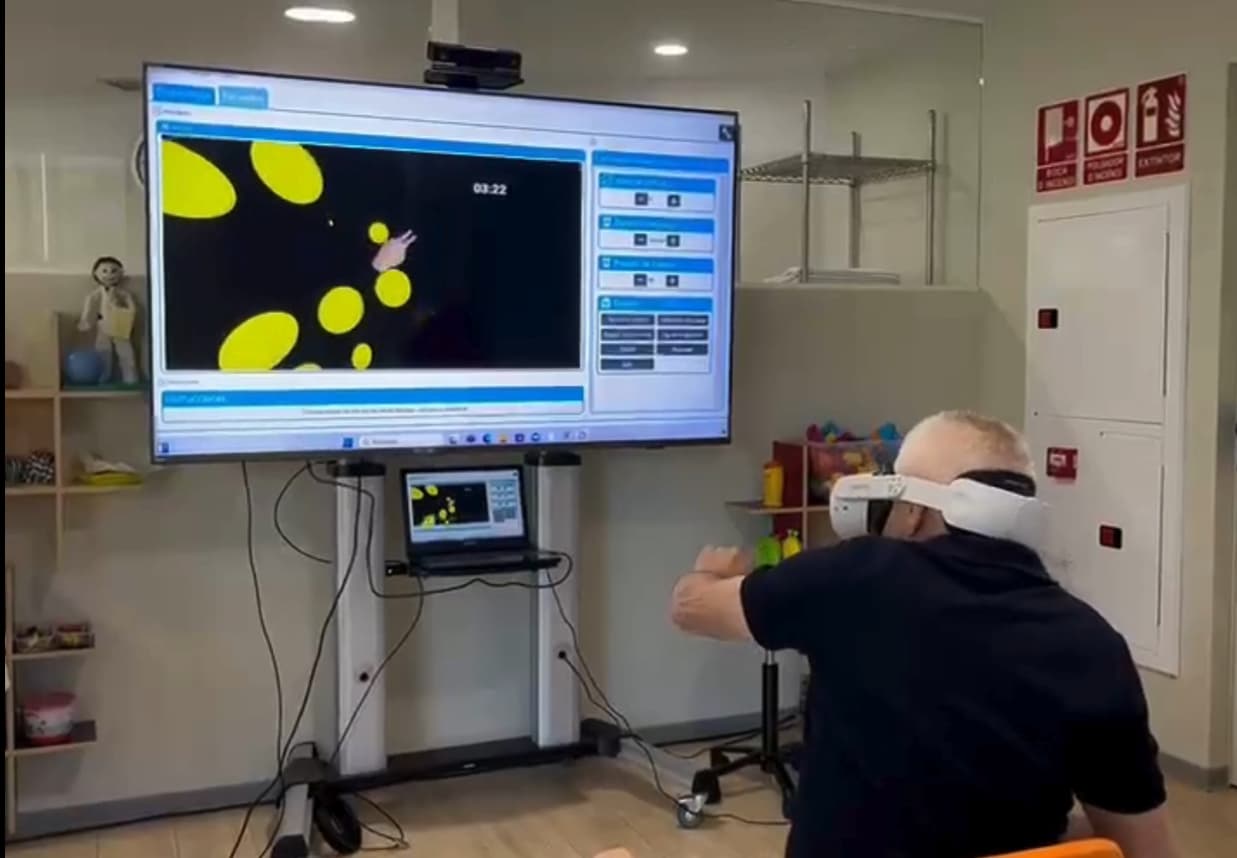
How Rehametrics fits into upper limb work
The platform covers the upper limb with two modules, used according to the segment you want to work on and the type of task.
Rehametrics Physical is the module used in the Talavera trial. Motion capture is done by camera, without body sensors or controllers, so a patient with an affected hand can work on shoulder and elbow reaching without having to grip anything. The professional configures the side, the plane of movement and the range of work, and difficulty adjusts automatically across all exercises based on the patient's success rate. Every repetition is recorded with its movement speed and the range of motion achieved at the shoulder and elbow.
For the hand and activities of daily living, the virtual reality module for occupational therapy offers more than 70 exercises for the upper limb, hand and everyday tasks on Meta Quest 2, 3 and 3S headsets with hand tracking, without controllers or gloves, so that gripping and releasing are done with the real hand. It includes digital versions of two standardised tests, the Box and Block Test and the Nine Hole Peg Test, with which manual dexterity can be assessed in the same environment in which it is trained. There is more detail in the articles on hand rehabilitation exercises with headsets and on fine motor skills with virtual reality.
In both modules, the report is generated automatically at the end, with the repetitions, speed and range for each exercise, without anyone having to transcribe anything. For the patient continuing at home, the headset module allows the programme to be prescribed from the clinic and followed remotely, which is precisely the condition the Karimi and Aminzadeh review associates with better results at home.
What the platform does not do deserves saying too. It does not assess movement quality or detect compensations; the therapist sees that. And it does not decide on its own when to change exercise or objective. On the general evidence for this kind of system in neurological patients there is more in clinical evidence in rehabilitation with immersive virtual reality and in the introduction to the use of virtual reality in stroke patients.
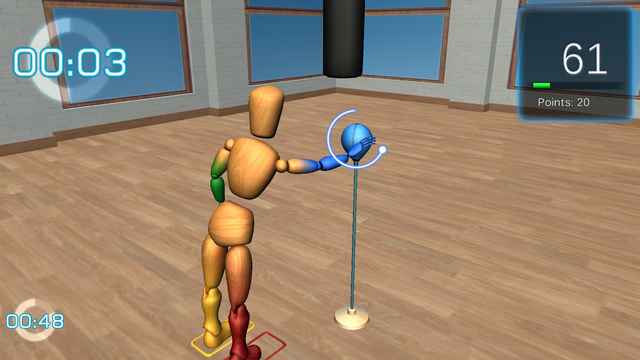
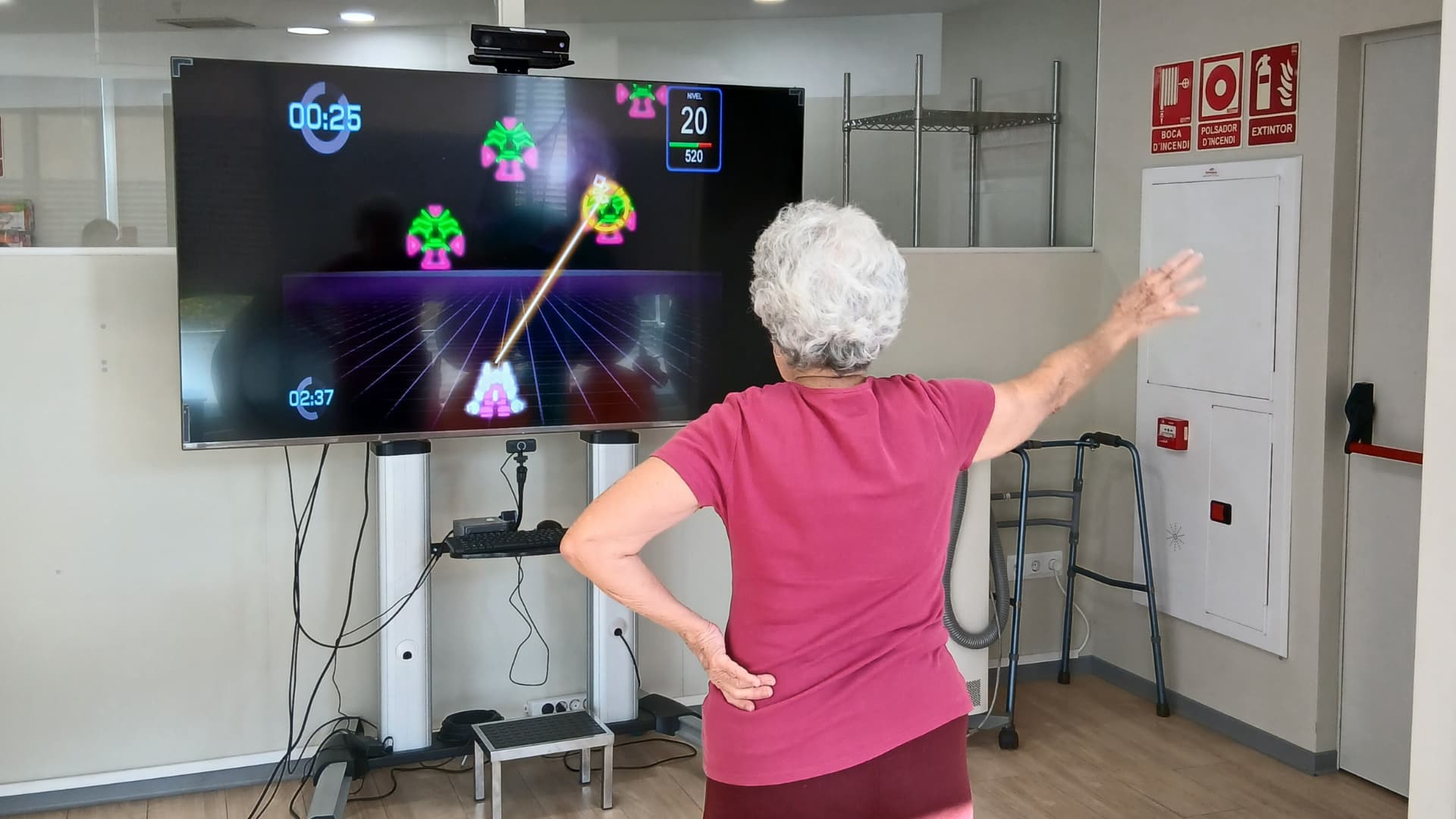
Shoulder and elbow reaching without gripping anything
More than 120 exercises with camera-based capture, range of motion measured at the shoulder and elbow, repetitions counted and difficulty that adjusts itself across all tasks.
View module →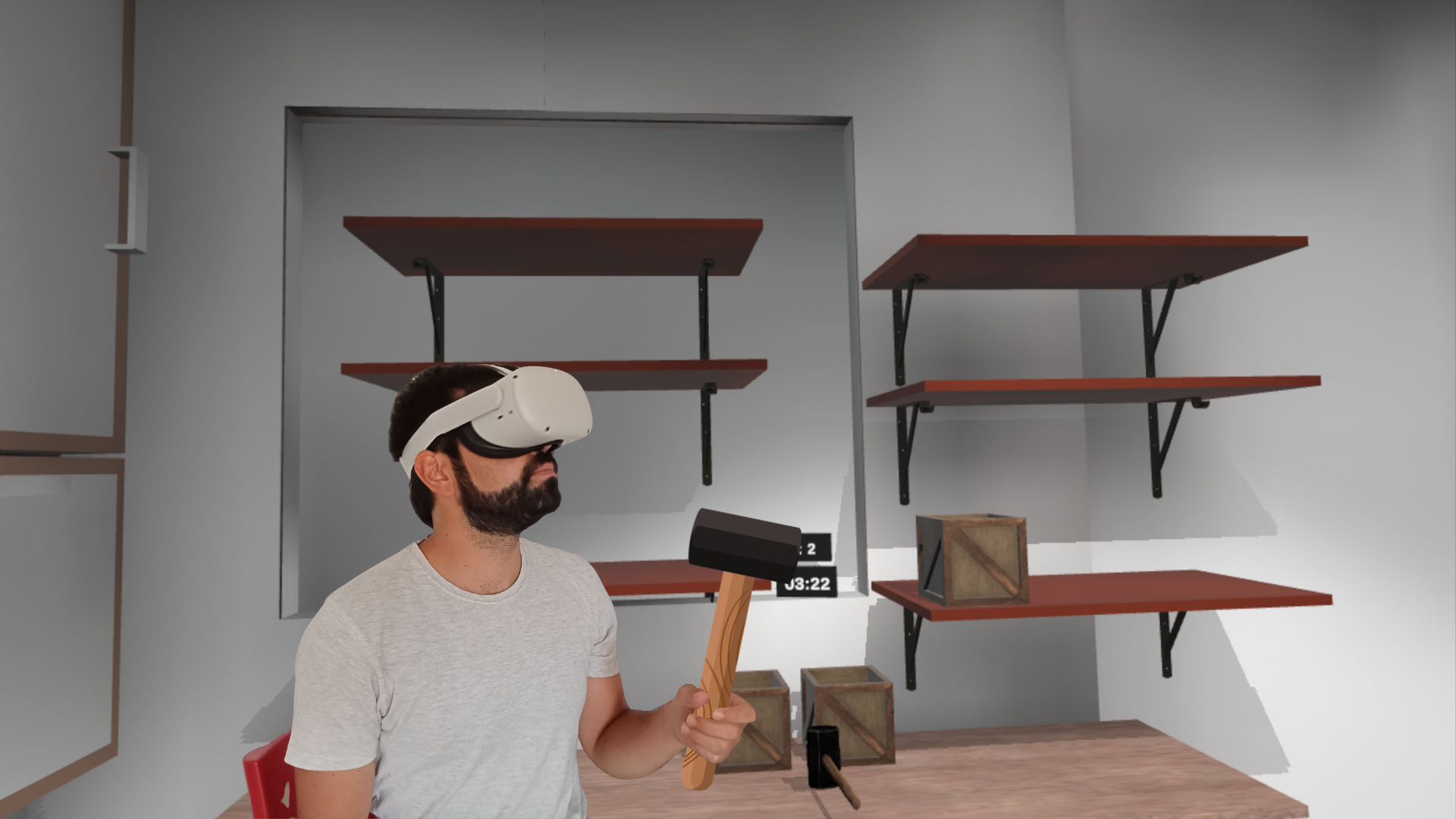
Hand and everyday activities with hand tracking
More than 70 exercises for the upper limb, hand and daily life on Meta Quest, with digital Box and Block and Nine Hole Peg tests and continuity at home.
View module →
The session documents itself
Repetitions, speed and range saved while the patient works, with the report ready at the end without transcribing anything.
View reports →Frequently asked questions
Does virtual reality replace manual therapy for the upper limb?
The 2025 Cochrane review places its greatest effect when it is added to usual therapy, not when it replaces it at equal time. In most centres it works as one stretch of the session, and hands-on work is kept for what the directed task does not cover.
Is it useful in patients with little active movement?
It is also used in early phases and with significant paresis, with direct supervision and the activity configured for that moment: limited range, chosen plane of movement, no speed demand. In the Talavera trial, patients started from an upper limb Fugl-Meyer score of around 12 out of 66.
Are the results maintained once the programme ends?
This is the weakest point in the evidence. The meta-analysis by Chen and colleagues found no evidence that the improvements were maintained after the intervention ended, and in the Talavera trial the between-group difference narrowed from 5.4 to 4.2 points at three months. As with any therapeutic exercise, continuity — in the clinic or at home with follow-up — appears to be the variable that counts most.
Which system was used in the Talavera trial?
A rehabilitation-specific virtual reality protocol combining several devices, among them Rehametrics with camera-based motion capture for 30 minutes per session for shoulder, elbow and trunk. The results correspond to the protocol as a whole, not to a single system.
Can the patient continue at home?
With the headset module, the professional prescribes the programme from the clinic and follows progress remotely. The review by Karimi and Aminzadeh (2026) associates precisely that active remote supervision with favourable results at home, as against programmes without follow-up.
Want to see it with your own patients?
We will show you how an upper limb session is configured in Rehametrics, what is recorded, and how other centres are using it with patients after a stroke.