
Dual-task training in Parkinson's disease: how to train it and how to grade it
Walking while talking, turning while counting backwards, or crossing the room carrying a glass are the situations in which the gait of a person with Parkinson's deteriorates first. Dual-task training works, and recent research backs that up fairly solidly. What the trials do not tell you is how to decide which patient to start with, where to start, and when to raise or lower the demand. This article focuses on that part.
Why dual tasking suffers so much in Parkinson's
In a person without a neurological condition, walking barely consumes any attention. The pattern is automated and the cortex is free to hold a conversation, look at a phone or think about something else. In Parkinson's disease that automation depends on basal ganglia circuits that are precisely the ones affected, and the result is that gait comes to require conscious control it did not need before. While the person is only walking, that control compensates fairly well. When a second task appears that also demands attention, it is usually gait that pays the price.
The phenomenon has a name, dual-task interference, and a fairly simple way of measuring it. You compare gait speed, step length or the time on a Timed Up and Go with and without an added task, and the difference expressed as a percentage is the dual-task cost. The review by Kelly and colleagues (2012) summarises what is known about that cost in Parkinson's: it is greater than in healthy people of the same age, it relates to cognitive status and to balance, and it does not depend on motor severity alone. Two patients with the same score on the motor scale can behave very differently when asked to count backwards while walking.
The clinical relevance goes beyond the figure. Falls and episodes of freezing of gait occur more frequently in dual-task situations — going through a doorway while answering someone, or turning with your hands full — than in the straight-line, silent walking of the physiotherapy room. Training gait in isolation alone prepares the patient for a condition that almost never occurs in real life.
What the evidence says about training it
For years, the reasonable doubt was whether it made sense to train dual tasking at all, or whether, in a patient with limited attentional resources, it was better to automate gait in isolation and avoid distractions. Current data tip the balance towards the former, with caveats.
The starting point is that exercise in general works in Parkinson's. The Cochrane review by Ernst and colleagues, updated in 2024, brought together 154 trials with 7,837 participants, most of them with mild or moderate disease. Training in gait, balance and functional tasks reduced the severity of motor signs by around 7.5 points on the UPDRS-III scale, with moderate confidence, and the authors found few differences between types of exercise. The practical reading is that the modality matters less than the fact that the patient does it regularly.
On dual tasking specifically, the strongest work is the meta-analysis by Johansson and colleagues (2023) in Journal of Neurology. With 11 studies and 597 people, motor-cognitive training improved dual-task gait speed by 0.12 m/s, stride length by around 10 cm, and reduced the dual-task cost on speed by almost 9 percentage points compared with control groups, with high-certainty evidence according to GRADE. It is, as far as we know, the first time it has been systematically demonstrated that people with Parkinson's can improve their dual-tasking capacity, and not just their gait in isolation.
A different question is whether training under dual-task conditions adds anything compared with training gait alone. The meta-analysis by Sarasso and colleagues (2024) directly compared the two options across 14 trials with 548 patients. The advantage of dual-task over single-task training was moderate in size for dual-task gait speed (SMD 0.48), with low certainty, and there were also improvements in dual-task cost and quality of life. Balance confidence, by contrast, did not change. The authors themselves call for more studies to determine which patients respond better, so the result is best taken as a direction rather than a guarantee.
Who to offer it to, and when
The trials cited worked mostly with patients at Hoehn and Yahr stages II and III, able to walk unaided and without relevant cognitive impairment. That is the profile for which the evidence is most direct. Outside it, the decision comes down to the team and to each case, and there are a few factors most physiotherapists take into account, even if they rank them differently.
Cognitive status
Dual tasking requires the patient to understand and hold two instructions at once. With moderate cognitive impairment, the secondary task can become a source of frustration rather than of training. In those cases many teams opt for very simple cognitive tasks (reacting to a stimulus, naming colours) rather than arithmetic or verbal fluency, or go straight to working each component separately first.
Freezing of gait and falls
Freezing is triggered by attentional overload, and a patient who blocks when going through a doorway may also block when a cognitive task is added in the treatment room. Excluding that patient from training is not the usual conclusion; what tends to change is the starting point (sitting or static standing rather than walking), how close the professional stays, and the rate at which demand is increased.
Medication timing
Dual-task performance changes between the ON and OFF phases of medication, and comparing sessions only makes sense if they are done under similar conditions. Noting where in the medication cycle the training takes place, or always booking the patient at the same time of day, avoids attributing to progression what is really a pharmacological effect.
Before the first session it is worth having a baseline measure of dual-task cost using whichever test the centre normally uses. Without that figure, there is no way of knowing afterwards whether the training did what it was meant to do.
How to grade a dual task: four axes
The difficulty of a dual task is not a single variable. You can raise it on the motor side, on the cognitive side, through the instruction given to the patient, or through the environment — and moving two axes at once is the quickest way to lose control of the session. Separating them helps you decide, at each point, which one to touch.
1. The motor axis
From lower to higher demand: cognitive task while sitting, while standing with a wide base, while standing with a narrow base or in single-leg stance, while walking in a straight line, while walking with turns and changes of direction, and finally while walking with obstacles or handling objects. Each step adds postural demand, and a patient can handle the cognitive task perfectly well while standing and lose it completely as soon as they start walking.
2. The cognitive axis
Here progression runs through the type of task, rather than its quantity. Reacting to a visual or auditory stimulus is the simplest. Discriminating (responding only to one colour, not the others) requires inhibition. Holding a sequence and reproducing it adds working memory. Counting backwards in threes or generating words from a category are the tasks that consume the most resources and that most degrade gait in the studies. Within each type, the rate at which stimuli appear is the second dial.
3. The priority instruction
This axis is often forgotten and it changes the result considerably. The patient can be asked to prioritise gait (keep your stride even if you miss some answers), to prioritise the cognitive task, or to try to do both as well as possible. Each instruction trains something different, and in real life the person needs to be able to shift priority according to the situation. Starting by prioritising gait is usually the safest option; introducing variable priority afterwards is what most closely resembles crossing a street while someone is talking to you.
4. The environment
A quiet room with the professional alongside is the easiest condition. Adding visual distractors, noise, other people moving around or time pressure brings the task closer to the street. It is the last axis to be raised, and in many patients it is never fully raised in the clinic; that stretch is worked on at home or outdoors.
As for when to move up, there is no threshold everyone accepts. One rule used by quite a few teams is to progress on an axis when the patient sustains performance on both tasks steadily across two or three consecutive sessions, with no warning signs. Others prefer to set a success rate on the cognitive task, or a dual-task cost below a certain value. Either is defensible; what matters is having decided before starting and applying it the same way in every session.

Training the two tasks together or separately
There is a long-running discussion about whether dual tasking should be trained as such (gait and cognitive task at the same time) or whether the same result is obtained by training each component separately. The DUALITY trial, by Strouwen and colleagues (2017), published in Movement Disorders, is the best available answer. One hundred and twenty-one patients at stages II and III were assigned to six weeks of home-based training led by physiotherapists, one group in integrated form and the other in consecutive form.
Both groups improved dual-task gait speed by between 7.75% and 13.44% relative to baseline, both on the trained tasks and on new ones, and maintained the improvement at twelve weeks. There were no relevant differences between the two methods, and fall risk did not change in either. For the physiotherapist, that has a welcome practical consequence: the choice between integrated and consecutive can be made on patient tolerance and session organisation, not on effectiveness.
In practice, many teams start in consecutive form with patients who block or who become anxious faced with the combined task, and move to the integrated form as soon as each component is established. With patients at early stages and good cognitive status, most go straight into the integrated mode. Some professionals prefer always to keep a stretch of separate work — cognitive work while seated at the start of the session, for instance — and there are no strong arguments against it.
How Rehametrics fits into this training
The four axes above are, at bottom, parameters you need to be able to move one at a time without rebuilding the session. That is why dual tasking sits well with a platform that lets you configure them and that records what happened on each attempt.
In Rehametrics Physical, camera-based motion capture, without sensors or controllers, makes it possible to work on balance and stepping exercises with a cognitive load built into the task itself: reacting to stimuli, discriminating targets, following sequences. The professional sets the base of support, the side and the range of work, and difficulty adjusts automatically across all exercises based on the patient's success rate. That adjustment moves within the limits the physiotherapist has set; changing exercise or moving up a step on the motor axis is a decision for the professional. In balance exercises, the platform records centre of gravity and base of support, as well as repetitions and movement speed, which makes it possible to see whether adding the cognitive task has made the patient sway more or load asymmetrically.
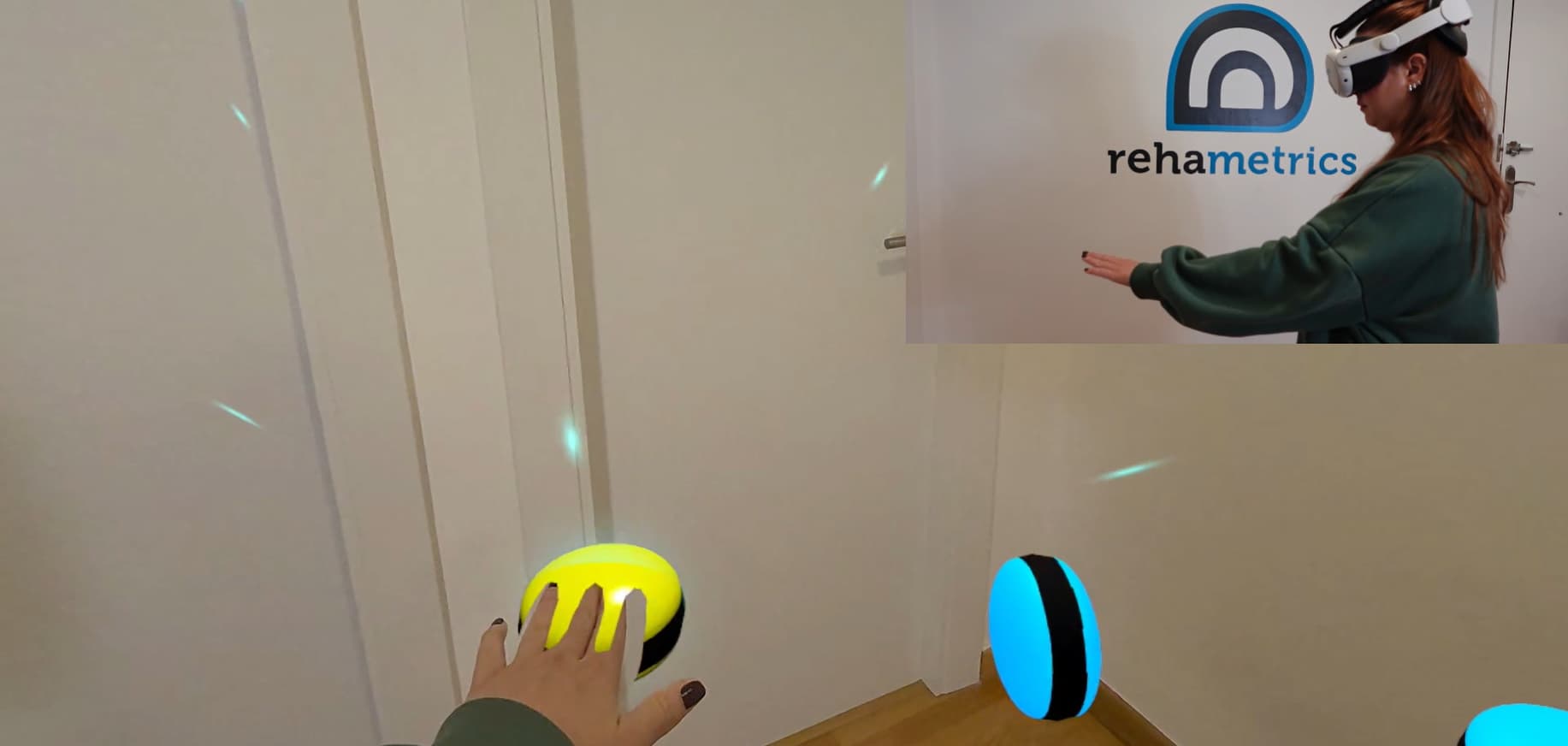
The immersive virtual reality module includes a family of dual tasks designed precisely for this work. Reaction lights with stepping asks the patient to react to stimuli while maintaining balance or moving. Hanging out the washing combines bimanual coordination with divided attention. Cognitive volleyball trains head control while the person responds to external stimuli, and there are others focused on working memory, categorisation or praxis. All of them run on Meta Quest 2, 3 and 3S headsets with hand tracking, without controllers, and the mirror screen lets the physiotherapist follow what the patient sees from outside. There is one figure worth knowing about this kind of system: in the meta-analysis by Sarasso and colleagues (2022) on virtual reality balance training in Parkinson's, 22 trials and 901 patients, the advantage over conventional training (around 2 points on the Berg Balance Scale, low certainty) was greater with systems designed specifically for rehabilitation than with commercial video games, and greater too in patients with more instability at baseline. The effects were not maintained at follow-up, which suggests the training has to be sustained over time.
When the team opts for the consecutive form, the cognitive component can be worked separately in Rehametrics Cognitive, which covers attention, working memory, processing speed and executive functions with recording of correct answers, errors and response time. Having both components on the same platform makes it easier to move from one format to the other without changing tool or patient history.
One clarification on the division of labour. The dual-task cost on gait is still obtained with whichever clinical test the centre uses, in a corridor and with a stopwatch; it is not a value the platform calculates. What it does provide is the record of each training session (which exercise, with which parameters, with what success rate and with what balance behaviour), which is the data that lets you apply whichever progression rule you have set and generate the physiotherapy report automatically at the end of each block.
Anyone looking for a more general introduction to managing Parkinson's with the platform can read Parkinson's disease: rehabilitation exercises, and for a description of dual-task formats outside any specific condition there is the article on examples of motor-motor and cognitive-motor tasks. On the relationship between attention and motor control, in any patient, there is more in Cognition and movement.
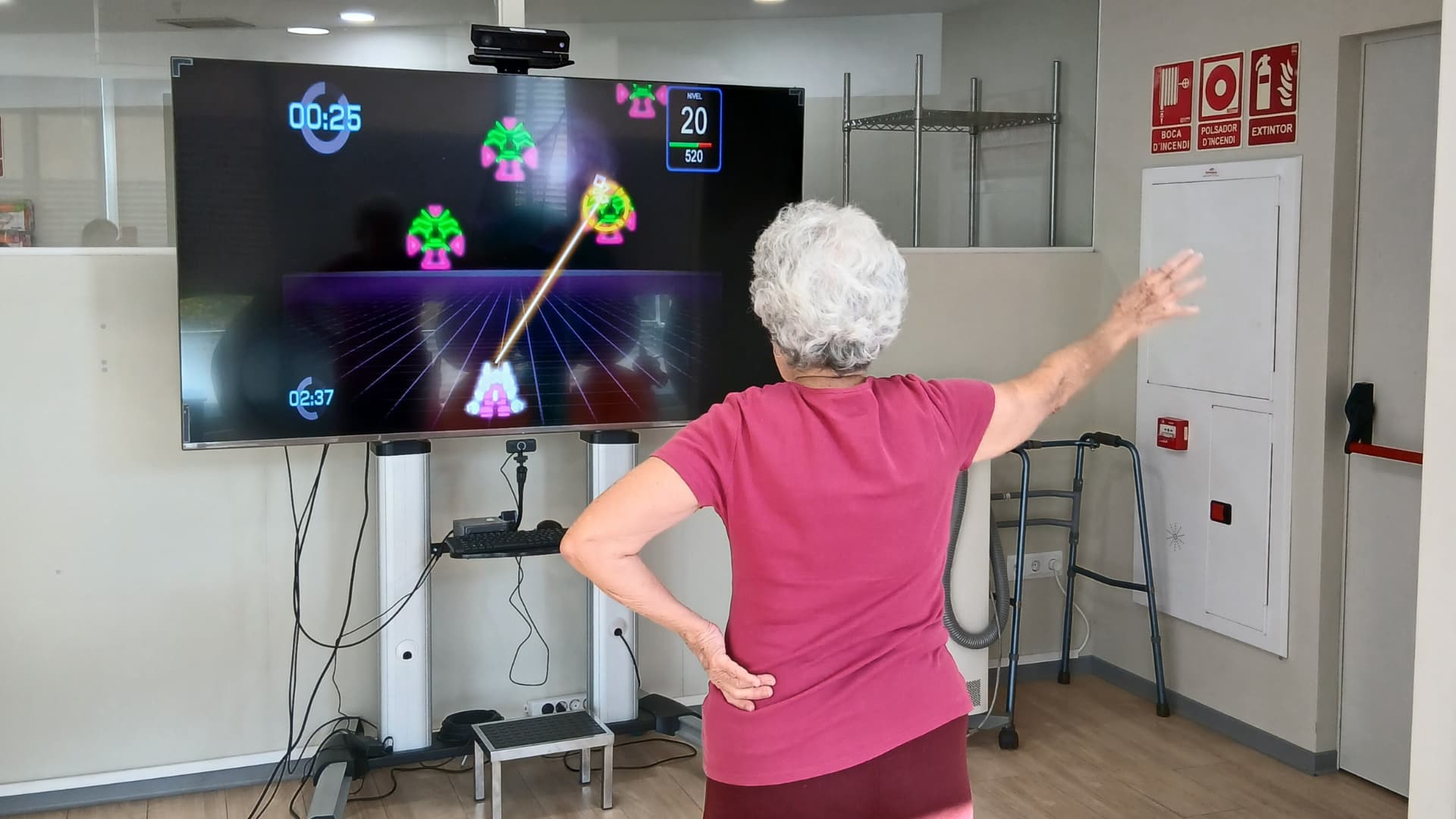
Balance with cognitive load and centre of gravity recording
More than 120 exercises with camera-based capture, configurable base of support and range, and difficulty that adjusts itself across all tasks.
View module →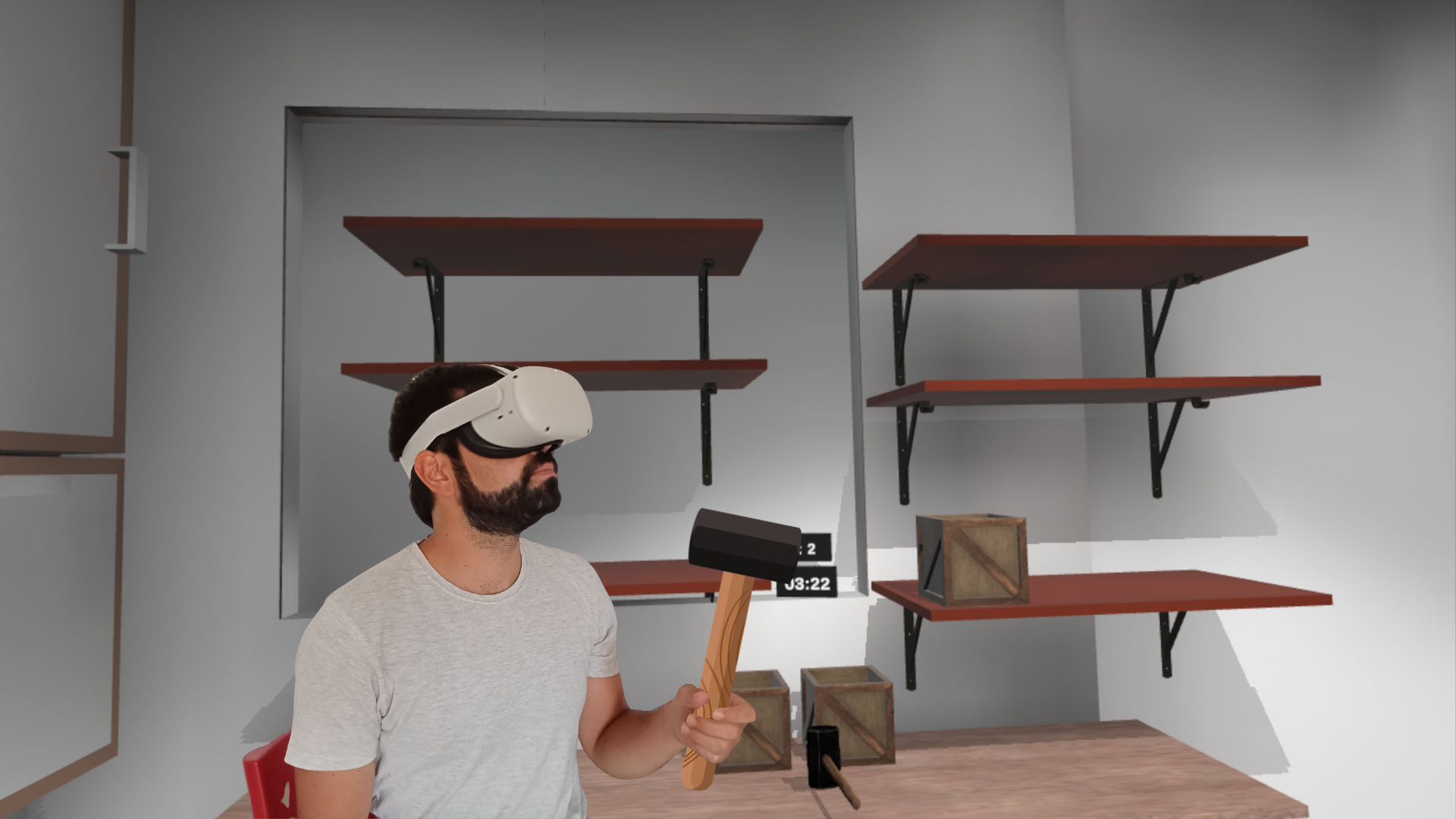
Dual tasks in immersive environments
More than 70 activities on Meta Quest 2, 3 and 3S with hand tracking, among them reaction lights with stepping, hanging out the washing and cognitive volleyball.
View dual tasks →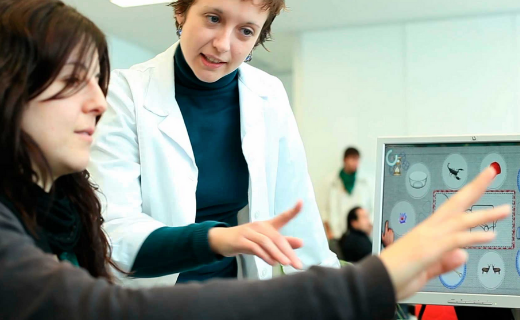
The cognitive component on its own
More than 190 exercises in attention, working memory, processing speed and executive functions, with correct answers, errors and response time recorded.
View module →Frequently asked questions
Does dual tasking increase fall risk during the session?
In the trials that measured it, such as DUALITY, fall risk did not increase with dual-task training. That refers to programmes supervised by physiotherapists and with patients at stages II and III; in people with freezing or previous falls, direct supervision and a more conservative starting point (sitting, static standing) are the usual practice.
Is it better to train gait and cognitive task together or separately?
On the DUALITY data, both forms achieved similar improvements in dual-task gait speed, maintained at twelve weeks. The choice can be made according to the patient's tolerance and how the session is organised, and many teams start in consecutive form with those who block and move to the integrated form afterwards.
Which cognitive task is best to use at the start?
Simple reaction to a visual or auditory stimulus consumes the fewest resources and lets you see how the patient responds without overloading them. Discrimination, working memory and arithmetic or verbal fluency are introduced later, in roughly that order, although each person's cognitive status may alter the sequence.
How do you know whether the training is working?
By comparing the dual-task cost (the percentage difference between walking with and without an added task) at the start and after a few weeks, with the same test and at the same point in the medication cycle. Within sessions, the record of success rate and balance behaviour in each exercise indicates whether the patient tolerates the current step or whether it needs adjusting.
Is it useful in patients with cognitive impairment?
The most direct evidence comes from patients without relevant impairment. With mild impairment, simplifying the cognitive task and keeping the motor axis low tends to work; with moderate impairment, the decision depends heavily on the case and the team, and working each component separately may be the more realistic option.
Want to see it with your own patients?
We will show you how dual tasks are configured in the Physical and virtual reality modules, what is recorded in each session, and how other centres are using it with Parkinson's patients.