
Computerised cognitive training in mild cognitive impairment: what the recent evidence shows
Computerised cognitive training in mild cognitive impairment has been researched more thoroughly than at any other stage of cognitive decline, and several meta-analyses published in the past four years now give a fairly clear picture of what it contributes and of what is still unproven. We review that work, the role the research itself attributes to the professional who supervises, and what changes in the clinic or the care home when the training is done on a platform that records every session.
Why mild cognitive impairment attracts so much research
Computerised cognitive training in mild cognitive impairment is one of the most researched non-pharmacological interventions of the past decade, and the reason has to do with the uncomfortable position this stage occupies: there is a measurable decline in one or several functions, the person keeps their independence in the essentials, and some of those affected will progress to dementia while others will stay stable for years or even improve. With no drug treatment that clearly modifies that course, non-pharmacological interventions have moved to the centre of clinical interest, and among them computerised cognitive training is the one that has accumulated the most trials.
The reasons are practical. A digital programme makes it possible to match difficulty to each person's performance, to present many trials in a short time, to record exactly what has been done and to repeat it in the clinic, in the care home or at home. That ease of standardising the intervention is also what has made possible the controlled trials summarised below.
What the recent meta-analyses show
The most current work is that of Guan and colleagues (2026), published in the Journal of Neurology. It brings together 30 randomised controlled trials with 2,056 participants with mild cognitive impairment and finds a moderate improvement in global cognition compared with control groups (SMD 0.62; 95% CI 0.43-0.81). The most striking finding is in the subgroup analyses: the length of each session, the device used, the total duration of the programme and the weekly frequency produced similar improvements, with no statistically significant differences between formats. The authors read this as a sign that the benefit is consistent and does not depend on one particular protocol, though they warn of high heterogeneity between studies.
That result is consistent with the earlier meta-analysis by Li and colleagues (2022) in the Journal of Medical Internet Research, with 18 trials and 1,059 participants, which found an effect of the same order on global cognition (SMD 0.54) and more modest improvements in specific domains. That work already noted that samples were small and interventions short, and called for longer trials before recommending the training generally.
For anyone working with memory as the main objective, the meta-analysis by Chan and colleagues (2024) in npj Digital Medicine is the most specific. Across 35 studies, in which 1,489 participants had mild cognitive impairment, it observed improvements in verbal memory (SMD 0.55), visual memory (0.36) and working memory (0.37), with moderate certainty. In people with established dementia (371 participants), only verbal memory improved, and with low certainty.
Where the evidence is still weak
The limits deserve to be set out just as clearly. The first is the time frame: most trials last between a few weeks and a few months, and few follow participants beyond that. Whether the improvement in global cognition translates into a real delay in progression to dementia is not established, and none of the three meta-analyses claims it does.
The second is transfer. Improving on a neuropsychological test does not necessarily mean coping better with everyday tasks, and studies that measure activities of daily living are a minority. The third is heterogeneity: under the label of computerised cognitive training sit programmes that differ widely in content, dose and degree of support, which makes it hard to know which part of the effect is due to what. And the fourth is the quality of the measures: some trials assess with tests very similar to the tasks trained, which tends to inflate the result.
None of this invalidates the above. It means that the defensible claim today is that computerised cognitive training improves global cognitive performance in mild cognitive impairment while it is sustained, and that its long-term effects and its effects on daily life are an open question.
What the studies say about the professional's role
There is one result in the meta-analysis by Chan and colleagues that deserves a section of its own, because it answers a question teams ask often. When they separated supervised programmes from those the person did on their own, the differences were striking. With supervision, verbal memory improved with an SMD of 0.72, visual memory with 0.51 and working memory with 0.33. Without supervision, only verbal memory improved, and with a far smaller effect (0.21). The authors conclude that the unsupervised format has its place, because it allows training at home without consuming healthcare resources, but that professional support multiplies the effect.
A qualitative study by Zhang and colleagues (2025), also in JMIR, helps explain why. They followed 19 older adults with mild cognitive impairment for a month as they used a digital programme without ongoing support, and most did not complete the intended dose. The reasons they gave in interviews were that the training felt confusing, that it did not match their prior idea of what training your memory meant, that they did not perceive any short-term benefit, and that they experienced family pressure as a reason to avoid it rather than to continue.
Read together, the two pieces of work suggest that much of the value of computerised cognitive training lies with whoever accompanies it: someone who explains what each task is for, who adjusts what is not working and who helps the person see their own progress. The platform is the means, and the professional decides, as they always have, what is worked on, with whom and towards what goal.
What changes in the clinic and in the care home
Effect sizes aside, working with a platform changes some concrete things in day-to-day practice, and each team will judge how much those matter to them.
The first is the record. Every exercise leaves a trace of correct answers, errors and response time, and that information accumulates session after session without anyone having to write it down. For the neuropsychologist, that makes it possible to see a trend (whether processing speed is improving, whether errors caused by distractors are falling) instead of relying on the impression of one session or on a single test every few months. There is more on this in the article on the automatic neuropsychological report.
The second is the difficulty adjustment. The programme raises or lowers it according to performance, so that the person works on tasks they can solve with effort. The meta-analyses do not allow the effect to be attributed to this mechanism specifically, but it is one of the most frequently cited differences from paper worksheets, discussed in more detail in what a platform offers compared with paper.
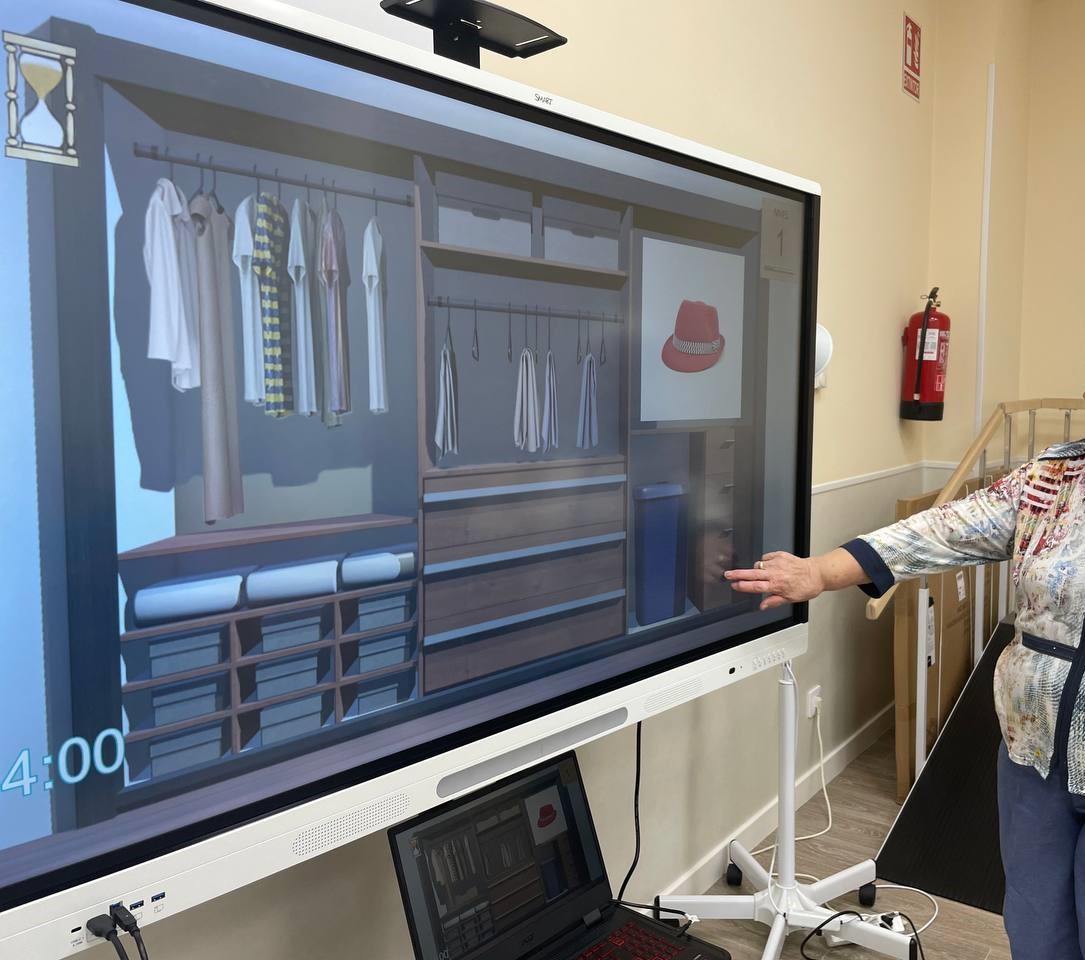
The third has to do with the care home. When several people work at once on tablets or on an interactive whiteboard, the professional can attend to the group and still review each person's individual performance afterwards, something that with paper material means marking by hand. And the fourth is the middle position between the two formats in the studies above: a programme the person does with a degree of autonomy, in the day room or between sessions, but whose record the professional reviews afterwards.
How Rehametrics Cognitive fits in
Rehametrics Cognitive is the platform's cognitive stimulation module, with more than 190 exercises covering attention, memory, working memory, processing speed, language and executive function. Each exercise records correct answers, errors (classified by stimulus type and number of distractors) and response time, and difficulty adjusts automatically to the person's performance within the parameters the professional has set.
The module includes specific protocols for older adults and for cognitive impairment, which serve as a starting point for each person. It runs on tablets and on interactive whiteboards, which allows both the individual session in the clinic and group work in a care home, and it generates printable reports with each person's progress over time. More than 75 care homes in Spain use it, among them publicly run centres in several autonomous regions.
What the module does not do is worth saying too. It does not diagnose and does not replace neuropsychological assessment: the record of correct answers, errors and times describes performance on the tasks trained, not the person's cognitive status, and the interpretation belongs to the professional. Nor does it guarantee that improvements transfer to daily life, which is precisely the part the research has not yet resolved. For concrete examples of tasks, the articles on executive function exercises and on the module's memory exercises describe several of them.


Six domains with a record of every exercise
More than 190 exercises in attention, memory, working memory, processing speed, language and executive function, with difficulty that adjusts itself.
View module →
Progress, session after session
Correct answers, errors and response times saved while the person works, with the printable report ready at the end.
View reports →
Protocols for the clinic and the care home
Specific protocols for older adults and cognitive impairment, on tablet or interactive whiteboard, for individual or group work.
View clinical use →Frequently asked questions
Does computerised cognitive training delay dementia?
What the recent meta-analyses show is an improvement in global cognition in people with mild cognitive impairment for as long as the training lasts. That this delays progression to dementia is not established, because almost no trial follows participants for long enough to know.
Does the type of programme or the length of the sessions matter?
In the meta-analysis by Guan and colleagues (2026), session length, device, total duration and weekly frequency produced similar improvements, with no significant differences between subgroups. That suggests the benefit does not depend on one particular format, though the heterogeneity between studies calls for caution in interpreting it.
Is it useful if the person does it alone at home?
In the meta-analysis by Chan and colleagues, unsupervised programmes showed an improvement only in verbal memory and of small size, against larger improvements across more domains with supervision. The authors themselves position the autonomous format as a complement, with the professional reviewing what the person has done, and not as a substitute for supported work.
Does it also work in established dementia?
The evidence is far more limited. Among the 371 participants with dementia in the meta-analysis by Chan and colleagues, only verbal memory improved, and with low certainty. Most teams approach training at that stage with different objectives, oriented more towards maintenance and participation than towards improving performance.
What does the platform actually measure?
Correct answers, errors by stimulus type and number of distractors, and response time in each exercise, with progress across sessions. It is a measure of performance on the tasks trained, not a neuropsychological assessment, which is for the professional to carry out with their own tests.
Want to see it with your own patients?
We will show you the Rehametrics cognitive impairment protocols, what gets recorded in each session, and how clinics and care homes with a similar profile to yours are using it.