
Virtual reality in paediatric rehabilitation: clinical applications and use of digital platforms
The incorporation of virtual reality in paediatric rehabilitation responds to a specific clinical need: to increase intensity, repetition significantly and adherence therapy in children. It is not a question of replacing conventional intervention, but rather to complement it with structured and measurable tools.
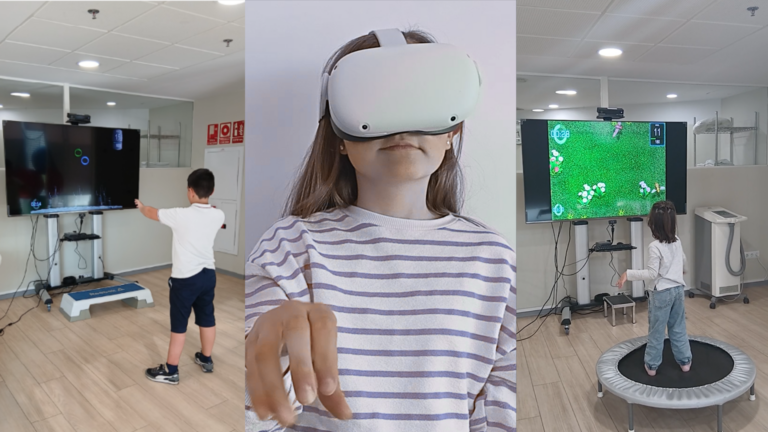
Table of contents
Why incorporate virtual reality into paediatric rehabilitation?
Clinical basis
The developing brain exhibits high plasticity dependent on experience. Virtual reality allows:
-
Intensive task-oriented repetition
-
Immediate feedback
-
Progressive difficulty adjustment
-
Greater active involvement of the child
When it is well indicated, it can facilitate motor and cognitive learning in controlled environments.
Motivation and adherence to treatment
Children respond better to structured play environments than to conventional repetitive tasks. Well-designed gamification increases:
-
Active participation
-
Effective working time
-
Tolerance for frustration
However, motivation should not be the primary objective, but rather a means to increase therapeutic intensity.
Clinical applications of virtual reality in children
Cerebral palsy in children
In cerebral palsy, virtual reality is primarily used to increase the intensity of motor training in function-oriented tasks. Its most common applications include:
-
Upper limb reaching and manipulation training
-
Postural control training in sitting and standing positions
-
Dynamic balance training
-
Hand–eye coordination
The virtual environment allows the difficulty to be adjusted in real time (range of motion, speed, required precision), encouraging structured repetition without losing motivation. It is particularly useful in intensive therapy programmes.
Acquired Brain Injuries
Following traumatic brain injury, brain tumours, or central nervous system infections, virtual reality can be integrated in the subacute and chronic phases to:
-
Retraining of motor patterns that have been altered
-
Bilateral coordination training
-
Improvement of sustained attention during functional tasks
-
Processing speed training
The possibility of recording objective metrics facilitates the monitoring of recovery and the making of therapeutic decisions.
Developmental disorders and motor coordination difficulties
In individuals with attentional difficulties or impaired executive functions, some platforms allow cognitive demands to be integrated into motor tasks, targeting:
-
Sustained Attention
-
Inhibition of impulsive responses
-
Basic cognitive flexibility
-
Working memory in a functional context
This combined motor-cognitive approach can be useful in interdisciplinary intervention, provided that the design of the task is clinically justified.
Cognitive rehabilitation in children
In children with balance impairments, proximal weakness, or gait disturbances, virtual reality can be used to:
-
Training in transferring weight
-
Balance reactions training
-
Anticipatory postural adjustments
-
Work in simulated environments with progressive demands
The main advantage is the possibility of adjusting the challenge without constantly modifying the physical environment.
Clinical digital platforms: what professionals should require
Not every technological tool is a valid healthcare resource. Professionals must assess:
It is not the same thing to use a a5> commercial video game versus a clinical tool such as Rehametrics. A clinical platform should allow:
-
Control of therapeutic parameters
-
Registration of data
-
Individual adaptation
-
Professional supervision
The use of commercial devices without a clinical framework may limit effectiveness and safety.
Customization based on functional goals
Intervention should be based on measurable goals: functional reach, postural stability, attentional improvement, etc. Technology must adapt to the therapeutic plan, not the other way around.
Metrics tracking and monitoring
One of the main contributions of digital platforms is quantification:
-
Active time
-
Precision
-
Speed
-
Number of repetitions
This facilitates clinical decision-making and communication with the interdisciplinary team.
Motor rehabilitation and postural control
In combined programs, virtual reality can complement motor training, while clinical platforms enable standardized measurement of balance, postural control, and functional outcomes.
Conclusion
Virtual reality in paediatric rehabilitation should not be seen as a sophisticated entertainment tool, but as a therapeutic resource that, when properly indicated, can increase intensity, precision, and adherence.
Its clinical value depends on:
-
Healthcare-oriented platform design
-
Integration within the therapeutic plan
-
Professional supervision
-
Appropriate patient selection
In this context, technology does not replace professionals. It enhances their work when used with clinical judgement.
Frequently Asked Questions
Current evidence suggests that virtual reality can improve therapeutic intensity, adherence, and certain functional outcomes in children, especially those with cerebral palsy and acquired brain injury. Its effectiveness depends on correct clinical indication and integration into a structured therapeutic plan.
It is used mainly in:
Cerebral palsy in children
Acquired Brain Injuries
Developmental coordination disorders
Attentional impairments and executive function difficulties
The indication should be individualized and supervised by a specialized healthcare professional.
No. Virtual reality is a complementary tool. It does not replace functional assessment, manual intervention, or clinical reasoning. For this reason, it is important to have a programme of virtual reality virtual that is a product of healthcare and is used exclusively in clinical contexts. Its objective is to increase reproducibility significantly and improve the monitoring of results.
A clinical platform enables:
Setting of therapeutic goals
Adjustment of difficulty parameters
Recording of objective metrics
Monitoring of the progress of the patient
Professional supervision
Commercial video games are not designed with health criteria in mind, nor do they allow for structured therapeutic control. a7> allow for structured therapeutic control.
In general, yes, provided it is used under professional supervision and with control over the duration of sessions and sensory load. It is important to assess cases with photosensitive epilepsy, sensory hypersensitivity, or significant attention difficulties. In addition, virtual reality allows us to work on various functional and analytical tasks in a controlled clinical environment.
In paediatric rehabilitation, it is not recommended to choose only "virtual reality headset", but rather assess the entire system: hardware, clinical software and capacity for monitoring.
It is important that:
The device should be safe and ergonomic for use by children.
Allow control intensity and stimuli.
Include configurable therapeutic targets.
Record clinical objective metrics.
Allows professional supervision.
Some centres combine commercial devices with specific clinical platforms. There are also solutions designed for healthcare environments, such as Rehametrics, which integrate virtual environments with therapeutic personalisation and structured recording of results in hospitals and specialist centres.
The choice should be based on clinical and functional criteria, not solely on technological ones.
Yes, Rehametrics can be used with children provided there is an appropriate clinical indication and professional supervision.
The platform allows adapting the tasks according to:
Age and developmental level (Rehametrics can be used from approximately 4 years of age)
Motor or cognitive profile
Individualized functional goals
Progressive level of difficulty
Furthermore, it enables the recording of objective metrics and the monitoring of progress, which facilitates its integration into hospital environments and interdisciplinary teams.
As in any intervention involving technology in paediatrics, it is necessary to adjust the duration of the sessions and the sensory load to the specific characteristics of each child. a15> each child.
The indication must be based on clinical criteria, not solely technological.
Yes, virtual reality can be used with children in therapy, provided there is an appropriate clinical indication and professional supervision.
In the field of paediatric rehabilitation, it is used as a complementary tool for:
Increase the intensity and repetition of functional tasks
Improve motivation and adherence to therapy
Facilitate immediate feedback during motor or cognitive learning.
Its use must be adapted to the child's age, level of development and sensory profile. It is essential to control the duration of sessions and visual and auditory stimuli, especially in cases of sensory hypersensitivity or a history of photosensitive epilepsy.
Virtual reality does not replace conventional intervention, but rather complements it within a structured therapeutic plan.