
Rehabilitation Technology in Addressing Frailty: The Experience of the Mollet Health Foundation
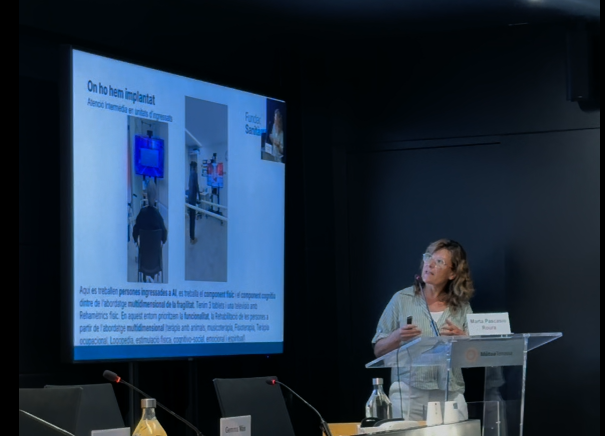
During the First Conference on Virtual Reality in Rehabilitation, held at MútuaTerrassa University Hospital in April 2026, Marta Pascasio, a physical therapist and coordinator of the rehabilitation department at the Mollet Health Foundation, shared her team’s experience in addressing frailty using various digital rehabilitation tools.
His presentation was based on a very clear idea: in rehabilitation, it is not enough to know what the patient should be doing. The real challenge is getting that person to do it, maintain it over time, and integrate it into their recovery process.
From there, he presented a cross-cutting model in which technology is not incorporated as an isolated element, but rather as part of a broader clinical strategy aimed at improving adherence, addressing different aspects of the individual, and facilitating therapeutic continuity across a wide range of care settings.
Table of contents
Fragility and adherence: the underlying clinical problem
One of the most interesting aspects of the presentation was the way Marta Pascasio defined frailty. She did not limit it solely to the very elderly or those with high levels of dependency, but rather described it as a state of vulnerability that can occur in a wide variety of people.
In his experience, many patients with persistent pain or progressive functional loss are also frail. This frailty is associated with increased pain, greater difficulty moving, loss of functional ability, and even cognitive decline.
That is why the problem is not just what treatment is prescribed, but whether the person actually follows through with it. Pascasio summed it up with an observation that is all too familiar in clinical practice: often, the professional tries to get the patient to work on issues they consider very important, but the patient does not see them in the same light.
“I don’t know if this has ever happened to you: sometimes you want people to work, to do things that you think are very important, but that aren’t important to the patients.”
From this perspective, technology is valuable not because it is novel, but because it can help people become more engaged, stay on track with their treatment, and do what they truly need to do to improve their health.
“We need to change because we need more motivating tools; we need them to be integrated.”
Rehabilitation Technology in Nursing Homes
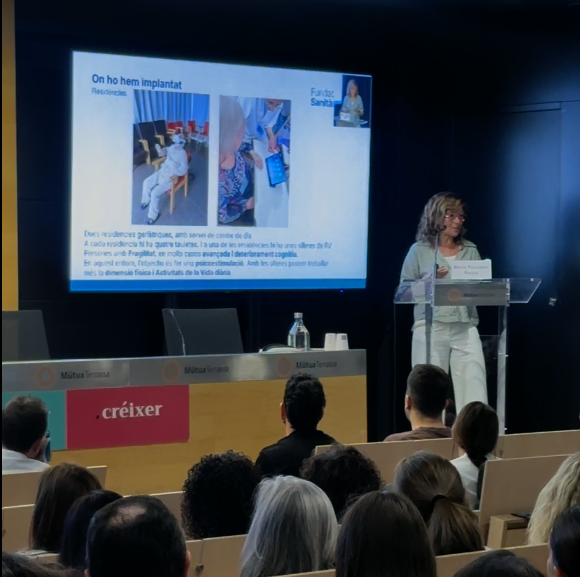
One of the settings where the Mollet Health Foundation team has implemented these tools is in nursing homes. As Marta Pascasio explained, they operate two nursing homes that serve approximately 100 people, including residents and day-care center users.
In these settings, they use tablets running Rehametrics Cognitivo for cognitive stimulation, particularly for individuals with mild or moderate cognitive impairment, and virtual reality with Rehametrics to focus primarily on physical rehabilitation and activities of daily living.
These are individuals who often have advanced frailty, so selecting appropriate goals and tailoring the content are particularly important. Rehabilitation professionals—whether physical therapists, occupational therapists, or psychologists—determine the therapeutic plan and decide what type of exercises each person should perform.
One of the key points highlighted was that this model makes it possible to expand the scope of the intervention. Once the professional has planned the content, the network of volunteers and student interns can help ensure that more people use the tablets and engage in therapeutic activities more frequently.
Virtual Reality at a Center for People with Disabilities
Another highlight of the talk was the section on the center for people with disabilities, where they use virtual reality for a wide range of functional purposes.
Marta Pascasio presented examples of users with relatively good functional ability, capable of performing complex movements during activities, as well as other cases involving much more impaired movement patterns or very limited mobility.
In this context, he emphasized the importance of the professional being able to see on a screen what the person is doing within the virtual environment in order to guide them through the task. This supervision is particularly useful when the user needs ongoing guidance or when their actions are more difficult to interpret.
He also explained something particularly interesting from a clinical perspective: even in patients with severe impairment, responses can emerge that would be much harder to elicit outside of that environment. In one case, a patient who could barely move was able to participate verbally in the activity. For the team, this reinforces the idea that virtual reality can facilitate engagement, elicit useful behaviors, and promote learning that can potentially be transferred to daily life.
“Pensar que con estas personas es superdifícil trabajar y puedes llegar a conseguir que hagan cosas que con realidad virtual consigues que luego lo traslades a la vida real. Entonces, para nosotros, la verdad es que es sorprendente, aparte que les encanta.”
Digital Cognitive Stimulation in Mental Health
The presentation also demonstrated how these tools can be applied in the field of mental health. In this case, the team used tablets to provide cognitive stimulation to patients on heavy medication who also had associated cognitive impairments.
The goal here is not just to offer an activity, but to tailor it to each individual. The psychologists themselves design each person’s program and adjust the progression based on the progress they observe.
This point is significant because it shows that digital rehabilitation is not limited to motor or geriatric settings. It can also be beneficial for patients with attention difficulties, slow processing, or cognitive impairment resulting from a psychiatric disorder or its treatment.
Intermediate care: outcomes in frail patients
As Marta Pascasio explained, one of the most important aspects of the frailty project takes place in the intermediate care unit. There, they combine various resources: cognitive stimulation using tablets, Rehametrics Physical, music therapy, and animal-assisted therapy.
What makes this approach interesting is that it does not focus on just one aspect of the person. The intervention aims to integrate physical, cognitive, and emotional aspects into a single therapeutic process.
“On the first day, we assess each person, identify their individual potential and interests, and based on that, the occupational therapist assigns them a series of activities tailored specifically to them.”
In this context, the speaker noted that they were seeing very positive results within relatively short periods of time—between four and five weeks. Based on functional assessments, they observed how some individuals progressed from a pre-frail state to autonomy or from a frail state to a pre-frail state. (on the SPPB battery)
Beyond the specific data, the clinical message is important: in frail patients, an intensive, motivational, and well-organized approach can lead to significant functional improvements in a relatively short period of time.
“Everyone improves; in other words, when we administer the SPPB, we see them progress from pre-frail to independent, and from frail to pre-frail.”
Psychogeriatrics, Parkinson's Disease, and Touchscreens
At the psychogeriatric day hospital, staff work with people with cognitive impairment using various programs, including Rehametrics. In this context, Marta Pascasio highlighted a very practical yet clinically valuable aspect: the importance of touchscreens.
For people with Parkinson’s disease or those who have difficulty writing, using a touchscreen makes participation much easier than with conventional formats. It allows them to stay engaged in the task longer and reduces barriers that would otherwise arise with paper-based activities or less interactive tasks.
In addition, color, sounds, and immediate feedback help sustain attention and engagement. It’s not just about making the task more entertaining, but about making it easier for the person to truly engage with the activity.
“The fact that there are colors, sounds, and game feedback allows them to do things they can’t do with a game board. And for people with Parkinson’s, using a touchscreen makes it easier for them to stay engaged in the activity and participate for longer periods of time.”
What has the team learned from implementing these tools?
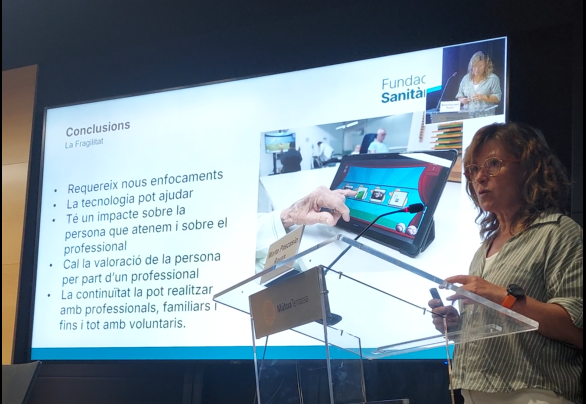
The final part of the presentation was particularly helpful because it didn’t romanticize technology. Marta Pascasio clearly explained what they had learned during the implementation.
First of all, it is essential to carefully select patients. Not everyone tolerates screens, tablets, or virtual reality headsets in the same way. Some may experience dizziness, feel uncomfortable, or simply refuse to use this format. That is why a preliminary assessment and listening to patients’ preferences are essential.
Second, training is needed. Professionals must be thoroughly familiar with the tools and test them before incorporating them into clinical practice.
Third, technology does not replace the professional. It is part of the process, but it requires clinical judgment, monitoring, adaptation, and supervision.
And fourth, implementation should be phased. Devices, updates, permissions, and organizational workflows can make the rollout very demanding if you try to do everything at once.
He also highlighted the value of the network of volunteers and other professionals. When a professional assesses the individual, sets the treatment plan, and provides follow-up care, other professionals can help ensure the continuity of these interventions and reach more clients without compromising therapeutic control.
“It never replaces a professional. It’s part of the process.”
Conclusion
The case study presented by Marta Pascasio demonstrates that technology can play a very useful role in addressing frailty when it is integrated based on clinical judgment and within a well-organized care model.
Their contribution lies not only in making rehabilitation more appealing, but also in helping people become more involved, continue their therapeutic activities in different settings, and keep doing what they need to do to maintain their functionality and independence.
En residencias geriátricas, centros de discapacidad, salud mental, atención intermedia, psicogeriatría o incluso diálisis, la tecnología actúa aquí como una herramienta al servicio de un objetivo mucho más amplio: sostener la rehabilitación en la vida real del paciente.