
Virtual reality and neck pain: what the evidence says and how cervical control is worked on with a headset
Chronic neck pain is one of the most frequent problems in a physiotherapy clinic and one of the most resistant to lasting improvement, because on top of the pain come the fear of moving the neck, the loss of speed and precision in movement, and a working life spent in front of a screen. Virtual reality headsets have one peculiarity here that they have in no other region of the body: the visor sits on the head, so any task that asks the person to look, follow or search for something is, by definition, a cervical exercise. This article reviews what the recent reviews say about virtual reality in neck pain, why the neck responds well to this format, and how cervical control is worked on in a session with a headset.
Why chronic neck pain is so hard to get moving
Anyone who has had neck pain for months ends up moving it differently: less range, less speed, turns made with the whole trunk, a head that avoids looking towards the side that hurts. Part of that adaptation is protective and part of it becomes the problem, because the cervical sensorimotor system, which coordinates information from the deep neck muscles with vision and the vestibular system, recalibrates itself around the pain and the avoidance. In time the complaints any physiotherapist recognises appear: imprecision when repositioning the head, a sense of instability, discomfort when following objects with the eyes, fatigue in front of the screen.
Active treatment works, but it runs into two obstacles that come up again and again: the fear that moving will make things worse, which leads to doing the exercise with the brakes on, and how unmotivating it is to repeat rotations and side bends facing a wall. The article on graded exposure to movement in low back pain and neck pain deals with the first; this one focuses on what virtual reality for neck pain adds for both.
What the evidence says about virtual reality for neck pain
Within the musculoskeletal system, the neck is one of the regions with the most virtual reality trials, and the reviews are starting to agree. A meta-analysis published in 2023 in the Journal of Medical Internet Research, with eight randomised trials and 382 participants, found a reduction in pain favouring virtual reality over controls, with moderate certainty, and a larger effect in the chronic neck pain subgroup and when virtual reality was combined with other therapies rather than used on its own. The groups treated with virtual reality also showed less disability, less kinesiophobia and better kinematic function, including cervical range of motion. A systematic review published in 2024 in PM&R, which compared virtual reality training with conventional rehabilitation in chronic neck pain, concluded that it is a promising intervention for disability and pain, and that what the evidence supports is adding it to conventional exercise within conservative management rather than replacing it. In 2026 a new systematic review specifically on immersive virtual reality in chronic neck pain was published in Musculoskeletal Science and Practice, a sign that the field keeps growing.
Across chronic musculoskeletal pain as a whole the picture is similar: the 2025 review with meta-analysis in Bioengineering, covering thirteen trials in the lumbar spine, knee, shoulder and fibromyalgia, found a favourable effect on pain with moderate certainty and improvements in function in most of the studies, with the usual caveat that long follow-ups are missing. What sets the neck apart is that virtual reality in neck pain is not only distraction and not only motivation: the task coincides with the movement you are trying to recover.
Why the neck responds well to a headset
Three reasons explain why virtual reality in neck pain has become one of the most studied applications of a headset anywhere in the musculoskeletal field. The first is mechanical: the visor follows the head, so following an object with the eyes, searching for a stimulus that appears to one side, or holding your gaze on a point while something moves around you are all cervical rotations, side bends and stabilisations that the person performs without anyone telling them to "turn your neck". The attention is on the task, and the movement comes by itself, with less braking and more range than the person would allow themselves if they were thinking about their neck.
The second is that the environment can be graded with a precision the treatment room does not allow. The professional decides how far the person has to turn to reach the stimulus, how fast it appears, how long there is to react and whether the background is calm or full of distraction, and can widen that margin little by little, session by session, without the person noticing where yesterday's limit was. It is graded exposure to movement turned into parameters. The third is that every repetition is measured: response time, accuracy, errors and the level reached, so the improvement the patient cannot feel because they still have pain can be seen on a graph — and that changes the conversation in week three, when dropout is looming. The article on how virtual reality changes the perception of pain develops the attention and distraction side that adds to all of this.
How cervical control is worked on in a session with a headset
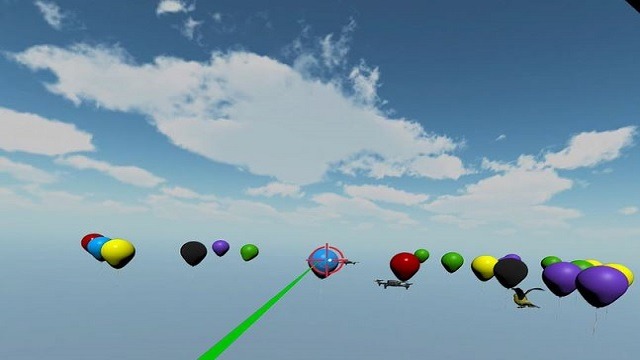
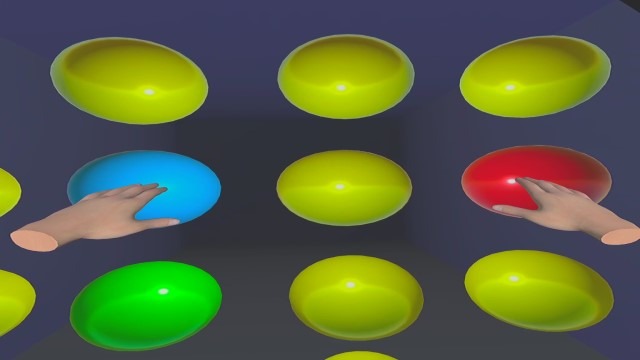
The tasks used in virtual reality for neck pain are recognisable straight away by what they ask of the head. Visual tracking tasks, in which the person follows a moving object with their eyes, work on smooth, continuous movement. Lateral detection tasks, in which something appears outside the field of view and the person has to turn to find it, work on range and speed of rotation. Reaction lights, in which the stimulus appears at different points and has to be reached within a given time, add reaction speed and eye-head coordination. And work-environment simulations, with several screens, a driving cab or a shelf to restock, take cervical control into situations resembling the ones the person has to learn to tolerate again in their life.
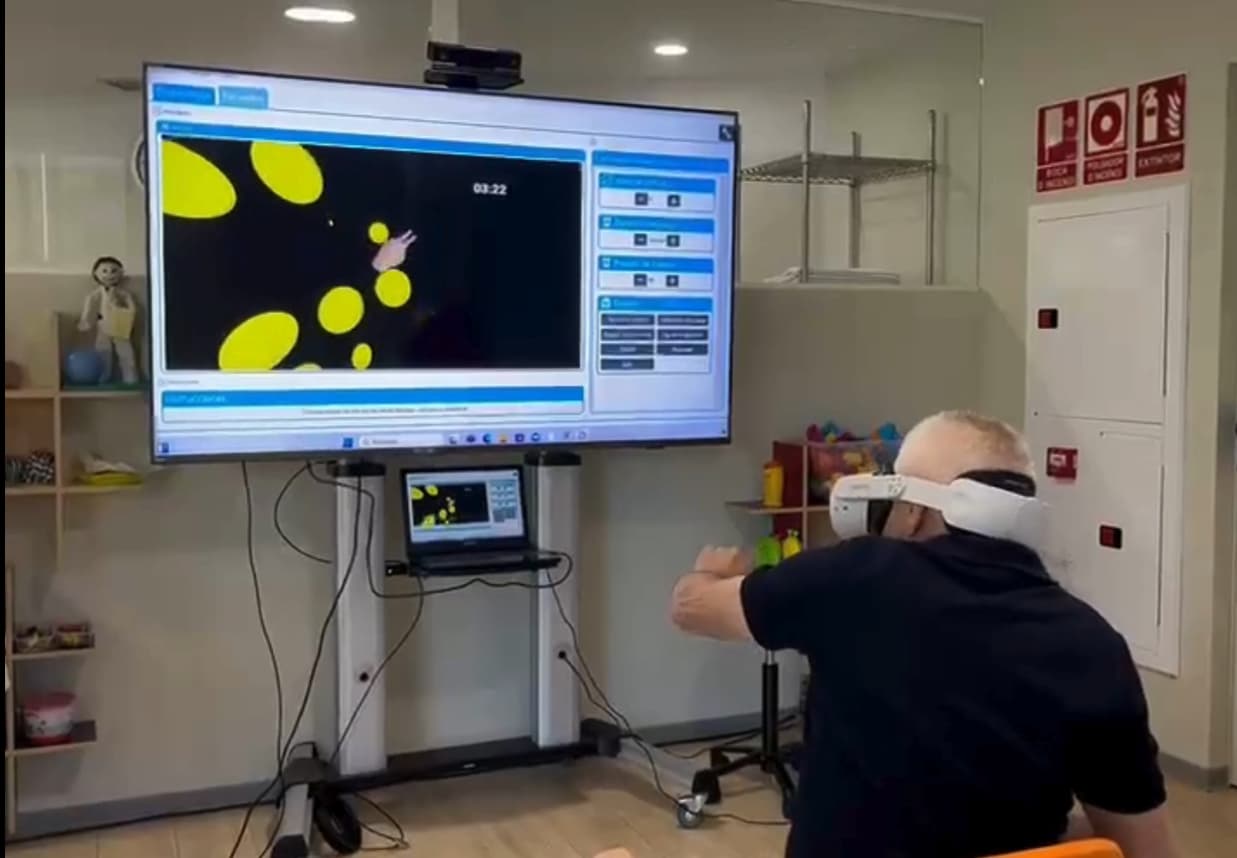
The session is run by the professional from outside, seeing the same thing the patient sees, and it is they who adjust the range the task demands, the speed, the reaction time and the stimuli, so that the same activity serves both the person who can barely turn today and the one preparing to go back to work. Many of these tasks are done seated and in mixed reality, with the room visible, which is how it is recommended to start, and the progression towards faster tasks or standing work is set by how the person responds, not by the calendar.
Who it is for, and with what precautions
The profile in which virtual reality for neck pain is most used is chronic non-specific pain, with or without a kinesiophobia component, and the person who works in front of screens and needs to regain tolerance for turning and holding their head. The trials included in the reviews cited above were carried out mostly in that profile, in the clinic and with the professional present, which is where the effect was largest. It is also used in neurological patients with impaired head control and in trauma care after a period of immobilisation, with the goals adapted to each case; the decision to use it, with which tasks and with what progression, belongs to each team and depends on each patient.
The precautions are the general ones for headsets, with two emphases specific to the neck. The first is dizziness: chronic neck pain is sometimes accompanied by a sense of instability or by dizziness of cervical origin, and in those people mixed reality, seated work and slow visual-tracking tasks are the starting point, with fast lateral-detection tasks left for later. The second is acute pain or radiation into the arm: a recent acute episode is a relative contraindication, as it would be for any other active exercise. The article on headset safety, indications and contraindications sets out the full pre-session assessment.
The cervical control exercises in Rehametrics VR
Rehametrics VR includes a set of cervical control exercises designed for physiotherapy and occupational therapy: visual tracking of stimuli, detection of lateral objects, multidirectional cervical control, reaction lights (also in mixed reality), eye-head coordination and work-environment simulations with screens, driving and object handling, as well as kitchen and supermarket-restocking tasks that combine head control with attention. The professional configures the range of movement the task demands, the speed, the reaction time and the visual stimuli, difficulty adjusts automatically to performance, and the system records response time, accuracy, errors and the difficulty level reached in each session.
It runs on Meta Quest 2, 3 and 3S with hand tracking and mixed reality, the therapist runs the session from their computer with a mirrored screen, and the platform is a Class I medical device with CE marking, with Rehametrics registered as manufacturer with the Spanish Agency for Medicines and Medical Devices, bringing together more than forty clinical studies. For anyone also working on the shoulder and upper limb in the same patient, Rehametrics Physical records range of motion at the shoulder, elbow, hip and knee with a sensor and no headset.
Cervical control exercises
Visual tracking, lateral detection, reaction lights and work-environment simulations, with configurable range, speed and stimuli.
View exercises →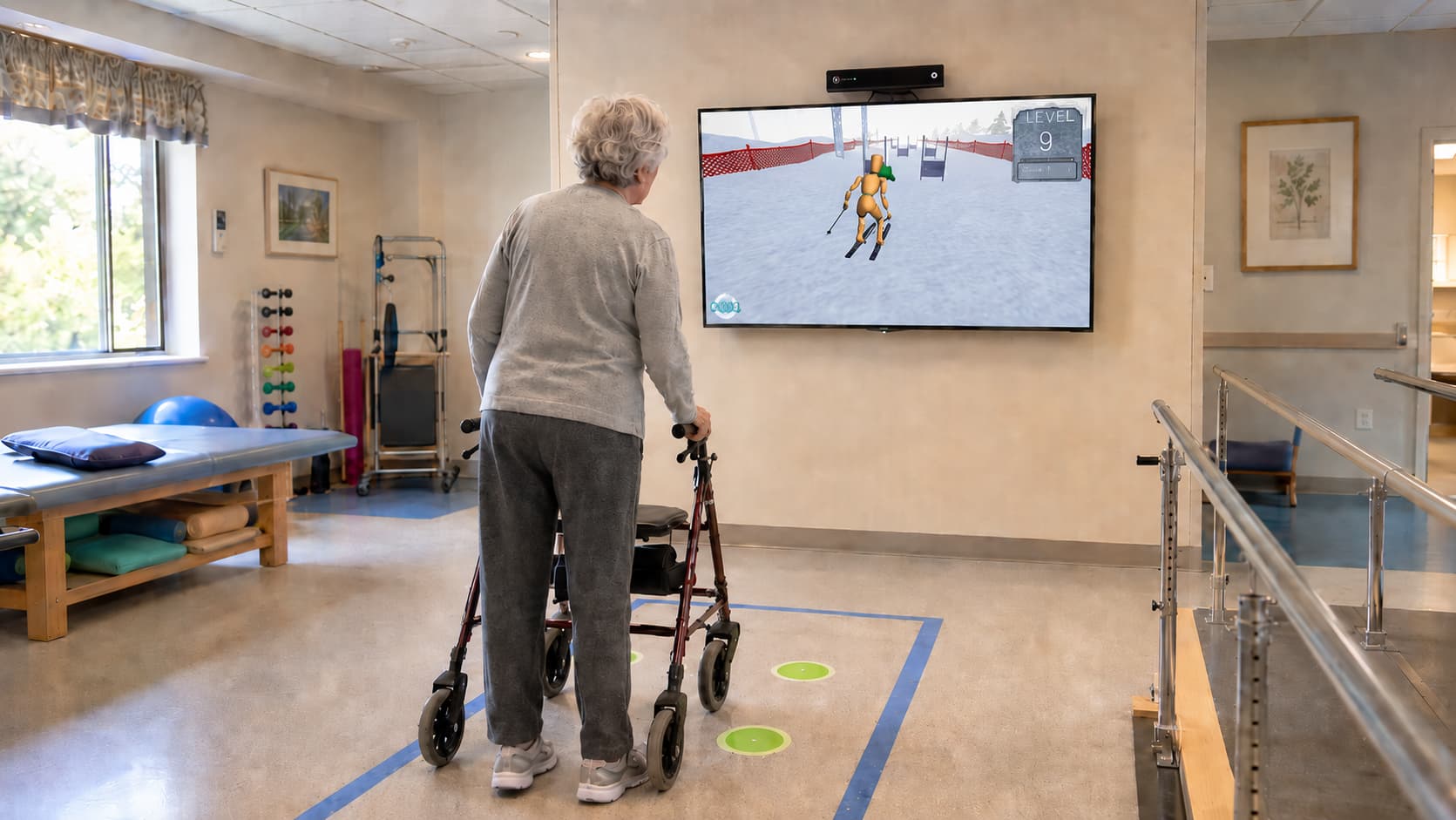
Shoulder and upper limb without a headset
More than 120 exercises with a sensor, recording range of motion at the shoulder, elbow, hip and knee.
View module →
Attention and processing speed
More than 190 exercises on a tablet or whiteboard, with every response recorded and per-patient reports.
View module →Frequently asked questions
Does virtual reality for neck pain actually work?
The 2023 meta-analysis covering eight trials found less pain, less disability, less kinesiophobia and better cervical range of motion in favour of virtual reality, with moderate certainty and a larger effect in chronic pain and when it is combined with other therapies. The 2024 review considers it promising as a complement to conventional exercise, not as a replacement.
Why is a headset useful for the neck in particular?
Because the visor sits on the head: any task that asks the person to look, follow or search for a stimulus forces them to rotate, tilt or stabilise the neck, with their attention on the task rather than on the pain. On top of that, the range, the speed and the stimuli are graded precisely and every repetition is recorded.
Does it make people with neck pain feel dizzy?
In most cases no, and in anyone with a sense of instability or dizziness of cervical origin you start seated, in mixed reality with the room visible and with slow visual-tracking tasks, leaving the fast ones for later. The pre-session assessment and the progression are the same as with any other patient.
What does the system record in a cervical session?
Response time, accuracy, errors and the difficulty level reached in each task, with the range and speed the professional has configured. That is what makes it possible to show the patient an improvement they cannot feel yet, and to adjust the next session.
Is it useful for returning to office work?
The work-environment simulations with several screens, driving or object handling are designed for exactly that: taking cervical control into situations resembling the ones the person has to tolerate again, with the difficulty graded by the professional. When to introduce them depends on each patient.
Want to see the cervical control exercises with a patient?
We will show you how virtual reality for neck pain works in practice: visual tracking, lateral detection and the work-environment simulations in action, and how the range, the speed and the stimuli are configured from the therapist's computer.