
Vocational Rehabilitation in Acquired Brain Injury: VR Workplace Simulation and Functional Tasks
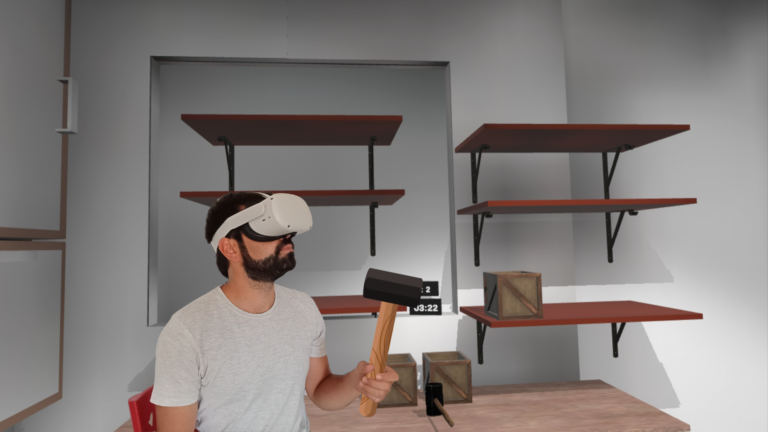
Table of contents
1. The role of vocational training as a functional goal in acquired brain injury.
Returning to work after an acquired brain injury does not depend solely on motor recovery or performance on neuropsychological tests. Employability is conditioned by the ability to manage simultaneous demands, maintain attention in distracting environments, plan action sequences, and tolerate time pressure.
In this regard, vocational rehabilitation in brain injury should be designed as an intervention focused on real-world occupational performance, integrating task analysis, cognitive profiling, and functional progression. It is not about “training isolated functions,” but about training performance in context.
2. The Added Value of VR Workplace Simulation
VR workplace simulation allows for the creation of structured scenarios where variables that are difficult to grade in real-world settings can be carefully controlled.
Key Benefits:
-
Repeated exposure to multitasking scenarios.
-
Controlled introduction of distractors.
-
Time pressure adjustment.
-
Objective performance tracking.
-
A safe environment for making mistakes
Clinical value does not necessarily reside in the visual fidelity of the environment, but in its ability to activate relevant executive and attentional functions. Functional realism is more critical than graphic realism.
Current limitations:
-
Limited variety of work scenarios.
-
Simplified social interactions.
-
Difficulty replicating real-world organizational complexity.
Therefore, simulators should be understood as therapeutic tools within a structured program, rather than as substitutes for the actual workplace.
3. Beyond the simulator: VR Tasks to enhance Vocational Rehabilitation
Even when they do not represent a specific job role, many virtual reality tasks train core abilities essential for professional performance.
Targeted skills:
-
Planning and sequencing: organizing steps, prioritizing, and monitoring behavior.
-
Divided attention: managing simultaneous stimuli and filtering distractions.
-
Multitasking under time pressure: cognitive resource management and rapid decision-making.
-
Functional working memory: retaining instructions while executing actions.
-
Cognitive flexibility: adapting to changes or errors.
-
Emotional regulation: frustration tolerance and persistence.
These skills are transferable across most work environments, regardless of the professional sector.
4. Clinical Criteria for Using Virtual Reality in Vocational Training
The integration of VR tasks into vocational training should be driven by specific functional needs rather than technological availability. Selection criteria must be based on the relationship between workplace demands and the cognitive processes affected by brain injury.
In patients with mild executive dysfunction, VR can be used to increase multitasking load and work on behavioral monitoring under controlled conditions. For profiles with predominant attentional difficulties, the focus can be placed on distractor resistance and performance stability under time pressure. In cases with marked cognitive fatigue, VR allows for objective observation of the performance drop-off point and gradual adjustment of load tolerance.
Not all virtual tasks are suitable for every patient. The clinical indication must consider:
-
Level of deficit awareness.
-
Self-regulation capacity.
-
Grado de impulsividad.
-
Frustration tolerance.
-
Premorbid functional level.
Likewise, VR does not replace gradual exposure to real-world environments. Its role is to serve as an intermediary space where critical skills can be trained before supervised return-to-work.
5. Therapeutic Grading
Progression should be systematic and based on objective indicators.
Modifiable VR Variables:
-
Number of distractors.
-
Instructional complexity.
-
Límite temporal.
-
Number of simultaneous tasks.
Progression Criteria:
-
Consistent reduction in errors.
-
Increased independence.
-
Stable performance under increased workload.
-
Improved emotional self-regulation.
Cognitive fatigue must be actively monitored, as it constitutes one of the primary barriers to returning to work.
6. Outcome assessment and transfer
The effectiveness of vocational training is not limited to performance within the virtual environment.
Quantitative indicators:
-
Execution time.
-
Number and type of errors.
-
Need for assistance.
Qualitative indicators:
-
Spontaneous strategies.
-
Level of supervision required.
-
Self-correction capacity.
-
Emotional regulation during challenging tasks.
The true validation of the process is the progressive generalization to real-world environments or to contexts increasingly similar to the workplace.
Conclusion
VR workplace simulation is a valuable tool for vocational training in brain injury rehabilitation when integrated into a structured clinical program. Even with less complex simulators, virtual reality enables the training of executive functions, attention, cognitive load management, and emotional regulation within functional contexts.
The distinguishing factor is not technological sophistication, but rather the clinical judgment used to design, select, and grade tasks. In the hands of occupational therapists and neuropsychologists, VR can serve as a therapeutic bridge toward vocational reintegration, provided it is used with clear objectives and systematic outcome assessment.