
Virtual reality for hemineglect after stroke: what the recent evidence shows
Hemineglect is one of the consequences of stroke that most constrains rehabilitation and one of the least amenable to conventional methods. Recent years have brought a Cochrane review, two systematic reviews on technology, a randomised trial using virtual reality and a study with patients and carers, which together make it possible to say with reasonable precision what we know, why virtual reality for hemineglect fits this presentation, what it has shown so far and where the limits still lie. This article summarises it for anyone working with these patients in neurorehabilitation, occupational therapy and neuropsychology.
What hemineglect is and how many patients it affects
Hemineglect, or unilateral spatial neglect, is the difficulty in attending to, perceiving or responding to stimuli in the half of space opposite the brain lesion, where no primary visual or motor deficit explains it. The person eats half the plate, shaves half their face, bumps into the left side of the door frame or stops reading halfway along the line, and often has no awareness of doing so. It appears above all after right hemisphere lesions, and it is one of the factors that most delays functional recovery, because it interferes with everything else: with gait, with use of the arm, with activities of daily living and with safety.
On frequency, a systematic review published in 2021 in Annals of Physical and Rehabilitation Medicine brought together 41 studies with 6,324 patients and estimated an overall prevalence of 30% after unilateral stroke: 38% after a right hemisphere lesion and 18% after a left one, which is more than is usually assumed. Two details of that review matter to the clinician: prevalence was far higher when ecological assessments tied to real activities were used than when paper-and-pencil tests were (53% against 24%), and it fell from the acute to the chronic phase, although the authors acknowledge that the figure in later phases is poorly estimated.
What the 2021 Cochrane review says
The obligatory reference is the Cochrane review by Longley and colleagues, published in 2021, which analysed non-pharmacological interventions for spatial neglect after stroke and other non-progressive brain injuries. It included 65 randomised trials with 1,951 participants and a wide range of approaches: visual scanning training, prism adaptation, sensory stimulation, limb activation, movement techniques, non-invasive brain stimulation and, in some studies, virtual reality.
Its conclusion is worth quoting as it stands: the effectiveness of these interventions in improving functional ability in activities of daily living remains unproven, because no approach has been investigated with trials of sufficient quality and size. Only two of the 65 studies were judged at low risk of bias, all had fewer than 50 participants per group, and no phase III trial was found. The authors add something just as important: that this absence of evidence is not evidence of ineffectiveness, and that, as several national clinical guidelines recommend, professionals should go on rehabilitating neglect in line with each patient's goals, taking part in research wherever they can.
Why virtual reality for hemineglect makes sense
Before looking at the results it is worth understanding why so many groups have tried virtual reality in this particular presentation. Hemineglect is not a problem of the eyes but of spatial attention: the brain stops giving priority to one half of space, and rehabilitation consists, in essence, of bringing attention back towards that side, over and over, until scanning becomes automatic. Conventional techniques attempt this by several routes: teaching the person to scan deliberately towards the left, using salient stimuli that capture attention from outside, activating the arm on the affected side, or recalibrating the perception of space with prism glasses.
The problem with the usual materials is the size of the space they cover. A sheet of paper or a tablet occupies a few degrees of the visual field, always in front of the person and at arm's length; it can be scanned in full without moving the head, and the neglect that most disables people in daily life — the kind that makes someone walk into a door frame or miss the car coming from the left — happens in large-scale space, the kind that requires turning the head and trunk and looking into the distance. Virtual reality headsets surround the person: stimuli can appear ninety degrees to the left, near or far, above or below, and the only way to find them is to turn towards the side the brain is ignoring. Near and far space, which in hemineglect can be affected differently, are worked in the same environment, and what the person does looks more like crossing a street than crossing out stars on a sheet of paper.
The second reason is control of the stimulus. A virtual exercise can be designed so that targets appear throughout the whole space, at whatever size, sound and movement suit, so that the person has to search to the left as well; and studies experiment with salient cues that draw attention from outside, or with shifting the whole background to push the search towards the neglected side, as the trial described below does. The third is immediate feedback: the person sees and hears at once whether they have found the target, which keeps attention active and helps against anosognosia, which in this presentation means many patients do not see why they should be training. And the fourth is measurement: every search leaves a record of where the stimulus was and whether it was found, so progress on the left side can be tracked at a resolution that paper cancellation does not offer. Motion capture in front of a large screen shares part of these advantages, with a wider field than a tablet and the possibility of working standing and moving the trunk, though without surrounding the person.
What virtual reality offers, according to the 2023 and 2025 reviews
Two recent reviews have looked specifically at the technology. The one by Salatino and colleagues, published in 2023 in Neuroscience and Biobehavioral Reviews, reviewed 26 studies between 2000 and 2022 and classified them by degree of immersion: non-immersive virtual reality (screen), semi-immersive (large screen or projection with motion capture) and immersive (headset). Of the studies, 84.6% found improvements on some measure of neglect: 85.7% of the non-immersive ones, 100% of the semi-immersive and 55.6% of the immersive. The other side of the coin is quality: only 42.3% had a control group and only 19.2% were randomised trials. The authors conclude that virtual reality for hemineglect opens real opportunities, pending confirmation with controlled trials.
The more recent one, by Somma and colleagues, published in December 2025 in the Journal of NeuroEngineering and Rehabilitation, focused on three-dimensional technologies — immersive and non-immersive virtual reality, augmented and mixed reality, and robotics — for both assessing and treating neglect. From 2,891 references it selected 37 studies: 15 on assessment, 17 on treatment and 5 technical. Its reading is that these tools offer realistic scenarios and precise stimulation that paper tests cannot provide, but that they remain at an early experimental stage, with poorly standardised protocols and results too heterogeneous for a meta-analysis.
Together, the two reviews paint the same picture: many small studies with favourable results, few controlled trials, and growing interest in using the technology not only to train but to assess, because a three-dimensional environment makes it possible to measure how much the person explores the left side of space, where they turn their head and which stimuli they respond to, in a detail that star cancellation on paper does not give.
A recent trial: searching for stimuli on the forgotten side
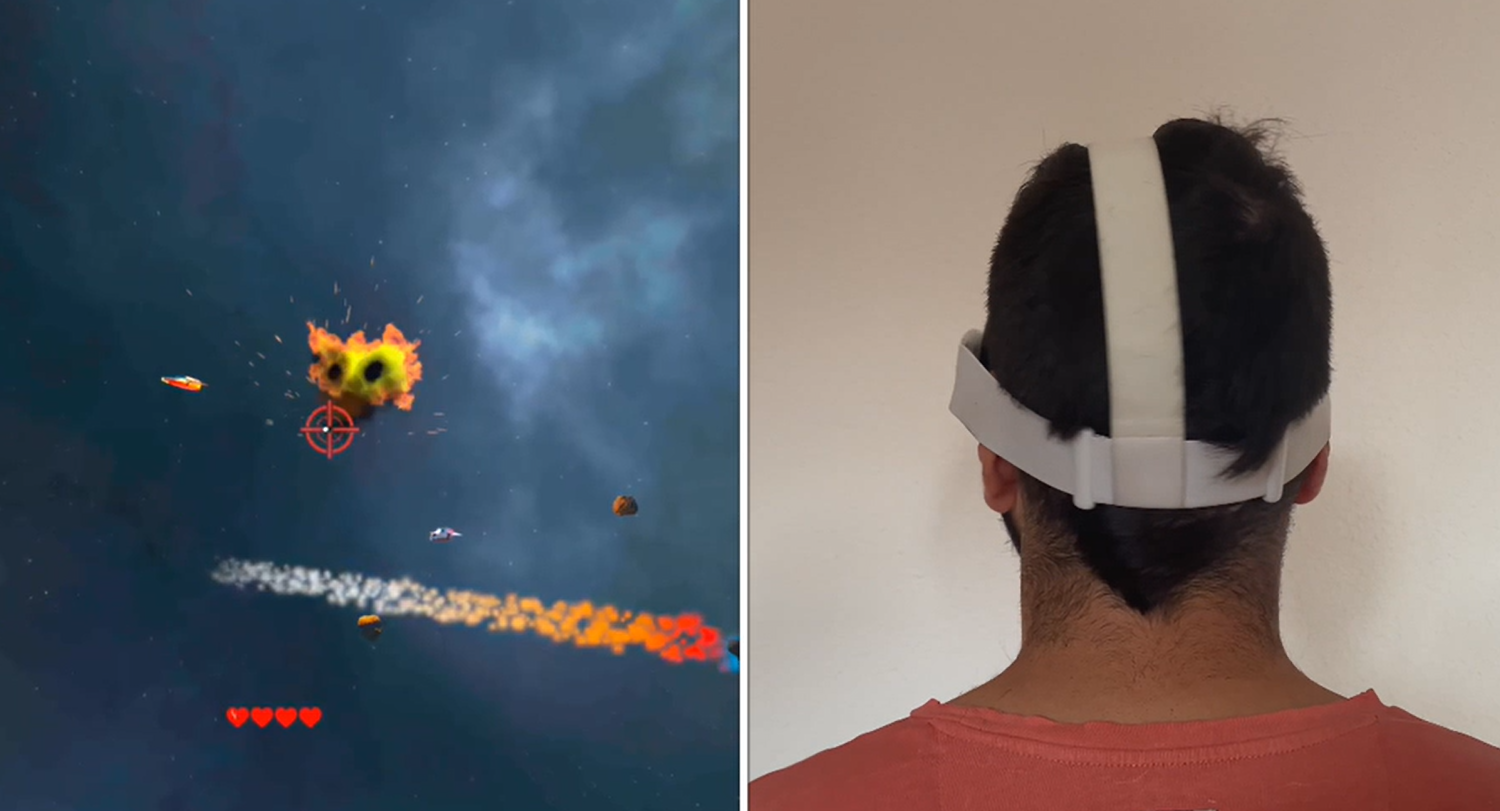
To see how a trial of virtual reality for hemineglect translates into practice, Motomura and colleagues published in 2024 in Archives of Physical Medicine and Rehabilitation a double-blind randomised trial with 42 patients in the acute phase with a right hemisphere lesion and neglect in daily life. Three virtual reality tasks were compared over five days: searching for balloons that appeared suddenly on screen, the same task with a background shift that pushed the search towards left space, and a control task of holding the gaze on a fixed balloon.
Both search tasks improved reaction time to stimuli on the left side compared with the control, and the version with the background shift improved more in the furthest left zone, the most affected one. By contrast, the conventional clinical scales — the Behavioural Inattention Test, the Catherine Bergego Scale and the straight-ahead pointing test — showed no differences between groups. It is a typical result in this field and admits two readings: the task changed what it trained, the speed of detecting stimuli on the left, and in five days it did not change what the functional scales measure. The authors themselves present it as a sign that stimuli drawing attention towards neglected space may help, not as proof of functional effectiveness.
What patients and carers say
A qualitative study published in 2026 in JMIR Rehabilitation and Assistive Technologies interviewed ten patients with neglect and eight informal carers who had tried three extended reality serious games, one in virtual reality and two in augmented reality, designed for visual scanning training, which is the treatment the guidelines recommend. The patients described high engagement and enjoyment and, for the most part, were willing to use the games both at the centre and at home; the carers agreed and underlined their motivational value. Both groups asked for accessible instructions and technical support, and the authors conclude that one solution does not fit everyone: customisable features are needed, along with structured support and attention to the different role each carer plays.
For anyone weighing up virtual reality for hemineglect, the relevant finding is motivation. Conventional visual scanning training is repetitive, and neglect is frequently accompanied by anosognosia, so the person does not see why they should be doing it. That a task is enjoyable and has a visible goal is, in this presentation, considerably more than a matter of presentation.
What changes in the therapy room
With the evidence in hand, using virtual reality for hemineglect introduces some concrete differences from conventional materials. Each team will weigh them according to their population and their way of working.
The first is control of the stimulus. A virtual exercise has built into it where the targets appear, how long they last and which distractors accompany them, and the professional adjusts difficulty without remaking the material. The second is the working field: with a headset, the session stops being limited to what fits in front of the person and comes to occupy all the space around them. The third is the record: where the person has looked, which stimuli they responded to and with what latency, session after session, which allows progress in the left hemispace to be seen at a higher resolution than a one-off test gives. And the fourth is motivation, which the studies with patients describe consistently.
The limit is equally clear in the literature. The improvements most easily measured are those on the trained task, and transfer to daily life, which is what really matters, is more poorly documented. That is why functional assessment, with the ecological scales the prevalence review identified as the most sensitive, is done by the professional, and the technology is one more tool within a plan that combines several approaches.

How Rehametrics approaches it
Rehametrics covers virtual reality for hemineglect from two directions. Rehametrics VR includes activities designed for this presentation on Meta Quest headsets, with hand tracking and no controllers: head control, in which the person searches for stimuli appearing across the whole visual field and has to turn their head towards the side they ignore; crossing the street, which requires watching for cars arriving from the left and the right before deciding when to cross; placing objects horizontally, which takes the hand towards the left hemifield; and popping bubbles in a wide space while avoiding distractors. The therapist controls the session from a computer with a mirrored screen and can work in mixed reality, with the room visible, in the first sessions. The article on spatial neglect exercises for virtual reality describes them one by one.
In Rehametrics Cognitive, on a tablet or interactive whiteboard, there are tasks of attention, inhibition, visual tracking and sequencing in which the stimuli are distributed across the whole screen and the person has to explore all of it to solve them, with a record of correct answers, errors and response time for each item. They are collected in exercises to treat spatial neglect on a tablet. The spatial neglect page brings together the remaining resources.
What the platform records is performance on those tasks — correct answers, errors, times, level reached; assessment of neglect in daily life and the decision about what to combine with what belong to the team.

Four headset activities for hemineglect
Head control, crossing the street, placing objects and popping bubbles, with hand tracking and a mirrored screen for the therapist.
View exercises →
Tablet tasks that force the whole screen to be explored
Attention, inhibition, tracking and sequencing, with a record of every response and its timing.
View exercises →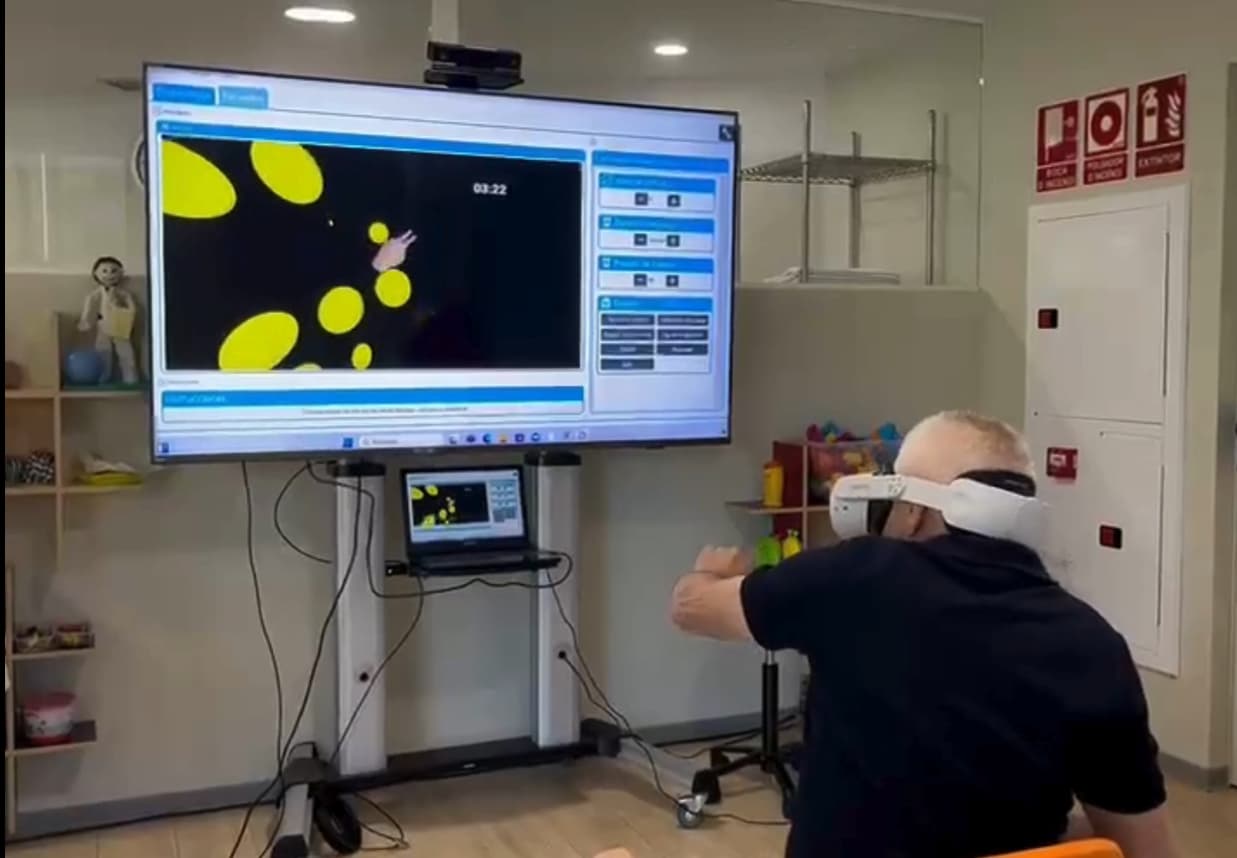
Spatial neglect rehabilitation
What it is, how it presents and which platform resources are used in the clinic.
View page →Frequently asked questions
Has virtual reality for hemineglect been shown to be effective?
Most published studies find improvements on measures of neglect, but they are small and few are controlled; the 2023 review counted 84.6% of studies with improvements and only 19.2% randomised trials. The 2021 Cochrane concludes that no intervention, technological or otherwise, has yet been shown to improve daily life in quality trials. Virtual reality is used as one more tool, with that caution.
Is immersive virtual reality better than screen-based?
The 2023 review found improvements in a higher proportion of semi-immersive and non-immersive studies than immersive ones, but the groups were small and heterogeneous and do not allow one modality to be called superior. Each has its advantages: headsets allow far space and head turning to be worked; a screen, with or without motion capture, is simpler to introduce and tolerate.
What does the technology measure that a paper test does not?
Where each stimulus appears and whether the person detects it, with what latency and in which zone of space, session after session. Recent reviews highlight that potential for assessment. Functional assessment, with scales tied to daily life, remains the professional's job.
Do patients with hemineglect tolerate headsets?
In the 2026 qualitative study, patients described high engagement and enjoyment and asked for clear instructions and technical support. Anosognosia and fatigue are frequent in this presentation and shape each case; short first sessions, seated and with the room visible in mixed reality, make the introduction easier.
Which Rehametrics activities are used for hemineglect?
On headsets, head control, crossing the street, placing objects horizontally and popping bubbles; on tablets, tasks of attention, inhibition, tracking and sequencing with stimuli distributed across the whole screen. The platform records correct answers, errors, response time and level in each one.
Want to see it with your own patients?
We will show you how virtual reality for hemineglect works on headsets and tablets, how the stimuli are configured and what gets recorded in each session, and how other neurorehabilitation services are using them.