
Clinical use of virtual reality in the treatment of balance disorders in patients with serious mental illness

During the First Conference on Virtual Reality in Rehabilitation, held at MútuaTerrassa University Hospital in April 2026, Luis Lomba de Teresa, a physical therapist at Doctor Rodríguez Lafora University Hospital, shared his team’s experience with the clinical use of virtual reality to improve balance in patients with severe mental disorders.
His presentation was based on an idea that is particularly relevant from a rehabilitation perspective: in cases of severe mental illness, the problem is not limited to the psychiatric diagnosis. These patients often exhibit motor impairments, physical comorbidities, high functional dependence, medication side effects, and significant difficulty engaging with treatment.
From this perspective, virtual reality applied to balance training in patients with severe mental disorders is seen as a useful tool not only for improving postural control, coordination, and fall prevention, but also for enhancing treatment adherence and facilitating participation in the rehabilitation process.
This clinical context has very specific characteristics that influence physical therapy intervention and make the use of structured, safe, and adaptable therapeutic tools particularly important.
Table of contents
A clinical setting with highly complex care needs
Luis Lomba explained that the Doctor Rodríguez Lafora University Hospital is a specialized mental health facility and a leading center in the Community of Madrid for the treatment of severe mental disorders. It is a public hospital with various short-, medium-, and long-term care units, as well as a day hospital and an addiction treatment unit.
One of the key points of his presentation was to emphasize that, in this patient population, a psychiatric diagnosis alone is not sufficient to understand the patient’s needs. What truly determines the course of treatment is the degree of dependency, associated comorbidities, and functional complexity.
Cardiovascular and respiratory conditions, obesity, metabolic syndrome, and physical deconditioning due to immobility are common in these patients. In addition, they often have a high medication burden, with psychiatric medications having a particular impact on motor function, including extrapyramidal symptoms and impaired postural control.
All of this significantly increases the risk of falling and makes improving balance a top priority in the physical therapy approach.
Technology as a tool for building therapeutic rapport
One of the clearest messages from the presentation was that, for this patient population, the primary goal is not always motor function. Before aiming for functional improvement, it is necessary to ensure adherence.
Luis Lomba emphasized that these are patients who are difficult to engage, often refusing certain interventions, showing little consistency in treatment adherence, and, in some cases, resisting direct physical contact. In this context, introducing a technological tool might, at first glance, seem like an added challenge. However, his team’s experience has been quite the opposite.
Virtual reality has served as a therapeutic entry point. Its playful nature, the predictable structure of the tasks, and interaction with a controlled visual environment have made it easier for many patients to attend more frequently, participate more effectively, and tolerate the intervention with less resistance.
The tool does not replace the therapeutic relationship, but it can help build it.
“Ultimately, it’s a fun environment—a safe space where it’s easier to build a little rapport.”
What type of virtual reality is used in this context?
In this clinical trial, the team chose to use a semi-immersive virtual reality modality. This choice was not based on an abstract technological preference, but rather on a clinical decision tailored to the patient profile.
As the speaker explained, patients with severe mental disorders often experience sensory difficulties, motor clumsiness, balance issues, perceptual sensitivity, or a sense of discomfort in overly demanding environments. For this reason, a highly immersive solution could lead to rejection, distress, or reduced tolerance.
Semi-immersive virtual reality offers an environment that is sufficiently engaging and motivating, while allowing the therapist to maintain greater control over the context and providing a less invasive experience for the patient.
In this case, the value lies not in how deeply the technology “immerses” the user, but in how well it adapts to the user’s actual capabilities.
Integrating Virtual Reality into Daily Clinical Practice
Work on mixed ranges and bodily dissociation
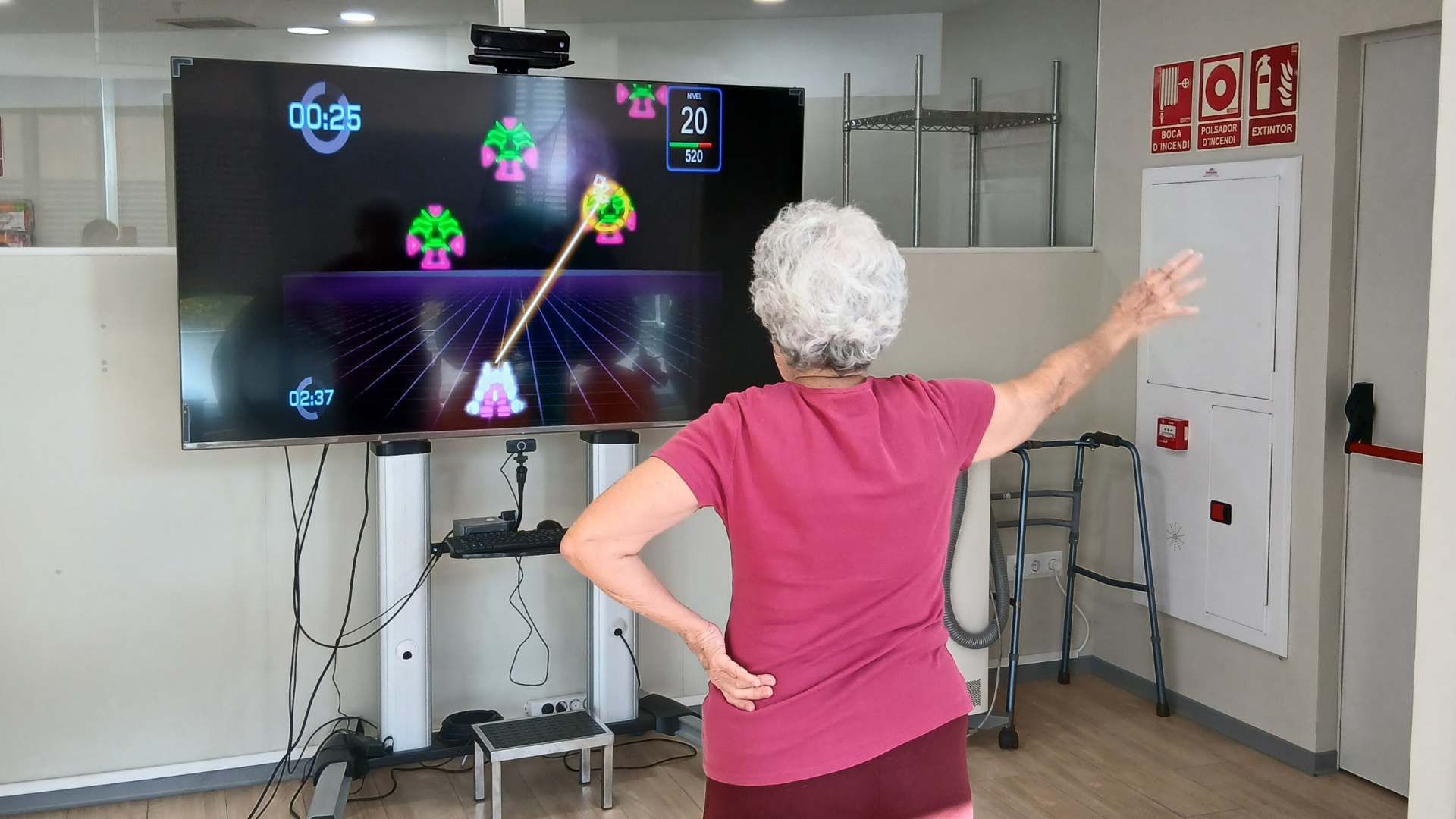
One of the most commonly used exercises is the mixed-reach drill. This exercise helps develop coordination between the upper and lower body, reaction time, hand-eye coordination, and dynamic balance.
As Luis Lomba explained, these patients benefit particularly from repetitive and predictable environments. Repeating the same task does not diminish the effectiveness of the intervention; rather, it fosters a sense of security, order, and confidence.
“We’ve also improved reaction time, which is important when it comes to preventing a fall.”
Postural adjustments, laterality, and kinesiophobia
Another part of the program focuses on upper-body movements in various positions, with the aim of inducing small shifts in the center of gravity and requiring subtle postural adjustments. This type of task allows for the training of static balance and body control without resorting to overly complex exercises, which is particularly useful for patients with significant functional frailty or low tolerance for new tasks.
However, the value of these exercises is not limited to postural control. As Luis Lomba explained, many patients with severe mental disorders also experience significant kinesiophobia and persistent chronic pain, often linked to previous surgeries, old fractures, or physical experiences that they continue to perceive as if they were still in an acute phase. In these cases, repeated mobilization of the segment within a guided, meaningful task contributes to a certain desensitization to movement and reduces functional self-restriction.
In addition, these activities help develop hand-eye coordination and lateralization. Although this may seem like a basic goal, the speaker emphasized that, in this patient population, the ability to distinguish between right and left is not always well developed. In this regard, the use of clear visual cues, such as colors and simple instructions, greatly facilitates understanding of the task and improves performance.
Lateral movements and functional upper-body exercises
Another exercise used targets lateral movement along with shoulder mobility and suspension. For patients who have great difficulty moving or even performing basic activities such as eating, these exercises serve as a bridge between postural training and upper limb function.
In addition, they subsequently facilitate the more specialized work of other team members focused on fine motor skills or functional activities.
Driving and obstacle avoidance
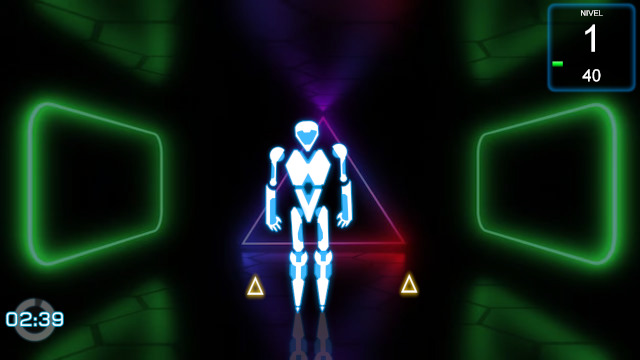
One of the exercises most readily accepted by patients is one that simulates walking while avoiding obstacles. According to the speaker, this activity is perceived as more closely resembling daily life and is particularly useful in situations where patients need tools to navigate hospital environments that are highly stimulating, busy, or anxiety-inducing, such as during mealtimes or in shared spaces.
Far from being a limitation, the simplicity of the task is precisely one of its strengths.
A particularly striking clinical case
Luis Lomba also shared a clinical case that, although not specifically focused on balance, illustrates the broad applicability of this type of intervention.
The patient was a middle-aged man with schizophrenia, obsessive-compulsive disorder, severe depression, and a high degree of dependency; he was also nonverbal and exhibited severe restrictive eating behavior, requiring enteral nutrition via a PEG tube.
During a session focused on upper limb rehabilitation, in which the exercise simulated the act of eating soup, the patient subsequently began eating again.
The team did not expect this result, and it cannot be interpreted as a direct causal relationship; however, it does demonstrate how a virtual task with functional significance can trigger relevant responses beyond the initial motor goal.
"Just by pretending to eat—in this case, pretending to eat soup—the patient has started eating again. It’s something none of us expected."
The importance of repetition, feedback, and task tolerance
One of the most interesting aspects of this approach is that it focuses not on variety, but on tolerance. For this group of patients, repeating familiar tasks may be more therapeutically beneficial than constantly introducing new exercises.
Repetition provides structure. Structure provides confidence. And that confidence improves grip.
In addition, visual feedback facilitates learning. Being able to see oneself represented by an avatar and associating movement with a response from the environment helps reinforce body awareness and improve sensorimotor control.
This point is particularly relevant for patients whose body schema is impaired or poorly integrated. Feedback serves not only as motivational reinforcement but also as a guide for reorganizing the motor response.
The key, therefore, is not merely that the exercise be performed correctly from a technical standpoint, but that the patient be able to sustain it, understand it, and repeat it without resistance.
“We’ve seen higher attendance at our sessions, greater participation in our programs, a reduction in absenteeism, and a higher number of completed sessions.”
Conclusion
The case study presented by Luis Lomba at the Doctor Rodríguez Lafora University Hospital demonstrates that semi-immersive virtual reality can be integrated in a useful and clinically sound manner into the physical therapy approach for patients with severe mental disorders.
Beyond its value as a tool for improving balance, coordination, and postural control, its main appeal seems to lie in its ability to improve adherence, increase participation, and provide a well-tolerated therapeutic option for a particularly challenging patient population.
In this context, technology should not be viewed as a mere accessory or a superficial innovation. Its value depends on its ability to address real clinical needs, adapt to the patient’s profile, and be integrated into an interdisciplinary approach with clear objectives.
The experience shared in this presentation points precisely in that direction: using virtual reality not for the sake of novelty, but for its clinical utility.