
Virtual Reality in physical therapy for therapeutic purposes: clinical applications by treatment goal
A physical therapy patient rarely arrives with a single goal, and almost never with the same diagnosis as the patient in the previous session. Organising interactive technology by goal — balance, gait, coordination, range of motion, endurance — rather than by pathology helps you decide, with better reasoning, which activity makes sense in each session.
Why organise technology-assisted physical therapy by goal
In a single morning of clinic you might see knee osteoarthritis, an ankle sprain in a progressive loading phase, a hip replacement in the first weeks of walking, and a patient referred after a mild stroke with subtle motor sequelae. Four different diagnoses, four different histories, but frequently the same handful of underlying goals: restoring range, improving balance, walking more safely, building endurance for everyday tasks.
This article works through general physical therapy the other way round from usual: instead of pathology by pathology, it goes goal by goal (balance, gait, coordination, range of motion, endurance) and points out, for each one, where interactive technology fits. What a virtual reality session looks like, what investment a centre needs, or what myths tend to surround its adoption is already covered in the article on the use of virtual reality in physiotherapy; that content complements this one well if the starting point is "why adopt it" rather than "what is it clinically for".

Balance and postural control
Balance appears as a cross-cutting goal in very different profiles: older patients at risk of falls, post-surgical hip or knee processes, ankle sprains in the proprioceptive re-education phase, vestibular disorders or mild neurological sequelae. What usually fails in practice is not identifying that balance is affected, but having a way to grade it and to show the patient, session by session, whether they are improving.
Real-time interaction makes it possible to set up dynamic balance tasks: reaching a target by shifting weight, holding a posture while responding to a visual stimulus, transferring load from one leg to the other following a pattern. In all of them the patient receives an immediate signal of how they are doing, instead of depending solely on the professional's verbal correction. The underlying clinical goal does not change; what changes is that the patient understands better, in the moment, what is being asked of them and why.
A descriptive study published in BMC Sports Science, Medicine and Rehabilitation (2021;13:83) on a virtual reality telerehabilitation programme in patients with balance disorders found significant differences between the initial and final assessment in balance, gait functionality and step length. As this was a descriptive design without a control group, these results are best read as an indicative signal rather than definitive proof of efficacy.
A more recent systematic review and meta-analysis, published in Journal of Clinical Medicine (2025;14(20):7247), studied virtual reality balance training in chronic low back pain and found significant improvements in dynamic and functional balance measures, such as the Timed Up and Go or the functional forward reach. By contrast, it found no differences in static balance measures such as single-leg stability or centre of pressure displacement, where heterogeneity between studies was also very high. On this evidence, interactive technology appears to perform better in dynamic and functional balance tasks than in isolated static tests; each team can still prioritise one or the other depending on the profile of the patient in front of them.
Gait and coordination
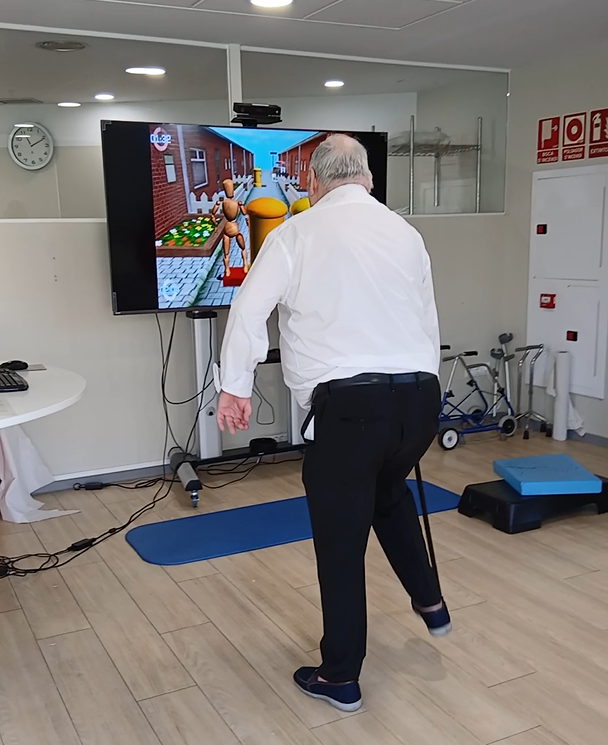
Working on gait in the clinic usually runs into a limitation of space and time: there is not always a long enough corridor, and reproducing the real conditions of walking down the street (obstacles, changes of pace, divided attention) is difficult inside a room. Interactive tasks make it possible to introduce some of those components in a controlled way: varying the rate at which a stimulus appears, asking for the step to match a visual cue, or combining the gait pattern with an upper-lower limb coordination task.
Coordination benefits particularly from immediate feedback. When the patient sees on screen whether they have reached the right point, with what precision and in what time, they can adjust the movement on the next repetition without waiting for the professional to put it into words; in bilateral tasks or hand-eye and foot-eye coordination work, that immediate visual feedback tends to shorten the motor learning curve.
A trial from the Gorgas sample (2015), itself included in a review of new technologies in multiple sclerosis published in the Revista Española de Discapacidad, found improvements in gait speed when combining balance training with light weights during walking. It is a result that illustrates how working on gait and balance together can offer more than working on them in isolation, although it should be taken with caution: the sample is small and it is not directly generalisable to all of general physical therapy.

Range of motion and endurance
Restoring range of motion is probably the most cross-cutting goal of all: it appears in post-surgical processes, in osteoarthritis, in capsulitis, in any prolonged immobilisation. The usual approach is to measure it with a goniometer at the start and end of a block of treatment, with little information in between about how it evolves session by session. Interactive tasks that require reaching a point in space with the arm or leg offer, alongside the movement stimulus, a continuous record of how much range is being achieved in each repetition.
Endurance, understood as the capacity to sustain a given number of repetitions or an activity for a specific time, benefits from a different mechanism: task difficulty can be adjusted according to the patient's performance in real time, avoiding both early fatigue from demanding too much and lack of stimulus from falling short. In patients with low exercise tolerance, this allows the volume of work to be dosed more precisely than by setting the same number of sets in advance for everyone.
In the specific context of anterior cruciate ligament reconstruction, a systematic review and meta-analysis published in PLOS ONE (2025), covering six trials with 464 patients, found improvements in knee reaction time and in joint angle reproduction at 30° and 60° after virtual reality balance training. The authors themselves note that much of the included evidence is of low or very low quality and that the limited sample size means the trend should be interpreted with caution, not as a settled conclusion.
What the evidence says about interactive technology in physical therapy
Taken together, the available evidence on virtual reality in physical therapy shares a pattern: fairly consistent improvements in functional and dynamic measures (gait speed, functional reach, joint reaction time) and more irregular results in isolated static or posturographic measures. Most of the studies cited in this article, moreover, have been carried out in specific populations — chronic low back pain, ACL reconstruction, balance disorders of various origins — not in a sample representative of all general physical therapy, so transferring the results to a different patient profile calls for clinical judgement rather than automatic application.
The authors of the reviews cited repeatedly point to moderate sample sizes, heterogeneity between protocols and devices, and confidence levels ranging from moderate to low depending on the variable measured. That methodological caution does not detract from the clinical usefulness of these tools; it does advise presenting them as a complement to conventional therapeutic exercise in selected patients, rather than as an alternative with efficacy demonstrated uniformly for any goal or profile.
How to choose the session goal and adjust difficulty
With these caveats in mind, a few practical criteria help decide how to incorporate interactive technology without the choice of activity getting ahead of the clinical reasoning:
- Start from a goal, not from a catalogue of exercises. Decide first whether the priority in that phase is balance, gait, range or endurance, and only then look for the interactive activity that best fits that specific goal.
- Begin with a task the patient can manage. The first session with a new tool should not also be the first time the patient faces the exercise at maximum difficulty; a starting point where they can reasonably succeed is preferable.
- Progress along different axes depending on the goal. In balance, the axis is usually the base of support or the speed of the stimulus; in range, the amplitude required; in endurance, the number of sustained repetitions. Not all goals progress in the same way, and mixing the axes of progression can make it harder to interpret what is actually improving.
- Use the session record to decide the pace, not just to document. Seeing how range, repetitions or stability have evolved over recent sessions helps decide whether to maintain, progress or rethink the activity, beyond the subjective impression on the day.
How much weight each of these four points carries varies from team to team: some prioritise having the goal very clearly defined before touching any activity, others give more weight to reviewing the session record frequently to correct course as they go. That variation between services is reasonable and does not need to be resolved with a single formula.
The role of Rehametrics Physical
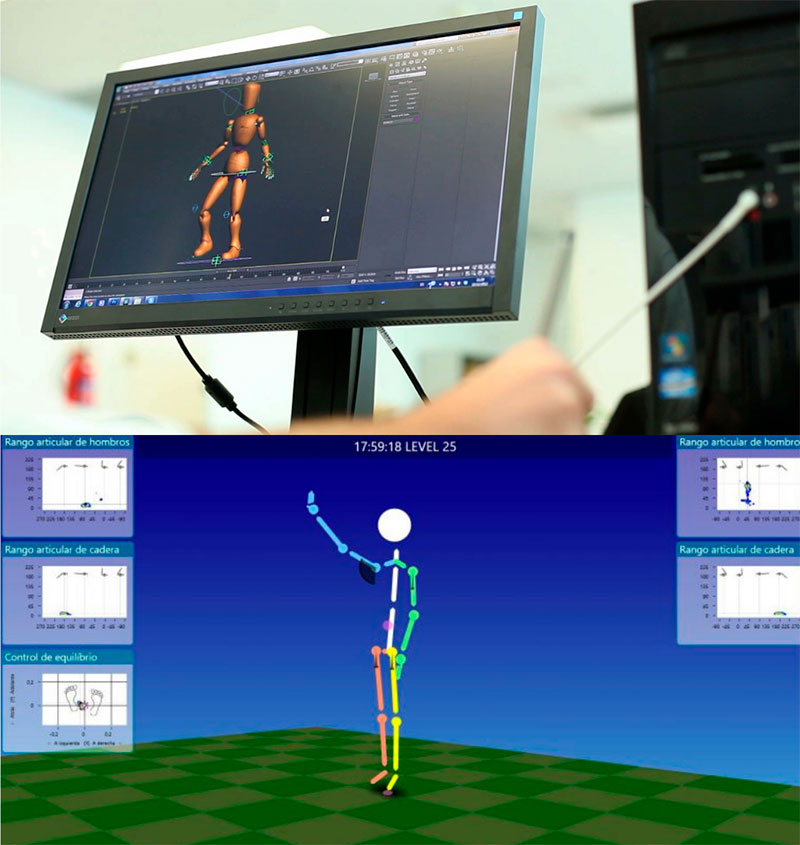
Rehametrics Physical brings together more than 120 semi-immersive virtual reality exercises organised into categories including range of motion, coordination, balance, body schema, transfers, laterality and gait, among others. The patient interacts by moving their own body: motion capture is done by camera, without body sensors or controllers, and the biofeedback arrives at the moment the movement happens, not afterwards.
In range of motion exercises, the platform records the range achieved at the shoulder, hip, elbow and knee, together with repetitions and movement speed; in balance exercises, it adds a record of the centre of gravity and the base of support. Difficulty adjusts itself across all exercises according to the patient's success rate against the target set, which avoids having to reconfigure each progression manually.
Which goal to work on in each session, which patients it makes sense to introduce this technology with, and when to progress the difficulty remains a decision for the physiotherapist: the platform provides the interactive stimulus and the objective record, but it does not replace the initial assessment or the clinical reasoning behind each treatment plan.

Modules relevant to general physical therapy
Balance, gait, range and coordination
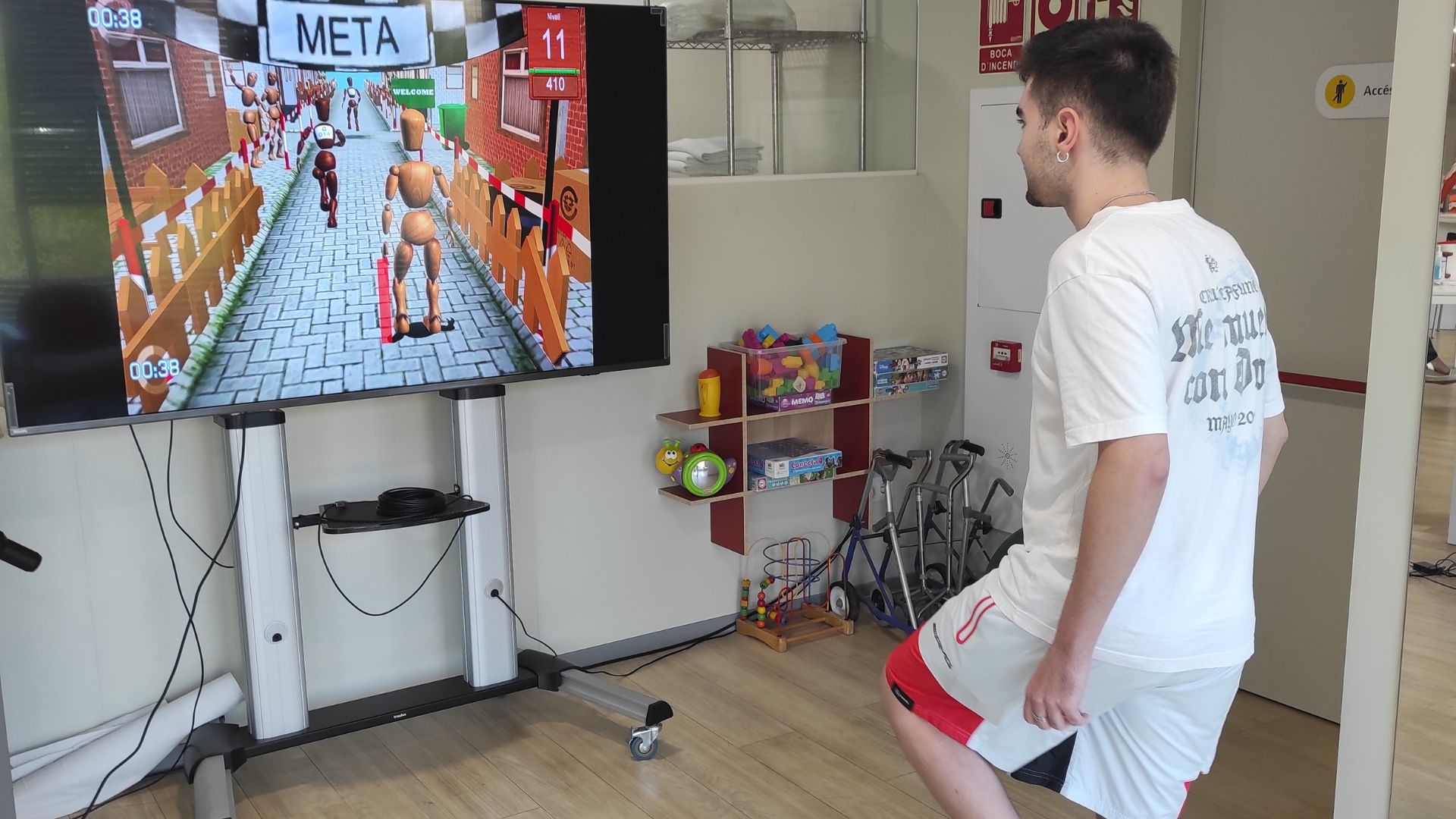
More than 120 interactive exercises with camera-based motion capture, without sensors or controllers, organised by therapeutic goal.
View module →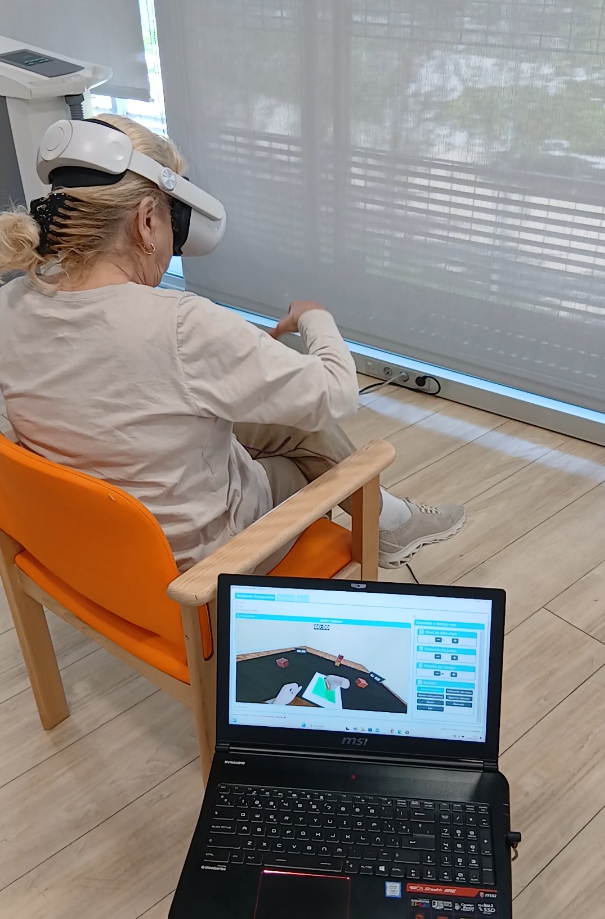
Reaching, range and functional tasks
Immersive environments with hand tracking to work on reaching, range of motion, fine motor skills and activities of daily living closer to the patient's everyday life.
View module →
Recording of range, repetitions and balance
Session-by-session follow-up of range of motion, repetitions, speed, centre of gravity and base of support.
See clinical validation →Frequently asked questions
Does virtual reality replace conventional therapeutic exercise in general physical therapy?
The available evidence positions it as a complement to therapeutic exercise and manual assessment, not as an alternative. It provides immediate feedback and an objective record of range, repetitions or balance; the choice of activity, the dosage and the progression remain the physiotherapist's responsibility.
Which patient profiles make most sense for starting with balance work?
It tends to be prioritised in patients at risk of falls, post-surgical lower limb processes, sprains in the proprioceptive re-education phase or vestibular disorders. That said, each team weighs these criteria differently according to their experience with similar profiles.
What exactly does Rehametrics Physical measure during an exercise?
In range of motion exercises, it records the range achieved at the shoulder, hip, elbow and knee, together with repetitions and movement speed. In balance exercises, it adds centre of gravity and base of support. Capture is done by camera, without body sensors or controllers.
How do you decide when to progress the difficulty of an exercise?
Difficulty adjusts itself according to the patient's success rate against the target set. Choosing which axis to progress (range, speed, base of support, number of repetitions) and at what pace is a decision for the physiotherapist, and varies considerably depending on the patient and the phase of treatment they are in.
Are there patients for whom this approach is not indicated?
In patients with marked frailty, orthostatic hypotension or uncompensated vestibular disorders, tasks requiring divided attention or weight shifts are best started more conservatively, with support and direct supervision, before progressing. Outside those specific profiles, there is no general contraindication: it is a matter of adapting the starting point.
Want to see examples by therapeutic goal?
We will show you balance, gait, coordination, range of motion and endurance activities with Rehametrics Physical, adapted to the patient profile you treat in your clinic.