
Musculoskeletal and Work-Related Injuries: How to Objectively Assess a Patient's Progress
In the field of physical therapy, the decision to advance treatment, adjust the workload, or close out a case can rarely be based solely on how the patient says they feel that day. Having objective data that is reproducible from session to session is increasingly becoming part of the standard of care.
Why Objectifying Evolution Matters Especially in Mutual Insurance Companies
Musculoskeletal disorders—lower back pain, neck pain, shoulder injuries, sprains, and post-traumatic conditions affecting the upper or lower extremities—account for a very significant portion of the healthcare services provided by occupational health insurance providers. Unlike in other clinical settings, here the patient’s progress is not monitored solely by the physical therapist or rehabilitation physician; it is also reviewed, at various stages of the process, by other team members who were not present at every session.
In practice, this changes what needs to be documented. It is not enough for the professional handling the case to know, based on their own clinical judgment, that the patient is making progress: it is advisable to be able to demonstrate this with something more objective than “the patient reports feeling better.” The importance that each insurance provider or team places on this need for objectivity varies depending on the volume of care, the type of injury, and the internal organization of each facility.
We’ve already discussed in another article how to improve adherence to shoulder treatment programs at mutual insurance companies. Here, we’ll focus on a different aspect of the same issue: once the patient completes the program, what specific data is used to document their progress, and how does that translate into something useful for the team?
The Limitations of Relying Solely on Subjective Assessment
The subjective assessment of pain and the sense of improvement remains a central component of clinical reasoning, and nothing that follows is intended to replace it. The problem arises when it is the only available reference for decision-making: pain varies from day to day for reasons that have little to do with the actual state of the tissue or function—rest, stress, the previous day’s activity—which can lead to slower progress than necessary on a good day, or to halting reasonable progress due to a single bad day.
This ties in with something we already discussed in the article on why many patients with musculoskeletal pain do not improve: the lack of objective feedback—not just dosage—is one of the aspects that most frequently falls short in daily practice, and in private health insurance companies, where patient volume is typically high, that lack of feedback is more difficult to compensate for with consultation time alone.
What data can interactive technology provide on a session-by-session basis?
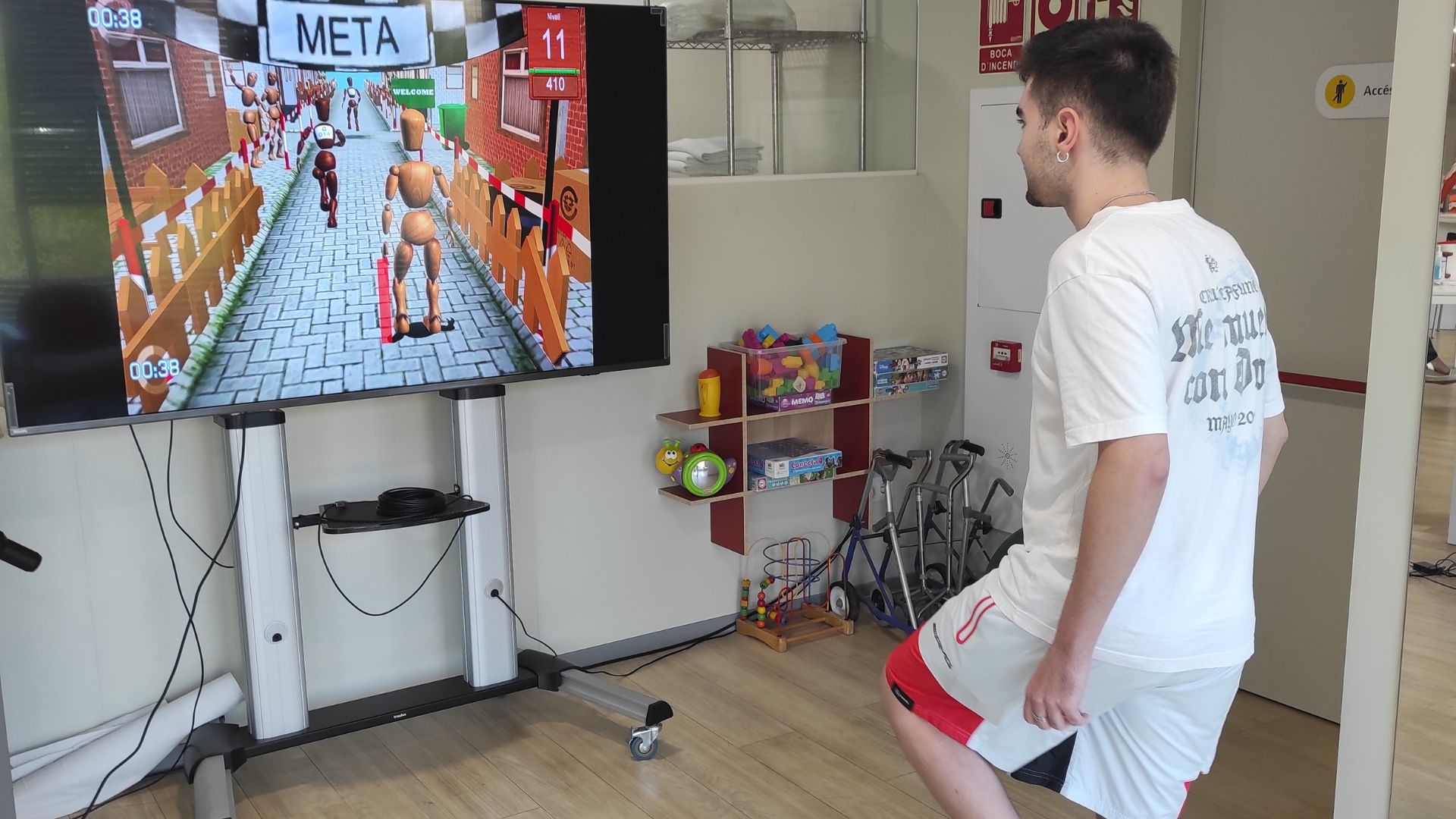
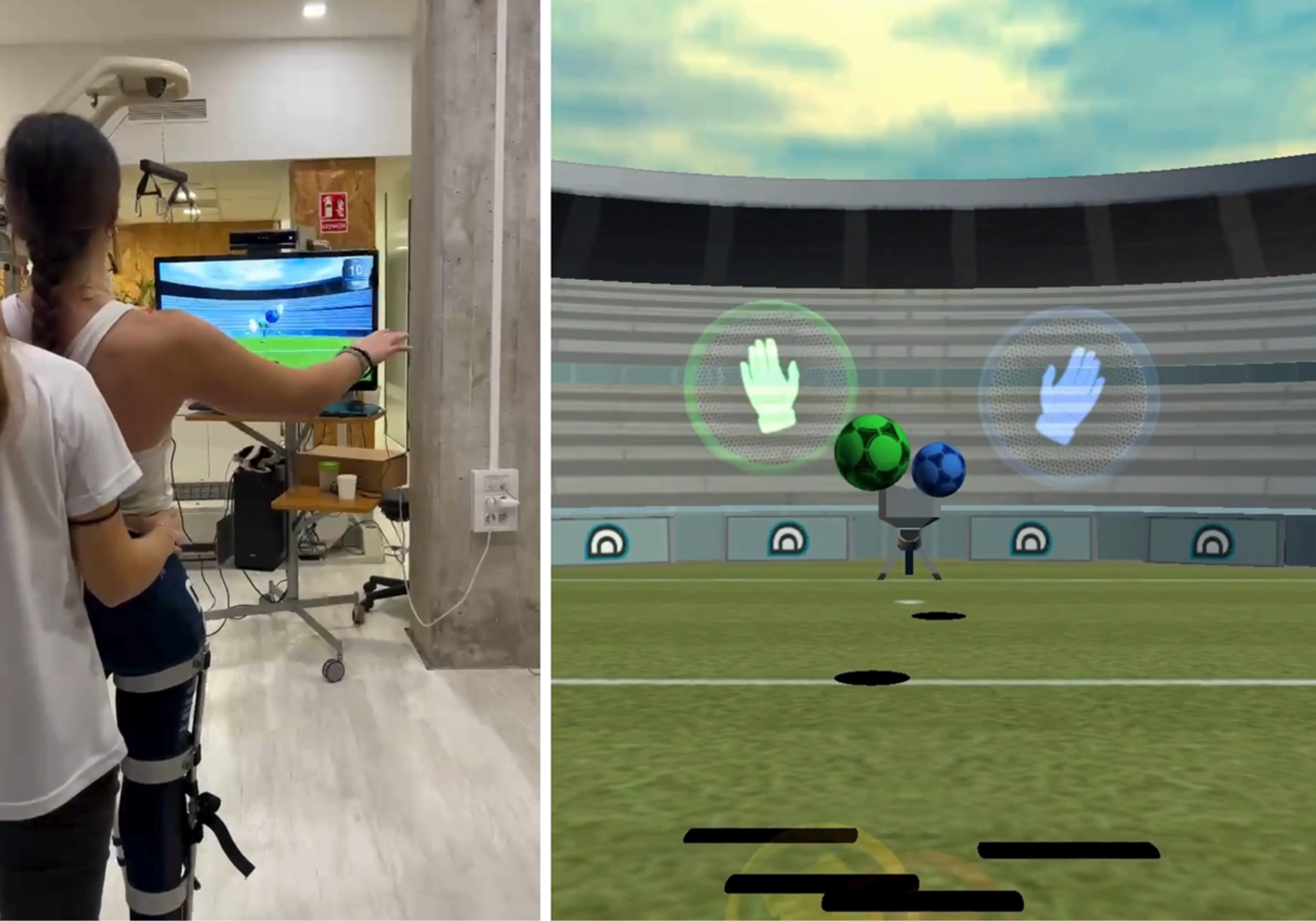
Motion capture platforms used in rehabilitation—including Rehametrics—allow for the recording, during the therapeutic exercise itself and without the patient noticing that they are being “measured” in any additional way, of variables such as the range of motion of the shoulder, hip, elbow, and knee; the number of repetitions completed; and the speed of execution. In balance exercises, it also records the center of gravity and the base of support. The data is captured using a camera, without the need to attach sensors to the patient’s body or use controllers, which makes it easy to use in a clinical setting without adding to setup time.
In all exercises, the software also automatically adjusts the difficulty level as the patient reaches a certain percentage of correct answers relative to the set goal, which provides additional information—such as the patient’s current level compared to two weeks ago—without requiring the professional to manually recalculate it session after session.
None of these data points can replace a physical examination or the professional’s judgment regarding what an improvement in range or repetitions means for that specific patient. What they do provide is an objective and reproducible time series that can be compared across sessions—something that subjective assessment, by its very nature, does not allow for with the same consistency.
From data to a useful report for the team
A single data point from a single session has limited value; what provides clinical value is seeing it tracked over the course of treatment. Rehametrics compiles these records into automatic, exportable, and customizable progress reports that show how range of motion, repetitions, or balance data have changed over the weeks. This allows the professional to review progress at a glance, rather than having to reconstruct it from memory session by session.
It is important to be clear about what this is and what it is not: a progress report provides an objective record of clinical data, but it does not replace or equate to the medical-legal documentation of the process, which continues to be based on the judgment and report of the rehabilitation physician or the relevant department. Its value lies in providing that documentation—and the team’s internal communication—with a more solid data foundation than subjective assessment alone, not in generating it automatically.
The Experience of Spanish Mutual Insurance Companies with Virtual Rehabilitation
This is not just a theoretical proposal. Several Spanish mutual insurance companies have incorporated this type of technology into their rehabilitation services. Unión de Mutuas is one such example: it implemented the technology in 2017, and its medical and physical therapy team has published the results of its experience in scientific journals. A study published in the Revista Española de Traumatología Laboral (2020;3(2):123-31) presents the results of a satisfaction survey of 149 patients with shoulder conditions who were treated with Rehametrics at the company’s centers during 2019.
It is important to be clear about what this study measures: it is a patient satisfaction survey, not an analysis of objective clinical data. Even so, its results are relevant to this article for two reasons. First, because it confirms that this type of technology has been integrated into the actual healthcare practice of Spanish mutual insurance companies for several years now, with a track record and published research to back it up. Second, because it describes a working model that aligns with all of the above: each protocol is initially reviewed by the rehabilitation physician; the physical therapist adjusts repetitions, duration, and equipment based on each patient’s progress; and supervision—initially direct during all sessions—is gradually reduced as the patient gains autonomy. The technology provides the data; the team retains the professional judgment.
Regarding satisfaction results: 62.6% of patients rated the effect on their motivation as “very satisfactory” (with an additional 26.17% rating it as “satisfactory”), and 71.0% rated the treatment as “very satisfactory” in terms of perceived quality. Overall satisfaction was “very satisfactory” for 51.40% and “satisfactory” for 29.91% of respondents. These are patient perception data, not measured functional progress, but they help explain why this approach has remained in use several years after its implementation.
The Role of Rehametrics in Objectifying Evolution
Rehametrics Physical includes exercises for joint range of motion, body control, coordination, and balance, with motion capture that tracks shoulder, hip, elbow, and knee range of motion, repetitions, and speed—and, for balance exercises, center of gravity and base of support—without the need for body sensors or controllers. This allows it to be used for different musculoskeletal injury profiles—shoulder, hip, elbow, knee, or balance control—within the same workflow, which is especially practical in facilities that, as is often the case with workers’ compensation providers, treat a high and varied volume of patients.
These records are compiled into automatic progress reports—which are exportable and customizable—that provide the team with a quantitative benchmark for deciding when to increase the workload, when to maintain the level of difficulty, and how to communicate the patient’s progress using data rather than just impressions. The decision regarding what to progress, when to do so, and how much weight to give that data relative to the clinical examination remains, at all times, with the professional managing the case.
This same principle of supporting—not replacing—clinical judgment is the guiding thread of our guide to technology-assisted musculoskeletal rehabilitation, which outlines how to measure what matters throughout the entire process, from pain management to a return to activity.
Related Resources
Range, repetitions, and balance
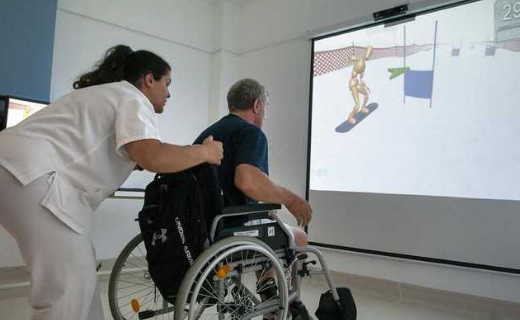
Motion capture without sensors or controllers for the shoulder, hip, elbow, and knee, with tracking of range of motion, repetitions, speed, and—for balance exercises—center of gravity and base of support.
View module →
Exportable progress reports
Automatic, exportable, and customizable reports that track the patient's progress throughout treatment.
See clinical validation →
Treatment adherence in mutual insurance companies
The other key factor alongside objectification: why adherence has such a significant impact on outcomes in shoulder pathology.
Read article →Frequently Asked Questions
Do Rehametrics' progress reports replace the medical-legal report for the case?
What specific data does Rehametrics record during a musculoskeletal rehabilitation session?
Is there any real-world experience with Spanish mutual insurance companies using this type of technology?
Can the reports be exported so they can be shared with the rest of the team?
Does this apply to any musculoskeletal injury covered by private health insurance?
Would you like to see how progress is tracked during a session?
We'll show you how Rehametrics tracks range of motion, repetitions, and balance, and how it converts this data into exportable progress reports for your team.
Request a demo