
Physical therapy clinic treating trauma patients: three management challenges and how to tackle them
Patients who do not complete their treatment, results that are hard to prove to whoever is paying for the session, and a treatment room that has no more capacity to give. Three separate matters that end up on the same desk, the director's, and here we review what room for manoeuvre there is in each one.
What puts pressure on managing a physical therapy clinic treating trauma patients
In a physical therapy clinic treating trauma patients there is one particularity that shapes the whole of management: a good share of the caseload involves long processes. An anterior cruciate ligament reconstruction, a rotator cuff repair, a knee arthroplasty or a lower limb fracture are not resolved in five sessions. They occupy the diary for months, pass through phases with very different objectives, and go through the hands of several professionals on the team.
On top of that baseline, pressures accumulate that management knows well. Patients compare centres and prices before deciding where to continue their treatment, and increasingly ask what they will get in return. The orthopaedic surgeon who refers wants to know how the patients they sent are progressing. And staff and floor-space costs rise faster than the average price per session, which means growing by hiring in the same proportion stops being viable in many centres.
Not every centre weighs these fronts equally. A clinic heavily focused on knee and shoulder post-surgical work feels the second one more acutely than a practice centred on sport and return to activity, where acquisition and retention probably matter more. The three sections that follow can be read separately, depending on which one is pressing hardest in each case. If the front that worries you most is the competitive one, we covered that angle in the article on how to set your rehabilitation clinic apart from the competition.

Challenge 1: patients who drop off before finishing
In trauma patients, dropping out is rarely caused by dissatisfaction. It usually happens because pain improves before function does. The patient stops noticing discomfort in everyday activities, concludes they have recovered and discharges themselves, weeks before regaining strength, control or confidence in the movement. Then they come back, at best, with a recurrence.
Figures in the literature vary considerably depending on what is measured and how, so they are best taken as an order of magnitude rather than an exact reference. Home exercise programmes have reported non-adherence rates exceeding half of patients, and in chronic low back pain a systematic review published in The Spine Journal (2013) found similar ranges along with the factors that most influence them, among them patient self-efficacy and support from those around them. On top of that comes plain non-attendance: a study across three centres of the Agencia Sanitaria Costa del Sol put outpatient appointments not kept at 13.8%, with an economic impact of more than three million euros. That is a public, hospital setting, different from a private clinic, but it gives an idea of what a repeated gap in the diary costs.
The classic levers remain the first ones to pull: setting realistic expectations about duration at the first visit, translating the objective into something the patient understands (running again, climbing stairs without support, sleeping on the operated side), reminding patients of appointments and spotting early the patient who starts spacing them out. We developed several of these in the article on how to improve adherence to rehabilitation treatments.
Where a platform such as Rehametrics can add something is at the most fragile point of that process, the stretch in which the patient no longer feels pain but has not yet recovered function. The system records, during the exercise itself, range of motion at the shoulder, hip, elbow and knee, repetitions completed and movement speed, and in balance tasks the centre of gravity and base of support. With those records the physiotherapist can show the patient, with a graph rather than an opinion, that their operated knee is still ten degrees behind the other side even though it does not hurt. A satisfaction survey published in the Revista Española de Traumatología Laboral (2020;3(2):123-31) by a Spanish orthopaedic rehabilitation service, covering 149 patients with shoulder conditions treated with Rehametrics, records that 62.6% rated the effect on their motivation as "very satisfactory". It should be read for what it is, patient perception rather than measured adherence, but it points in a direction consistent with what the teams using it describe.
Challenge 2: proving results to whoever pays and whoever refers
In a private centre there are two conversations that repeat every week and that are won or lost on the same thing. The first is with the patient who has paid for twelve sessions out of their own pocket and asks, quite rightly, what has changed since the first one. The second is with the orthopaedic surgeon who refers, or with the insurer that authorises a fixed number of sessions, when you have to make the case for why the process needs to continue.
The professional treating the patient has a clear answer from their examination and from what they see each week. The difficulty appears when that reasoning has to travel to someone who has not been present at a single session. "Good progress" and "the patient reports feeling better" describe well what happens in the treatment room, but they hold up poorly in a discussion about additional sessions, and even more poorly in a repeat purchase decision by a patient comparing centres.
Here the contribution of technology is direct, because the record is generated during treatment without extra steps for the patient or the professional. Rehametrics captures movement by camera, without body sensors or controllers, and compiles the records into automatic progress reports that are exportable and customisable. The team can see at a glance how range of motion or the number of repetitions has changed over the weeks, instead of reconstructing it from scattered notes. That same document serves three different purposes within the centre: showing it to the patient at the end of a phase, attaching it to the report that goes back to the referring doctor, and supporting an authorisation request.
The specific workflow, step by step, is set out in the article on how to objectify patient progress with data from each session.

Challenge 3: treating more patients without lowering standards
Staff costs are almost always the largest line in a physical therapy clinic's profit and loss account, and the one that most conditions profitability once the diary is full. With the treatment room at capacity during peak hours, the usual options are to expand the team, expand the space, or review how time is allocated within each session.
The third route usually offers the most room without compromising quality, because not all treatment time requires the same intensity of attention. Manual therapy, assessment, adjusting the progression or working with an immediate post-surgical case require the professional's full attention. The active work of a patient who has already passed the early phases allows, in many cases, a lower degree of supervision, provided the professional can check afterwards what they actually did and how well they executed it.
The rehabilitation service whose experience we cited earlier describes a model along those lines. The doctor initially reviews the protocol, the physiotherapist adjusts repetitions, execution time and accessories according to how each patient progresses, and supervision, direct in every session at the start, is progressively reduced as the patient gains autonomy.
In this area, two product characteristics have an operational rather than clinical effect. Camera-based capture avoids fitting sensors or handing out controllers, which reduces preparation time between patients. And having difficulty adjust automatically across all exercises, according to the patient's success rate against the target set, avoids someone having to recalibrate the task manually each time. The platform brings together more than 360 exercises across the Physical, Cognitive and VR modules, so a single station serves very different profiles in the diary.
What the evidence says in orthopaedic conditions
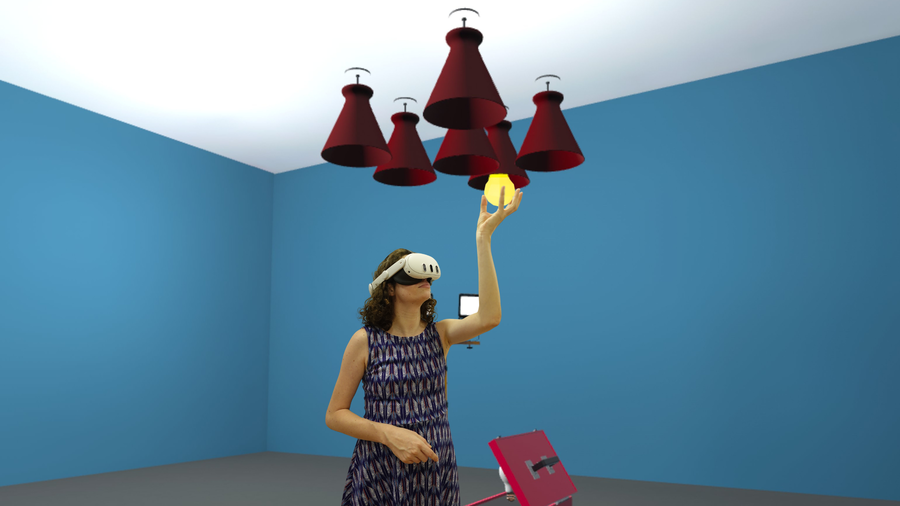
No investment decision should rest on management arguments alone, so it is worth reviewing what backing virtual reality has when applied to this type of condition, including its limits.
An umbrella review published in the Journal of Medical Internet Research (2025;27:e64576), bringing together 14 meta-analyses and more than 13,000 patients with musculoskeletal conditions, finds favourable results in several presentations: pain reduction and improved balance in the knee, immediate pain reduction in low back pain, and improvements on the HSS and WOMAC scales after arthroplasty. It also finds no significant differences in other variables, such as gait speed, range of motion in some analyses, or the six-minute walk test. The review itself notes that the GRADE quality of most results is low or moderate, with a single high-quality result among the 39 assessed, so the reasonable reading is promising support rather than a settled conclusion.
In specific processes that weigh heavily on a rehabilitation centre's diary, a meta-analysis published in PLOS ONE (2025) covering 6 trials and 387 patients after anterior cruciate ligament reconstruction describes improvements on the IKDC scale, in gait and in knee muscle strength compared with conventional rehabilitation. In frozen shoulder, a randomised controlled trial published in Physiotherapy Theory and Practice (2025;41(7):1435-1446), with 36 patients, found significant improvements in pain and range of motion relative to baseline.
Sample sizes are moderate and protocols heterogeneous across studies, which limits how far the findings can be generalised. With that caveat in place, the body of evidence supports the use of these tools as a complement to therapeutic exercise in selected patients and under professional supervision. How much weight to give this evidence against other factors in the centre, from the patient profile to the team's experience, is a judgement for each management team together with their clinicians. You can consult the details of the studies in the clinical validation section.
Questions worth asking before bringing in technology
The difference between an adoption that takes hold and equipment gathering dust in a corner rarely lies in the product. Five prior decisions explain a good part of the outcome.
- Which phases it will be used in. With a patient in the early phase, use is possible from early on, with tightly bounded parameters and direct supervision; with a patient in the intermediate or return-to-activity phase, it allows longer sessions and less supervision. Knowing how the caseload is distributed helps estimate how many stations are needed and in which time slots.
- Who leads it within the team. Without a professional who makes it their own and trains the rest, use tends to fade away in the first few weeks. It is worth identifying that person before installing anything.
- How it fits into the diary. Defining which time slots and which phases of treatment it is used in stops it depending on whether there happens to be a gap that day.
- Which figure you will look at to know whether it is working. Sessions completed per case, drop-out rate before discharge, number of reports exported or patient ratings are all different indicators. Choosing one or two and measuring them at three and six months avoids discussions based on impressions.
- What guarantees the product carries. Being a medical device with CE marking, with published studies behind it and with support and training included, changes the conversation considerably, both with the clinical team and with an insurer or a referring doctor.
None of these questions has a single answer for every centre, and there are management teams that will prioritise other aspects, such as the image of an advanced centre in the eyes of private patients or the possibility of opening a new service line. All of them are legitimate reasons, provided the decision about which patient does what stays where it belongs, in the hands of the clinical team. You can see how it is being used in other centres in the section on rehab centres.
Modules relevant to orthopaedic rehabilitation

Active work with objective recording
Range of motion, body control, coordination and balance exercises with camera-based capture, without sensors or controllers, and recording of range, repetitions and speed.
View module →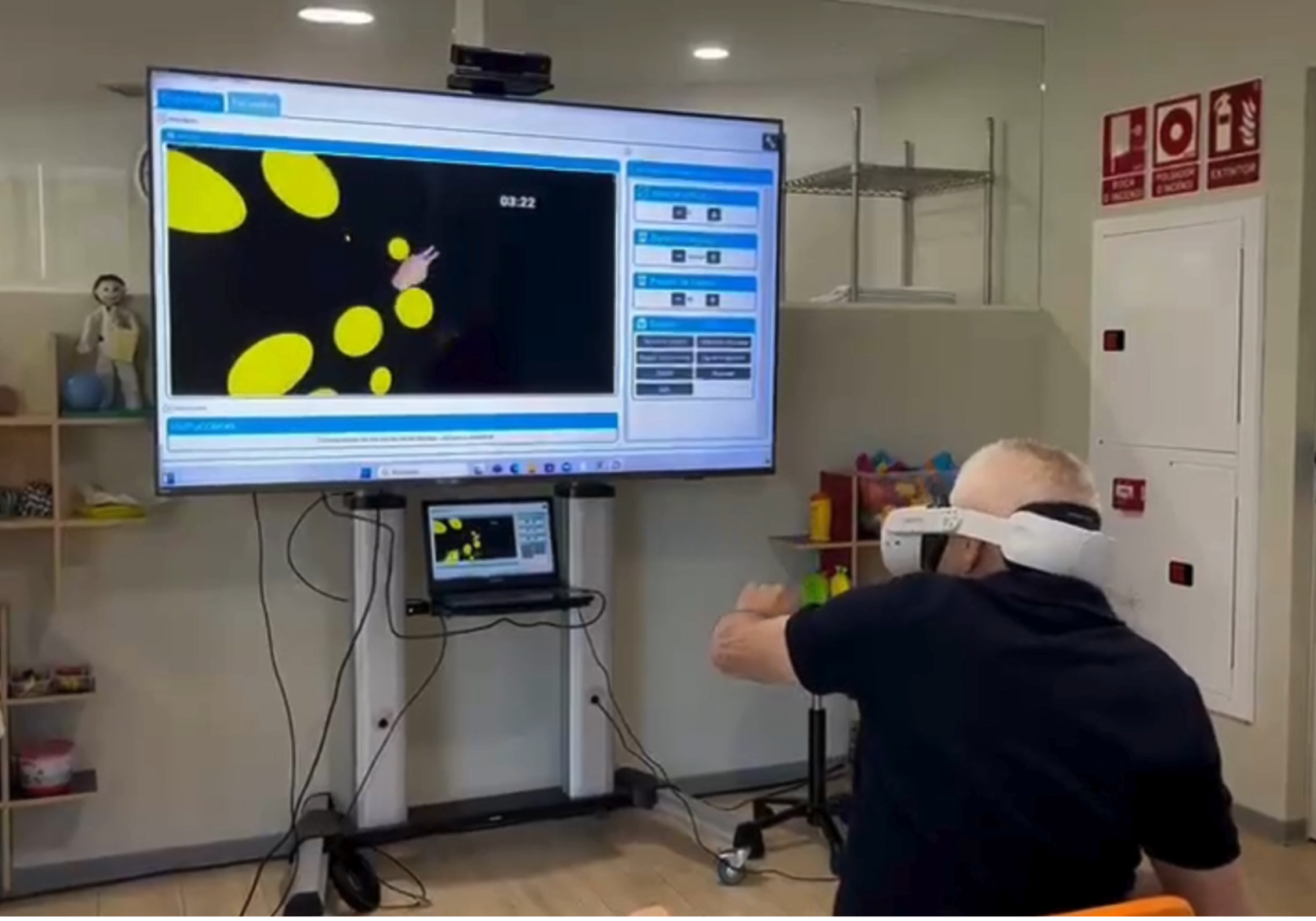
Gradable functional tasks
Immersive and mixed reality environments to reproduce everyday and sporting movements within a progression controlled by the professional.
View module →
Exportable progress
Automatic, customisable reports showing progress throughout treatment, useful in communication with the patient and with third-party payers.
See clinical validation →Frequently asked questions
Does it make sense if my clinic mainly treats recent post-surgical cases?
It is used in the early phase too, with direct supervision from the physiotherapist and the activity configured for that phase: limited range, low difficulty, no time pressure, and working the side and plane of interest. What changes as the process advances is not whether the tool is useful, but how much supervision each session needs and how much weight active work can carry within the plan. In a centre heavily focused on recent post-surgical cases, use starts earlier than is usually assumed, always with the professional alongside.
How much space and how much training are needed?
A workstation with camera-based capture needs a clear area for the patient to move safely, without building work or complex installation. As for training, what matters is not the initial hours but having someone on the team take on the roll-out and support the rest during the first weeks of use.
Can it replace manual physical therapy sessions?
It is not designed for that. It works as part of the active work within a plan that the physiotherapist continues to prescribe and supervise, and which patient uses it, at what point and with how much supervision is decided by the clinical team. Using it to cut manual treatment time where that treatment is indicated usually ends up affecting the outcome.
How do you measure whether the investment is working?
The most manageable indicators in a small or medium-sized centre are usually the proportion of patients who complete the planned course, sessions missed per case, and actual platform use per professional. Comparing them with the months before adoption, and reviewing them at three and six months, gives a more reliable reading than the team's impression, although many factors unrelated to the technology are involved and they should be interpreted with that caution.
Are the reports useful for justifying additional sessions to the patient or their insurer?
They provide a quantitative basis for functional progress that accompanies the clinical report and helps explain why a process needs to continue, both to the patient and to whoever authorises the sessions. The documentation that formally supports a discharge remains the responsibility of the doctor in charge, according to each organisation's process.
Want to see how it would fit in your centre?
We will show you, with real orthopaedic rehabilitation cases, how Rehametrics fits into the diary, what data it records and what reports it generates for the team, for the patient and for the referrer.