
Motor variability in neurological rehabilitation: why repetition doesn’t always mean improvement
For years, repetition has been considered one of the unquestionable pillars of neurorehabilitation. The logic is seemingly sound: if the brain needs to reorganise itself after an injury, repeating a movement many times should reinforce the neural connections involved and promote functional recovery.
However, daily clinical experience shows a more nuanced reality. It is common to see patients performing hundreds of repetitions of the same exercise with modest improvements in the therapeutic setting, but with little transfer to activities of daily living. In other cases, repeated repetition of a task ends up consolidating inefficient compensatory strategies, especially in patients with hemiparesis.
The question, therefore, is not whether we should repeat —because repetition is necessary—, but how we structure that repetition. Motor learning does not depend exclusively on the number of attempts, but also on the variability, the adaptation and the context in which the practice takes place. This is where the concept of a32> motor variability acquires clinical relevance.
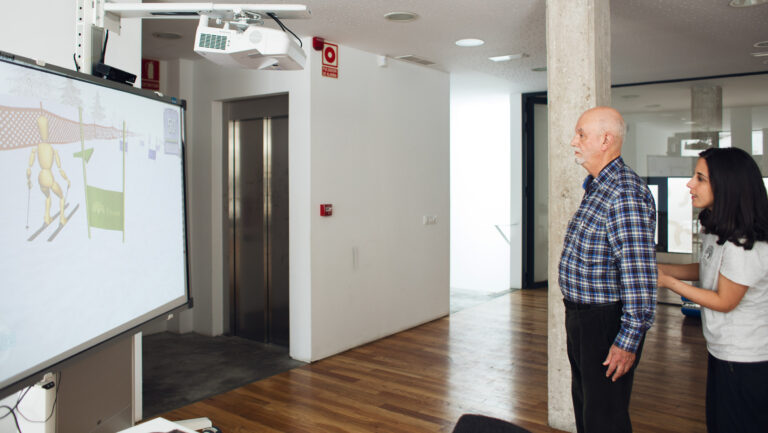
Table of contents
What is motor variability?
Adaptive variability vs disorganised variability
In general terms, motor variability refers to the small differences that appear between successive performances of the same task. Traditionally, in neurological rehabilitation, there has been a tendency to interpret any variation as a sign of lack of control. However, not all variability is negative.
It is important to distinguish between disorganised variability, characteristic of an injured neuromotor system that has not yet stabilised effective strategies, and adaptive variability, which reflects the system’s ability to explore different motor solutions in response to changes in the environment or task.
From a motor control perspective, an overly rigid system is not necessarily more efficient. In fact, the ability to adjust movement to small contextual variations is an essential feature of healthy motor function.
Relationship with motor learning and motor control
Contemporary models of motor learning indicate that constant practice improves performance under specific conditions, but a9> performance under specific conditions, but it may limit generalisation. On the contrary, variable practice —that which introduces systematic changes in the task or environment — promotes long-term retention and transfer to new situations.
In the context of neurological rehabilitation, this implies training a single pattern of reach, in a single plane and at a single speed, can improve that specific movement, but it does not guarantee that the patient will be able to use the affected limb effectively in real-life situations, where demands are constantly changing.
Implications in hemiparesis
In patients with hemiparesis following a stroke, rigid repetition can reinforce compensatory patterns such as excessive shoulder elevation, trunk tilt, or dependence on the healthy limb. If progressive adjustments are not introduced into the task, the system learns to “solve” the exercise, but not necessarily to recover a more efficient motor strategy.
Structured variability allows the expansion of the available motor repertoire, promoting a reorganisation that is more flexible and functional.
Repetition vs practice variable in stroke
Acute phase
In acute phases, the neuromotor system is in a highly vulnerable state. Guided repetition of basic patterns may be necessary to facilitate activation, reduce fear of movement, and establish a minimum basis for control. At this point, variability should be introduced cautiously, avoiding overloading a system that is still unstable.
Subacute phase
The subacute phase represents a particularly relevant window for introducing progressive variability. As the patient regains some control, modifying parameters such as speed, direction, support base, or attentional demand can stimulate more complex adaptation processes.
During this period, the variable practice not only promotes improvement in the trained task, but also can increase the probability of functional transfer.
Chronic phase
In chronic phases, many patients achieve therapeutic goals a7> when the treatment is based on tasks repeated without progression. The introduction of controlled variability can reactivate learning processes and a22> learning processes and avoid the automation of inefficient patterns.
In this context, variability becomes a strategic tool for breaking down functional rigidity and stimulating new approaches. to break functional rigidity and stimulate new motor solutions.
Current scientific evidence
The evidence in motor learning supports the usefulness of contextual interference, that is, the alternation between tasks or variations within tasks. a8> between tasks or variations within the same task. Although this methodology may reduce performance immediately during the session, it improves retention and transfer in the medium and long term.
Likewise, distributed practice and task-oriented training yield better outcomes when structured with progressive variability. In neurorehabilitation, programmes that combine intensity with dynamic adaptation tend to achieve better functional results than those based solely on constant repetition.
This does not imply abandoning repetition, but rather integrating within a more a9> therapeutic structure that is more flexible and based on principles of learning.
How to introduce variability into clinical practice
Variability should not be improvised. It should respond to specific objectives and be aligned with the patient’s functional level.
Modifying the environment is a simple and effective strategy. Changing the height of a surface, the position of the object, or the stability of the support forces the system to recalibrate the movement.
It is also possible to introduce variations in speed, in the amplitude of the movement or in the resistance applied. These modifications, when they are dosed appropriately, stimulate adaptation without causing excessive frustration.
The integration of cognitive tasks or dual tasks adds an additional dimension, which is particularly relevant in neurological patients, where the attentional component directly influences motor control.
In all cases, variability must be oriented towards real functional objectives. Changing parameters without a clear purpose can generate noise therapeutic without providing benefits.
Digital rehabilitation and motor variability
Digital rehabilitation offers a significant advantage in this context: the ability to structure and measure variability objectively.
Digital platforms allow systematic changes to be programmed in difficulty, virtual environment or demands for precision, virtual environment or demands for precision, maintaining consistency in therapeutic progression. Furthermore, the continuous recording of metrics such as time of a23> execution, number of repetitions, accuracy or variability of performance facilitates a analysis longitudinal more accurate.
From a clinical perspective, this allows the intervention to be tailored based on objective data, rather than solely on the therapist’s subjective impression. Technology does not replace clinical judgment, but it expands the ability to control dosage, intensity, and progression, facilitating structured and monitored variability.
In this regard, well-integrated digitalization can serve as a tool that optimizes the application of motor learning principles in daily practice.
Common mistakes in clinical practice
One of the most common mistakes is confusing variability with improvisation. Introducing random changes without a clear objective does not promote learning; rather, it can lead to disorganization.
Another common mistake is increasing the complexity too soon. If the patient has not yet established a basic level of control, excessive variability can lead to frustration and abandonment.
It is also common to assess improvement solely within the therapeutic setting, without analyzing functional transfer. Without this measurement, it is difficult to know whether variability is achieving its primary goal: improving function in real-world settings.
Clinical conclusions
Repetition remains an essential component of neurorehabilitation, but it should be viewed as part of a broader strategy. Structured motor variability promotes adaptation, retention, and functional transfer.
In clinical practice, the challenge is not simply to increase the number of repetitions, but to design therapeutic experiences that encourage the controlled exploration of motor solutions.
The integration of digital tools makes it possible to structure this variability with greater precision and measure its impact objectively. Ultimately, the goal is not to perfect a specific exercise in the clinic, but to improve the patient’s ability to function independently in their daily environment.
Frequently Asked Questions
Not always. Repetition is necessary to reinforce motor patterns, but without variety, it can limit functional transfer. Varied practice promotes adaptation and long-term learning.
It allows for the exploration of different motor solutions, reduces functional rigidity, and improves the transfer of movement to activities of daily living.
This is particularly important during the subacute and chronic phases, when the patient has already regained some motor control and can benefit from gradual adaptation.
Digital platforms allow for automatic adjustment of difficulty levels, tracking of objective metrics, and the implementation of structured variations, facilitating progression based on clinical data.