
Stroke and acquired brain injury: Rehabilitation and how to grade cognitive task difficulty by phase
In cognitive rehabilitation, the variable most often manipulated during a session is not the exercise chosen but its level of demand. Getting it right depends on the phase the patient is in, on what you observe while they work, and on knowing which axis to move when something is not working.
Why difficulty is the central clinical decision
In a cognitive rehabilitation session after a stroke or a traumatic brain injury, the therapist makes many small decisions: which activity to set, how long to sustain it, when to give a cue, when to stop. Almost all of them come down to the same thing, which is where to set the bar. If the task falls below what the patient already resolves without effort, the session turns into a check of what they have retained. If it sits far above, frustration, fatigue and drop-out appear, and the information obtained is not much use either.
The challenge point framework, described by Guadagnoli and Lee (2004) for motor learning, is also useful here as a way of thinking: learning is optimised in an intermediate band of difficulty, and that band shifts as the person improves. What is an appropriate challenge today may fall short in three weeks. It is best taken as a conceptual model rather than a formula: it was formulated for motor tasks and its transfer to cognition after brain injury is reasonable, but it has not been validated in the same way.
The practical consequence is that difficulty should be reviewed with the same regularity as the dose of physical exercise, rather than being set in the first session and left unchanged for months.

What changes between the acute, subacute and chronic phases
The phases are not watertight compartments and their duration varies considerably between patients, but they help orient what can be asked for and what to expect.
Acute and early subacute phase
Here the limiting factor is usually tolerance, not capacity. High fatigability, fluctuations across the day, fragile sustained attention and, in some cases, disorientation or confusion. Long sessions yield little. A brief, repeated format tends to work better, with single-step tasks, few simultaneous stimuli, no time pressure and the therapist very present to redirect. The realistic objective of this period is often to maintain activity and identify which domains are most affected, rather than to produce measurable improvements week by week.
Subacute phase
This is where the most productive work tends to concentrate. The person tolerates longer sessions, moderate time pressure can be introduced, the number of stimuli can be increased and supports can start to be withdrawn. It is also the point at which it makes sense to start requiring the task to resemble something from real life, rather than staying in an abstract format.
Chronic phase
The expectation of spontaneous recovery diminishes and the emphasis shifts towards transfer: making what is worked on in session show up at home. Here compensatory strategies, training in everyday tasks and dual tasking gain prominence over training an isolated domain. How much emphasis to give each approach in this phase is a matter of legitimate debate among professionals, and depends considerably on the patient's profile and goals.
The axes along which a cognitive task can be graded
When an activity does not fit, the most frequent reaction is to change the activity. Often it is enough to move a single parameter. These are the axes that tend to offer the most scope:
- Number of stimuli. How many elements have to be processed or held at once. It is the most direct axis and the one that changes the workload fastest.
- Distractors. Adding irrelevant elements that compete for attention. This is different from increasing the number of relevant stimuli and affects different processes.
- Time pressure. From an untimed task to a response within a short window. In early phases, removing time pressure shows what the patient is capable of when processing speed is not penalising them.
- Supports and cues. Semantic cues, visual aids, reminders of the instruction. Withdrawing them gradually is a progression in itself, even if the task does not change.
- Duration and number of trials. This mainly affects sustained attention and fatigability, which in brain injury shape outcomes more than is usually acknowledged.
- Executive demand. Adding set-shifting, sequencing, inhibition or dual tasking turns a simple activity into an executive task without changing its appearance.
- Task context. Moving from an abstract format to a recognisable everyday situation. This is the axis most closely related to transfer and the one most often forgotten.
The practical recommendation is to move one axis at a time and to record which one was moved. When three parameters are changed at once and performance drops, there is no way of knowing what to revert.

What the evidence supports and where caution is advisable
This is an area where results are sometimes promised a little too freely, so it is worth looking at the actual numbers. And those available for structured computerised cognitive training after stroke are reasonably favourable.
A systematic review with meta-analysis published in JMIR (2025;27:e73140), bringing together 19 randomised controlled trials and 875 patients with post-stroke cognitive impairment, finds significant improvements compared with control groups in:
- General cognitive function (SMD 0.46; 95% CI 0.21–0.71), with moderate-quality evidence.
- Attention, with high-quality evidence and practically zero heterogeneity between studies, which is an uncommon indicator of consistency in this field.
- Executive functions (SMD 0.39; 95% CI 0.12–0.67), with moderate quality.
- Quality of life (SMD 0.34; 95% CI 0.15–0.53), with high quality.
There is also a finding with a direct practical reading: the more intensive programmes concentrated in time — more than three sessions a week over six weeks or less — obtained better results than longer, more spaced-out programmes. If that difference is confirmed in later studies, it suggests that frequency matters as much as the total number of sessions when planning treatment.
The same authors point out where it is best not to go beyond what the data allow: in memory the improvement did not reach statistical significance and heterogeneity between studies was high, and only six trials contributed follow-up data at one or three months, so maintenance of the effect is far less documented than the immediate effect.
On this last point a clarification is worth adding, as it is frequently misread. The Cochrane review by Loetscher and colleagues (2019) on cognitive rehabilitation of attention deficits after stroke found improvement in divided attention immediately after treatment (SMD 0.67), but concluded that there were insufficient data to draw conclusions about long-term maintenance. That review rests on just six trials and 223 participants, and its conclusion describes the scarcity of research available at the time, not an effect shown to be absent. It is an important distinction: the question of whether the benefit persists remains open, and more recent meta-analyses now work with considerably larger evidence bases.
The INCOG 2.0 guidelines (2023), in their section on attention and processing speed, contribute the part most useful for designing the session. They recommend, at level A, metacognitive strategy training applied to everyday activities and dual-task practice, and specify that computerised attention tasks should not constitute the sole intervention, without accompanying functional work. Read positively, this is a fairly concrete indication of how to integrate them: structured, graded practice to accumulate volume and calibrate the level, combined with tasks that have context and with the professional's work on strategies, awareness of the deficit and transfer.
Taken together, digital work by domain now has support for delivering improvements in general cognition, attention, executive functions and quality of life, and works better when it forms part of a plan that also includes functional tasks. We approach this balance between tool and professional judgement from another angle in the article on how to increase participation in neuropsychology sessions.
How to read the patient's response session by session
The overall percentage of correct answers is the least informative figure of all those that can be recorded. Two patients with 70% correct may be in opposite clinical situations: one fails at the end of the task through fatigue, the other fails from the start when distractors appear. What guides the decision is the pattern, not the number.
Three readings tend to pay off in practice:
- Where the errors cluster. If they group in the final trials, the axis to move is probably duration. If they appear when distractors increase, the problem is selective attention and it is better to step back along that specific axis rather than lowering overall difficulty.
- The relationship between correct answers and response time. A patient who maintains their accuracy but takes longer and longer is compensating with effort, and that effort has a cost that will show up later in the session or at home. A simultaneous improvement in accuracy and in time is a stronger signal than an improvement in either one on its own.
- What happens between sessions rather than within one. Cognitive performance fluctuates with sleep, mood, medication and time of day. One bad session does not mean regression. The trend across several weeks says considerably more than a comparison between Tuesday and Thursday.
Recording this by hand is possible and many teams do it, although it is usually the first thing to be dropped when the diary gets tight. Having it recorded automatically changes the clinical reasoning very little and the likelihood of the information being available when the decision has to be made a great deal.

How Rehametrics Cognitive fits into this logic
Rehametrics Cognitive includes more than 190 exercises with multiple levels and environments, organised by domain: attention, memory, working memory, processing speed, language and executive functions. It can be used with a mouse or a touchscreen, both at the centre and at home, which makes it easier to maintain continuity between in-person sessions.
In relation to what this article covers, three aspects are directly applicable:
- Automatic level adjustment. Difficulty adapts according to the patient's performance, which helps keep the task within the useful band of demand throughout the session without the therapist having to reconfigure it on every trial.
- Recording by error type. As well as correct answers and errors, the system records the type of stimulus involved and the number of distractors present, along with response time. That is precisely the information that makes it possible to distinguish a failure through fatigue from a failure through interference.
- Progress reports. Records accumulate across the course of treatment and can be printed or exported, which makes it easier to review the trend with the patient and the family, and to document the plan when it has to be justified to third parties.
For the transfer work to everyday life — the point where the evidence specifically asks that not everything stays on the screen — the occupational module with immersive virtual reality adds activities of daily living, praxis and fine motor skills, with remote control from an external computer, so that the professional directs the session without interrupting the patient. How the two modules are combined and in what proportion depends on the patient's profile, the phase they are in and the team's judgement.
The decision about which exercise to prescribe, when to raise the level, when to introduce dual tasking and when to move to functional tasks remains the professional's. The platform provides the repertoire, the continuous adjustment and the record; the clinical reasoning is not delegated.
Modules relevant to neurorehabilitation
More than 190 exercises by domain
Attention, memory, working memory, processing speed, language and executive functions, with automatic level adjustment and recording of correct answers, errors and response time.
View module →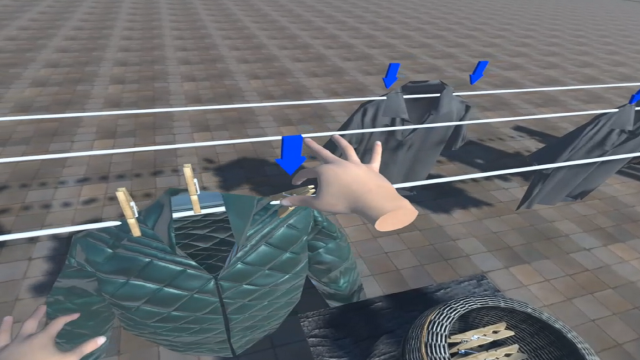
Activities of daily living
Functional tasks and praxis in an immersive environment, with remote control from an external computer, to work on transfer beyond the screen format.
View module →
Automatic reports
Progress by domain across the course of treatment, exportable and printable, to review the trend and document progression decisions.
View reports →Frequently asked questions
When should the difficulty level of a cognitive task be raised?
When the patient maintains high performance consistently across several sessions and response time has reduced or stabilised. A single good result in one session is not enough, because cognitive performance fluctuates with rest, mood and time of day.
What do I do if the patient makes a lot of errors but is motivated?
It is worth identifying which axis they are failing on before lowering overall difficulty: if errors cluster at the end, the problem is usually duration; if they appear with distractors, it is selective attention; if response time shoots up, it may be processing speed. Stepping back only on the affected axis keeps the rest of the challenge intact.
Do on-screen exercises help improve the patient's everyday life?
The 2025 meta-analysis in patients with post-stroke cognitive impairment finds significant improvements in general cognitive function, attention, executive functions and quality of life, the last of these measured directly on the patient's day-to-day life. To reinforce transfer, the INCOG 2.0 guidelines recommend accompanying structured work with functional tasks and with strategy training applied to everyday activities, rather than leaving it as the sole intervention.
Can cognitive work begin in the acute phase?
It depends on the patient's condition and the team's judgement. In the acute phase tolerance usually takes priority: brief sessions, single-step tasks, few stimuli and no time pressure, with more modest expectations of progression. Where there is fluctuating level of consciousness, confusion or marked fatigue, clinical assessment takes precedence over any protocol.
How often should the difficulty plan be reviewed?
There is no standard interval. Many teams review at least every two or three weeks, and sooner if clear changes appear in performance or tolerance. What matters is that the review is deliberate and recorded, so that changes in level can be related to changes in the patient's response.
Want to see it with your own patients?
We will show you how cognitive rehabilitation sessions are prescribed, graded and recorded with Rehametrics, with examples adapted to your patient profile.